
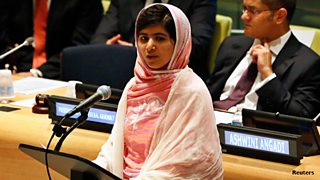
Malala addresses the United Nations
“I want this movie to be not just a movie but a movement.” That was what 18-year-old Malala Yousafzai told Emma Watson recently about He Named Me Malala, the documentary about her life.
The film takes us from the invasion of her village by militants to her impressive UN speech on her 16th birthday and receiving of the Nobel Peace Prize – becoming the youngest recipient ever.
As a researcher for the BBC Academy, I was struck by the severity of the Taliban’s clampdown on basic rights in north-west Pakistan and how it made life almost impossible for reporters – partly people were too frightened to speak out.
Malala came to the world’s attention after she agreed to speak to a journalist from the BBC World Service. In the film, her father Ziauddin Yousafzai talks about the enormity of that decision, saying that the instinctive reaction to journalists in the Swat Valley was always: “No. I can’t speak. I can’t risk my life.”
As a result of her contact with the BBC, Malala started writing a blog anonymously, under the pseudonym Gul Makai. Anonymity afforded her a degree of protection, as did BBC Urdu’s very cautious communications with her.
The real dangers for all in Malala’s village were demonstrated when she was shot on her way home from school in 2012. As she recovered in hospital in Birmingham, the Taliban’s Pakistani spokesman said they would directly target her if she stepped foot in Pakistan again, for “attacking Islam”.
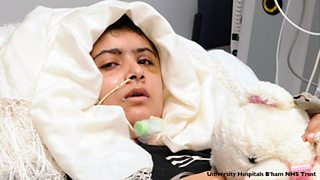
Malala recovering
There’s no sign that the dangers of speaking to journalists are any less today than when Malala was shot. Reporters themselves are under threat too. At the start of this month, the Pakistani journalist Zaman Mehsud became the latest to be murdered by the Taliban: police reported he was shot five times while riding his motorbike. His death brought the total number of journalists and media workers killed in the country since 2002 to 71.
I asked Aamer Ahmed Khan, former head of BBC News Urdu and current director of news for Aaj TV in Karachi, about the realities of practising journalism in Pakistan today. He told me: “Working conditions are absolutely abysmal. And I really mean abysmal. The pay is scarce and training and support is extremely limited.” He described how when the state doesn’t like something that’s being covered by the media it exerts pressure until owners and journalists alter their reporting.
Pakistan currently ranks ninth in the Committee to Protect Journalists’ global impunity index. For female journalists, restrictions are even more severe. This year’s Global Gender Gap report by the World Economic Forum (WEF) named Pakistan as the second-worst country in the world for gender inequality, behind only Yemen.
I spoke to one of BBC Urdu’s multimedia journalists Qandeel Shaam. “If you’re female you need to make sure that you have male 'bodyguards',” she said. “You need to make sure the network around you is male. You need to know who they are. Do you really trust them? Be 100% certain.” Further advice Qandeel offered included making sure only to do quick trips and not at night.
Guidance for women journalists offered by the International News Safety Institute’s Hannah Storm includes dressing as close to local style as possible, covering hair, thinking carefully about where to sit on public transport (not at the back of a bus) and staying in groups.
All of those I spoke to said that recent attacks in Pakistan represent a further deterioration of conditions. As Qandeel said: “Things have become worse for journalists… So many topics stay off the table and you just can’t mention them. Basic freedom is not in place.”
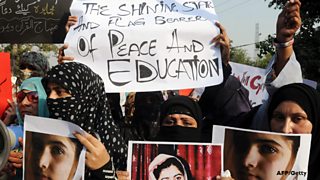
Demonstration in Lahore
While in the West Malala Yousafzai’s forgiveness towards her attackers and the standing ovation she received at the UN have turned her into an almost saint-like figure, there are those in Pakistan who are more cynical. Some believe she’s been lucky and that other school girls could have gained equal acclaim for disobeying the Taliban. One newspaper editor is even quoted as saying: “Her father is a good salesman, that's it.”
Her work with the Malala Fund, however, offers a real chance to change children’s lives in Pakistan – bringing education to youngsters in deprived areas.
Despite worsening conditions for journalism in Pakistan, there has been a notable increase recently in people speaking out against militants, perhaps as a result of Malala’s story and a sharp increase in print, television and online media sources. A shopkeeper, Rahim Khan, says: “It’s been more than a decade now that we have remained silent, but it’s impossible to stay silent anymore.”
And there’s no doubt that Malala has had an effect in her own country. Nadia Noreen, a 16-year-old from Karachi, says Malala has “inspired” her to pursue a similar path. And some media sources are already calling Neelam Ibrar Chattan ‘the next Malala’ for her tireless work running conflict-resolution workshops to prevent children from joining the Taliban.
It’s hard not to be inspired by He Named Me Malala and to want to find out more about its subject, and what she was up against.
