Ten storytelling tips for journalists and producers from Thinking, Fast and Slow

Charles Miller
edits this blog. Twitter: @chblm
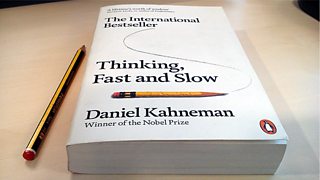
By making the science more widely known, Kahneman hopes to help us think more effectively by understanding how we make systematic mistakes in the conclusions we reach and therefore the decisions they lead to. He wants to make the world run more smoothly by making people think more clearly.
Although the book has sold surprisingly well, if you drop a line such as 'I suspect the affect heuristic' into an argument, as Kahneman suggests, it probably won’t floor your opponent but just make you look like an insufferable clever clogs.
But there’s undoubtedly a practical side to Kahneman’s findings. Here’s my list of possible implications for journalists and programme-makers:
1. Our brains have an almost irresistible desire to turn disparate facts into a coherent story. But the more information we have about a subject the harder it is to produce a straightforward account. Kahneman writes: “It is the consistency of the information that matters for a good story, not its completeness.” Executive producers viewing a documentary rough cut have the advantage of not knowing all the details of the subject. To them, it appears obvious how the story could be simplified and strengthened. A director who’s been immersed in the subject for months is left offering pedantic-sounding objections. Don’t worry: it’s just what Kahneman would predict.
2. Actual numbers are irrelevant to the impact of a story. In one experiment, different groups were asked how much they would pay for anti-pollution measures to save birds. It turns out that the sums of money offered by three groups were almost the same whether they were told that 2,000 or 20,000 or 200,000 birds would be saved. In the same way, stories with stats depend far more on the emotional impact of the context than the actual numbers: we don’t react very differently to being told that something is 10 billion rather than a billion. Don’t expect your audience to draw detailed conclusions from large numbers, beyond registering ‘that sounds like a lot’.
3. High production values contribute to the credibility of a report - not just because there is an implication that this is a ‘quality product’ but because of a more basic psychological effect. Kahneman describes “cognitive ease” as a condition which can be created by various factors, including the rather mundane one of how clearly something is presented visually. Its effect, however it is created, is to make what is communicated ‘feel true’.
4. Beware of journalistic explanations that answer a different, easier question than the one they should be addressing. Kahneman says that one of the ways we draw false conclusions is by not realising when we can’t answer a question and subconsciously answering a simpler one instead. So, if you want to know whether a company is worth investing in (hard to decide), you may choose to invest simply because you like its ads (easy to decide). In telling stories in documentaries, I plead guilty to highlighting facts that probably fall foul of this problem: if you are giving an account of why Microsoft became so successful it’s probably irrelevant that Bill Gates’s teacher said he had an incredible memory when he was 14 - but it’s an easy piece of evidence and emotionally consistent with the bigger picture.
5. Editing techniques can contribute unfairly to the impact of the facts you present. A television audience watching a factual programme will be trying to make sense of it intellectually and emotionally. The way it is filmed and edited - the type of shots picked, the rhythm of cutting and the music - will pretty much determine a certain emotional impact. Viewers then have difficulty making an objective assessment of the facts, independent of how they feel about them.
6. Beware the false implications of statistics. Kahneman has a great example: why do you think kidney cancer is lowest in rural, sparsely populated, Republican-voting counties of the US? Because fresh air and traditional lifestyles stop people getting cancer? Because Republicans are healthier than Democrats? No, the answer is: for the same reason kidney cancer is also highest in exactly the same kind of counties. Small statistical samples (low populations in this case) will always produce more extreme results, both high and low, than large samples. Our minds search for stories and can be blind to mathematical artefacts.
7. Beware figures that mean nothing at all. A human being often acts like “a machine for jumping to conclusions”, says Kahneman, and “the tendency to see patterns in randomness is overwhelming.” I’ve never been a sports journalist but I suspect that the confidence with which commentators analyse results based on a few numbers may often be misplaced. It would be sacrilege to suggest from a commentary box that if a champion had lost an important match by a couple of points rather than just winning, or if one particular goal hadn’t gone in, no new conclusions could be drawn. Sport creates drama by capitalising on our instinct to deduce stories from numbers.
8. If you want to impress with how large or small a number is, set up an expectation. Kahneman explores ‘anchoring effects’ which influence people’s expectations through exposing them to earlier stimuli. Amazingly, the effect works even if the ‘anchor’ is clearly irrelevant: judges asked to roll a dice before saying how many months in prison they’d give a hypothetical defendant - more or less than whatever comes up on the dice - gave sentences closely related to the numbers rolled. I wonder if in telling a story an audience’s expectations of a number - and therefore their reactions to it - can be similarly affected by such (completely illogical) priming techniques?
9. Aim to reach your audience when they are well-fed. Judges have been found to be more lenient in their decisions after a meal break, while issuing longer sentences if they are hungry. The chances of having an appreciative audience would seem to be better if they have just eaten. The Queen’s Christmas broadcast must have the best spot in the schedule in this respect (although there may a bell curve here, with drowsiness creating a downhill slope among the over-indulgent).
10. Throw in doubt to counteract the deceptive confidence of a story. If you have read Kahneman you will be mindful of the way, both in journalists’ and audiences' minds, that facts coalesce into stories that make emotional and dramatic sense despite the messy complications of the real world. That explains the doubtful note struck at the end of many a programme or report: “...time alone will tell”, “...it’s too early to say” or “...nobody can be sure”. There are good reasons to end a piece by distancing it from any apparent impressions of neat inevitability.
One effect of reading Kahneman as a media type is to produce a sense of responsibility. The media’s natural appetite for good stories - the dramatic, the visual, the concrete rather than the abstract - has a measurable effect on people’s beliefs about the world.
Kahneman describes a US study of perceptions of the causes of death. Tornadoes, for instance, were thought to cause more deaths than asthma, though the truth is that asthma kills 20 times more people. Kahneman concludes: “Estimates of causes of death are warped by media coverage,” which is “biased towards novelty and poignancy.”
The media will never want to aim for mostly dull, often confusing, pictures of the world - even if they would be more accurate. But it might be worth being conscious of the forces driving us towards neater, more emotional representations of the subjects we report.
