Meet the Syrian conflict ‘heroine’ of Russian TV
Stephen Ennis
is Russian media analyst for BBC Monitoring.
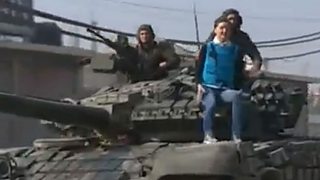
She has been a regular feature on bulletins on official channel Rossiya 1 over the past 18 months or so, often reporting on the bloody conflict amid the sound of gunfire and detonating shells. Young, slim, with long, dark hair, Popova has become the rather glamorous face of the Syrian conflict for many Russians.
Her front-line journalism has played an important role in promoting Moscow's message that Syrian President Bashar al-Assad is facing a violent insurrection dominated by terrorists and foreign mercenaries, and armed by some Arab states and the West.
It has also won her, her cameraman and director official recognition in the form of medals for bravery awarded by President Vladimir Putin at a ceremony in the Kremlin in December.
The Syrian conflict has not been a dominant theme on Russian TV news, but Popova has caught the eye with some dramatic reports from the war zone.
She first arrived in Syria in August 2011, as she has confessed, knowing little or nothing about the conflict that was just beginning to escalate from a political struggle to a full-fledged civil war. In any case, the strength of Popova's journalism has not been her analysis of the political situation but her willingness to report from the heat of battle.
In a dispatch on 13 May 2012, she was with a police patrol that came under fire in the city of Homs. She also visited a school where she said “guerrillas” had tortured and beheaded government soldiers, and raped teachers and a six-year-old girl.
Popova was in Homs again last July when she again spoke of opposition atrocities against the background of a fierce gun battle in which her cameraman was almost hit. The Rossiya 1 news presenter prefaced the report by saying that the station's journalists were "risking their lives".
The risks to Russian media workers in Syria were highlighted in October when rebels captured Ankhar Kochneva, a Ukrainian blogger and journalist who has reported on the conflict for a number of Russian media. Kochneva's captors have threatened to execute her. Latest reports earlier this month suggest she is still in captivity.
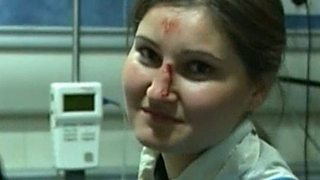
This kind of thing only adds to the impact of her reporting, as does her personality. Writing in the Financial Times in August, Russian film director Andrey Nekrasov was sceptical about the content of Popova's reports, but conceded that she was "charismatic".
And Aleksandr Melman, TV critic for Moskovskiy Komsomolets (a paper often critical of the Kremlin), chose her as his "hero of the year", praising how she and her crew remained focused on "providing information and transmitting pictures" as the bullets flew around them. “We witnessed this Middle East carnage to the accompaniment of her beautiful face," he wrote.
As well as being embedded with the Syrian security forces, Popova has portrayed the conflict exclusively from the government's point of view - echoing Syrian state TV, for example, by using televised ‘confessions’ from captured rebels.
Russian diplomats have been repeatedly at pains to stress that Moscow takes a neutral stance in the Syrian conflict and does not support President Al-Assad. Popova's reports tell a different story. In an interview with Al-Assad in May she appeared to give the lie to Moscow's neutrality by asking: "Why do you think Russian and China are supporting you?"
Popova claims she is striving to tell a "different truth" about the conflict from the one promoted by most Western and Arab media, which, she says, are biased in favour of the opposition. "I would like to create some sort of balance," she recently said on a Russian talk show.
There is however little balance in the coverage of the Syrian conflict within Russia. All the three main TV channels broadly toe the Kremlin line, and even independent media show little interest in presenting the opposition case.
Not surprisingly, polls suggest that many more Russians back Bashar al-Assad than the opposition in the conflict, though there are also significant numbers who are either neutral or indifferent.
The Russian media often speak about an ‘information war’ raging around Syria. So it was appropriate that Popova, her cameraman Mikhail Vitkin and director Yevgeniy Lebedev were awarded the For Valour medal that is normally given to service personnel.
Presenting the medals, Putin paid tribute to the journalists' "courage and their honest and unbiased work" which has allowed "millions of people around the world to learn the truth" about Syria.
Popova has so far not returned to Syria this year. But her roving remit has now taken her to the conflict in Mali. She has brought home the turbulence and tension of the situation there and, to be fair, unlike most of her reporting from Syria, there was no anti-Western bias in a report she made from Timbuktu on 3 February, for instance.
The first Russian journalist to visit Syria in 2011, according to state-sponsored radio broadcaster Voice of Russia, Popova was also the first foreign correspondent to get into Timbuktu after French troops captured it from Islamic militants at the end of January, says Rossiya 1. She appears well on her way to establishing herself as Russian TV's star war zone correspondent.
