Art of the obituary: you’re a journalist not a funeral director

Nick Serpell
is obituary editor for BBC News, based in Salford
There have been thousands of warm and some surprising words written this week about the late Richard Briers: sitcom stalwart, national treasure, serial smoker and possibly the fastest Hamlet in history.
Nice work if you can get it, that obituary writing, you might think. But there are certain tricks to the trade of turning out an obit that is a strong and reliable read on the day, strikes the right note for the audience without losing balance, and, importantly, has enough shelf life.
Nick Serpell writes and edits obituaries for the BBC News website. Here’s his guide to dealing with death:
Most obituaries for prominent people are written in advance of their death. This gives valuable time to fully research the subject and ensure the piece reflects the individual concerned.
An obituary is a broad-brush look at someone’s whole life, so avoid the temptation to give undue weight to events later in life purely because they are more recent. You are aiming to produce an objective assessment which will stand the test of time.
Try to imagine how the individual’s life and achievements would be seen by someone looking back from 50 years in the future when much of the minutiae of a life would have been forgotten and a more objective assessment would be possible.
Like any other piece of BBC journalism, an obituary should be true, balanced and fair in the context of that person’s life. It should neither be a eulogy or a character assassination.
The tone should be broadly neutral and objective, but feel free to celebrate those aspects of someone’s life you think deserve celebration. The exceptional career of Bee Gee Robin Gibb might be a case in point.
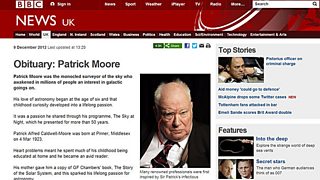
Think also about how a particular death is likely to be received by your readers. If you feel that there will be great affection for the deceased - Patrick Moore, for instance - then don’t be afraid to touch on this in your piece.
If you feel that a particular individual might be seen as divisive then reflect that in your writing. But make sure the various points of view get equal weight. Not surprisingly, politicians can be tricky.
The BBC News obituary that appeared when Jimmy Savile died in October 2011 had been prepared a number of years previously. Many glowing tributes appeared in other media outlets at the time.
A purist might argue that an obituary is supposed to be a snapshot at the time of death. The subsequent profile content, published on the BBC website a year later and updated for obvious reasons, is the exception rather than the norm.
We would of course update the obit of a living person if there were some scandal, and certainly if they were convicted of an offence.
The normal BBC online style guidelines also apply to obituaries, but there are some additional style points.
Don’t refer to the deceased as Mr/Mrs/Ms throughout the piece - it looks awkward. It is perfectly acceptable to use the surname.
In the same vein, if someone has a title, you don’t need to use that as well. Most people receive titles late on in their career, so it is wrong to be writing things like 'Sir Elton’s first big hit was'... as he wasn’t Sir Elton then. For the same reason, don’t use titles in the headline.
The only exception to this would be royalty and aristocracy who were born to a title. Be guided by what the individual was commonly known as during the most active periods of his or her life.
An obituary will normally have been linked to from the news story of the death. So it’s not necessary to refer to the circumstances of death in the first line. If they weren’t dead they wouldn’t have an obituary.
The first three or four paragraphs should be a summary of the person’s life and major achievements. You can then show details of the birth and family, and work chronologically from there.
And don’t use euphemisms. People die, they don’t 'pass away' or, even worse, just 'pass'. You are a journalist not a funeral director consoling a grieving relative.
Avoid references that will date the piece, such as 'last year' or 'five years ago'. A written obituary should have a shelf life of several years unless the subject is particularly active, as would be the case with people who are still prominent in their later years.
Many big obituaries are written years in advance of a death, and have to be maintained and refreshed with new facts and new perspectives.
If you are doing a musician or actor, avoid the temptation for the text to become just a list of albums or films. Stick to the more important stuff and keep to a narrative style.
Only use authoritative sources and double check any references. For actors, IMDB is a great source for films and TV programmes in which they appeared. For musicians, All Music is one of the most authoritative sources on the web.
Quotes, whether by the subject or other people, add colour to a piece and a couple of quote boxes add interest to the page. Always attribute quotes.
Profiles and interviews with individuals, particularly in broadsheet newspapers, can be searched on Lexis Nexis. And BBC journalists can research subscription-based biographical sources via the BBC intranet.
Interviews are particularly useful both for quotes and for checking facts. Don’t forget that many people will have appeared in radio and TV chat shows which are a great source of biographical detail and quotes straight from the horse’s mouth.
