
What happened to a litter of seven Staffordshire Bull Terrier pups born in the East End at the end of last year? For the Wonderland series,Seven Pups for Seven People (below) on BBC2 found out.
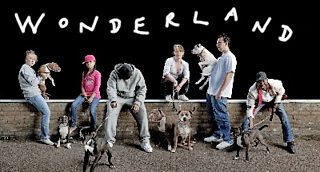
In the words of Spinal Tap's Marty DiBergi, the film's director Charlotte Desai might have said of her, if you will, dogumentary, "I wanted to capture the sights, the sounds, the smells ... And I got that. But I got more, a lot more."
Indeed, the dogs were an entrée into lives filled with low-level crime and any number of human and social problems. You knew what kind of world it was when the highlight of a chat between mother and daughter was the excited revelation that "Sainsbury's have personal scanners in for a fiver."
Apart from the challenge of gaining access to this world, Desai was up against two other potential problems. First, how do you tell seven different stories in 40 minutes? And, second, what is the right tone for a piece that could easily make fun of its subjects, or, on the other hand, appear judgmental of them. How do you deal with a dad who, cooing over his baby, says "when she's three I'll put her in for kick-boxing"?
On the first, there's no question it was a busy film, with lots of characters and situations to follow - not to mention the names of the various puppies. Four Puppies for Four People would have been more manageable, but might not have produced the rich range of characters (and would have lost the subliminal Hollywood reference).
But Desai managed to give us enough time with each of her stories to avoid - on the whole - bamboozling us into wondering 'is this the one with the hubbie who died, or the one whose girlfriend doesn't like dogs?'
On the question of tone, I thought the first overheard interview question, "they look quite frightening to me?", inadvertently exposed a middle class disapproval of the world of the film. And the romantic piano music gave a kind of poetic serenity - almost like a French art movie - to a raw and uncomfortable world.
But somehow it all came right in the end - for the film, if not for the subjects or the dogs. The material clearly wasn't being played for laughs, or for shock value: one couldn't help empathising with the unemployed dog-loving father who was always slipping into the world of crime but remained convinced that if he could only get a break into a decent job with prospects he'd be fine. And we had been given an insight into the unstated conviction of many of the contributors that the dogs were easier to deal with than their fellow human beings.
