Reporting from North Korea: push the boundaries, keep your eyes open, do what you can
Stephen Evans
Korea correspondent, BBC News @EvanstheAirwave
Stephen Evans made a rare reporting trip into North Korea as the country marks the 70th anniversary of its ruling Workers’ Party.
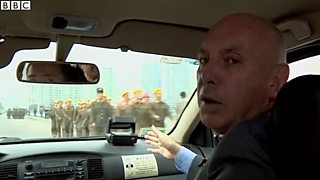
There can't be many places where journalists are so tightly controlled. We were a BBC team of five people - two ‘suits’ (there to assess the situation as the BBC plans a Korean language service) and three other journalists, producer Jo Floto, cameraman Duncan Stone and me, there to report what we could.
At Pyongyang Airport, we were met by two minders - Mr Kim and Mr Rhy - and then shepherded around by them for five days. We met in the hotel lobby first thing in the morning and were accompanied constantly until we arrived back at the hotel at the end of the working day.
All the places we visited were determined by them. We put in requests - to get out of Pyongyang to a farm, to go to a brewery, to get out of the taxi at busy, bustling places - but they were invariably refused. One of the minders stayed in the hotel, which was on an island.
As with all the media crews allowed into the country as it celebrates 70 years of the Workers’ Party, our minders ate separately from their charges. They seemed to have a floor of their own at the hotel, which was high-rise, with great (filmable) views of the city, but isolated from it.
Within those tight constraints, there was some, small, room for negotiation. We were ferried, for example, to a square with an opera house. Once there, we could film street scenes and we asked to talk to people. The people stopped were through the minders (we’d been refused
permission to take a translator). And all the people interviewed replied with versions of: "It is through the wise leadership of the ‘Supreme Leader’ that...... ”
You have to work with what you've got so it became a jostle over boundaries. In a game of cat and mouse, the cameraman wandered and ‘got lost’.
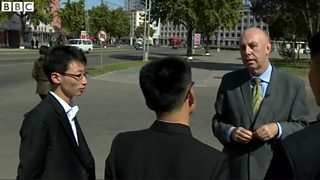
Once we realised that no open and honest vox pop was going to happen, you let the answers tell a story. I asked one woman who had been out in the open all day for the military parade if she was cold and she replied: "I would stay out longer to hear the ‘Supreme Leader’ speak." Her answer said something about the DPRK (Democratic People’s Republic of Korea); or rather, North Korea.
The minders very much prefer DPRK but I explained to one of them that people outside didn't know what it meant. The audience might not distinguish between the DPRK and the ROK (Republic of Korea - South Korea). For us, it is North Korea and South Korea. You know where you are then.
In the end, that wasn't a big issue. What they perceived as a lack of respect for ‘Supreme Leader’ Kim Jong-un was. I had two disputes with Mr Rhy, once when I questioned in a piece to camera whether Kim Jong-un could survive increased openness and once when I asked a tourist with a ‘friendship group’ whether political prisoners didn't colour his rosy view of the country.
Mr Rhy told me there were no political prisoners. In both cases, the references remained in the piece.
Much depends on the relationship with minders. We got to realise that ours were doing a job and were accountable to someone they might well fear. They were not going to suddenly soften and take us to a church, for example. But they could be more amenable, or less so, depending on our relationship with them.
Some crews from other countries and stations complained that they were told they had to show what they had shot before broadcasting it. We never were and wouldn't have agreed if we had been. On the other hand, we seemed to get less permission to film on the street than other crews.
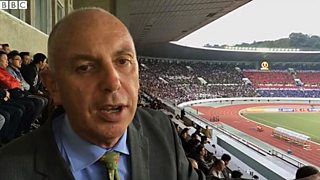
Filmed on a mobile in the football stadium
There is debate to be had about how much ‘normal’ life can be conveyed with such restrictions, but, to my mind, the task is to do what you can within the conditions. Push the boundaries, keep your eyes open.
The big bottom line is: no vetting of output. It means that the team needs to be nimble. The more people who can shoot on a mobile phone, the better. We were told we couldn't take a camera to a big football match, which, as it turned out, had the most amazing synchronisation and control of pro-DPRK supporters - thousands moving as one. Fortunately, we had mobiles which provided stunning footage.
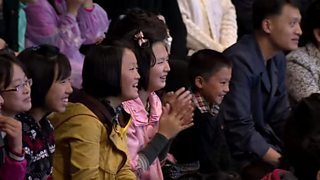
Happy crowds enjoy a display at a Pyongyang dolphinarium
The correspondent needs to be nimble, too, in order to serve multimedia outlets - opportunities for pieces to camera and radio ‘stand-uppers’ come and go quickly.
There is also the issue of how much weight to put on the human rights situation. Is it the only thing to be said about the country? I take the view that it is clearly dominant and no viewer, listener, or reader should be left ignorant of the abuses that exist.
But there are other things worth reporting, like the changing economy. Just showing what people are wearing, or the absence of light at night in apartment blocks, or the gangs of soldiers doing manual labour on roads, speaks volumes.
Just as there are many aspects to life in China beyond the political monopoly of the Communist Party there, so there are facets to North Korean life which throw light on the wider situation. Not every piece reported about China is about political repression. Nor should it be in North Korea.
A question also hangs over the role of the reporter. I took the view that my reporting was about the country I was in, not about me being there.
Previous BBC coverage has taken a similar view. In the week that we learned of the death of journalist and film-maker Sue Lloyd-Roberts, her 2010 reporting from North Korea particularly comes to mind. Sue’s approach was to report what she and the camera saw, with an astute eye and an astute lens - the camera occasionally letting the minders intrude tellingly when they stepped in to restrict the filming.
It’s all about reporting North Korea to our audiences. The focus should be the country and its
people, not the reporter.
