Impartiality in practice and the duty to say it straight

Najiba Kasraee
editor of the BBC Academy's language websites
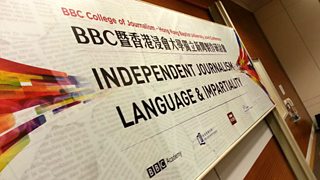
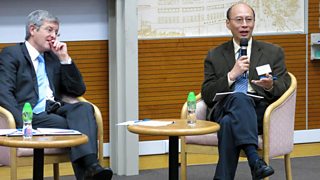
“Audiences need to be able to trust us to see through and cut through loaded language, and to report objectively,” argued the BBC’s head of newsgathering and head of the College of Journalism. “If we do not have that trust then what we do is of no value. We are wasting our time, and their time too.”
He went on: “Not only must they write well and clearly, they must spot and avoid all those pitfalls of language that lie in wait for everyone, and which they seek to expose in others. There is a direct line between this mission and the most basic values of journalism - values like truth and accuracy, impartiality, fair dealing and independence. Putting any of these values into practice is impossible without precision and clarity of language.”
Laudable ambition from the keynote speaker. But no-one said any of this was easy, as the two days of discussion and workshops at the joint BBC and Hong Kong Baptist University event demonstrated.
The theme was impartiality in language, be it Chinese or English. Journalists in China, for instance, are on the one hand experiencing massive development in the world of social media while on the other they are still governed by rules and regulations which make sure what they say is acceptable politically.
So a government meeting is usually described as ‘the grand meeting’; a ceremony involving officials is ‘the victorious ceremony’. Journalists in Hong Kong are aware of this practice and are trying to resist following the trend from across the border in mainland China.
However, the younger generation of journalism students in China is eager to differentiate itself from older generations, the conference heard, and most students studying at Hong Kong Baptist University are from mainland China.
Bush again: "Any government that supports, protects or harbours terrorists is complicit in the murder of the innocent and equally guilty of terrorist crimes." Note the number of strong, emotionally charged words here… (snaaaarrrrl).
The ‘what’s in a name?’ dilemma persists for journalists, Jonathan said. The “wall” built by the Israelis around the West Bank is referred to by Israelis as “a security fence” - less threatening than a 20-foot concrete wall with watch-towers - and in fact for most of its length through the countryside the “wall” is indeed a fence.
“But if we describe this construction as a security fence we could be seen to be implicitly accepting the Israeli characterisation. Because that’s not what the Palestinians call it. To them it is ‘an apartheid wall’,” Jonathan said, adding: “If we use that phrase we could equally be seen to be buying into the Palestinian terminology.” His solution? A neutral term like ‘barrier’ or ‘separation barrier’ passes the impartial language test.
Similarly, ‘terrorist’ is a perennial hot potato. The BBC tends to use terms that give a clearer indication of what’s actually happened. “So we talk about ‘bomber’, ‘attacker’, ‘gunman’, ‘kidnapper’, ‘insurgent’ and ‘militant’,” Jonathan said.
“We do not adopt other people's language as our own. Our responsibility is to remain objective and report in ways that enable our audiences to make their own assessments about who is doing what to whom.”
Bruce Lui, an experienced local journalist, showed how even the careless use of words and punctuation can drastically change meaning. He quoted this news headline, in Chinese: “The son is obedient and the mother feels happy.” No offence there, you’d think, but, simply for want of a missing coma, the line became “the son has got venereal disease and the mother feels happy.” Terrifying.
And as senior Baptist University lecturer Cheung Siu Wai explains in this short video, the new generation of journalists in China, especially those working for online publications, need to exercise proper journalistic and linguistic checks to avoid being misleading.
(If you have trouble viewing this video, try using another browser.)
A special session covered the issues of impartiality in the Chinese language. Raymond Li, the head of BBC Chinese who is currently teaching at the host university, raised concerns over the latest attempt by the Chinese government to ask Weibo users to register with their real names - seen as an attempt to exercise more government control.
It was argued that the free use of language currently enjoyed by users with pseudonyms would be lost and that self-censorship would result.
Over two days in Hong Kong I had the chance to share the experience of the BBC College of Journalism’s international sites in wrestling with language difficulties - over translation, use of dialects and social media. We looked at what might be learned from guidelines that already apply to BBC journalists.
Importantly, the conference was an opportunity for local journalists and those from other parts of the region, such as Singapore, to share their practical experiences with each other.
“It is amazing that we can speak so freely to such a high-level figure in the BBC,” was the joyful observation of one female student from mainland China, having quizzed Jonathan Baker long and hard on how to identify loaded words in her language.
Impartiality and language in the world of Weibo
Chinese media censorship: All-pervading, increasingly challenged
Access the College of Journalism’s free language sites
BBC values: Impartiality
