Stand out from the crowd with clarity, excellence and great human stories

Cathy Loughran
is an editor of the BBC Academy blog
In the insatiable seasonal tradition of summer picks (best beach reads, must-see Edinburgh stand-ups, more unmissable listings by BuzzFeed), I’d like to recommend some highlights from the recent Polis Summer School talks.
Aimed at an audience with an interest in journalism and international politics, the daily talks by journalism professionals ranged from freelancing to feminism, issues of consent in crisis reporting and life 'at the edge of the digital frontier’.
There were also a couple of stand-out and refreshingly timeless reminders about what it (still) takes to be a successful journalist and storyteller - my personal picks:
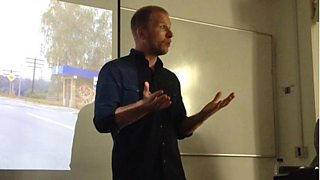
The ABC reporter and former al-Jazeera and Channel 4 journalist (pictured above) used clips from two of his international films to talk about the sometimes conflicting responsibilities, to audiences and interviewees, when covering trauma and crisis.
The first film, made for ABC in Norway, centred on two compelling characters to shed light on the country’s restorative justice system: a young victim of gang rape who courageously describes her ordeal on camera and a journalist who’d become a writer after being imprisoned for a double murder. They held polar opposite views on Norway’s prisons.
Getting a traumatised person to relate their experiences can be “nerve-wracking”, he says: “You need to elicit the story and you need to do it in an engaging way… in a way that lets the audience understand the gravity of what happened.
“And that means asking some quite explicit questions. What happened to you? Can you give me more detail about that? At the same time [you have to] balance all that with what’s clearly been a life trauma for that person. You don’t know to what extent they’ve recovered from it, and where they are in that process.”
He adds: “If you’re telling a news story, this thing might have just happened to them. So you’re aware of the responsibility to get the story, but also your responsibility to that individual.”
Macdonald remembered the Norwegian interviews well, and the enduring relationships he developed with both “inspirational” subjects.
For him, one of biggest challenges of any journalism is that reporters inevitably develop a relationship with the people they tell stories about: “Yet you always need to maintain a professional distance from what it is that they’re telling you.”
But finding characters who can tell a story well is always “the best tool for enabling your audience to make decisions, judgements and form opinions about where they stand on a particular issue”, he argues.
His second film clip was a case in point. For a re-examination of Chernobyl, Macdonald went in search of people who’d never really left the nuclear disaster zone and came across an elderly couple living in virtual isolation in an abandoned village, collecting giant mushrooms and brewing lethal home-made vodka.
A scene where the tiny, irrepressible old man slams down bread and vodka on a ramshackle table to share with Macdonald and his crew is television gold.
As the Australian TV reporter explains: “We have perceptions of Chernobyl in the same way we have perceptions of war zones. The perception never really matches the reality - and there are always these fantastic human stories to be found.
“Chernobyl is great example of a place where you would not expect to find life, humour, joy, happiness. They were great characters that we stumbled upon - it wasn’t planned. To have that little moment with them… for me, that helps to tell the story of Chernobyl and what happened next probably better than anything else. A few moments with two lovely human beings helped tell a more powerful story.”
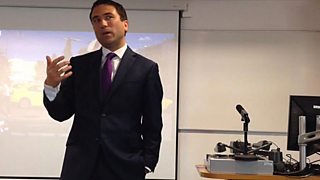
The be-suited presenter of BBC Outside Source, the BBC News Channel and BBC World News displayed genuine boyish excitement as he recalled two of his recent Eureka moments in the march of media technology.
One was the startlingly raw coverage last year by Vice News of the funeral of Michael Brown in Ferguson, Missouri. “They were streaming it online - not doing any of the things you’re supposed to do as a TV reporter… and viewers were just watching the scene as if they were in the crowd. It was all live; it was like being there; it was amazing. And it wasn’t like any traditional TV.”
Then Periscope came along. Atkins saw it used in anger this summer by foreign correspondents covering the protests in Greece in the run up to the country’s referendum. Again, no production trimmings, but raw “as if you’re there” coverage, he enthused - like the Vice stream but with an instant messaging element.
“It’s like being a remote control correspondent,” Atkins says. And for the consumer, with real time responses from the journalist holding the phone, it’s “incredible”.
“When technology lets you get that close, it’s visceral… Technology is removing the gaps between the consumer and the story.”
That’s not to say a story like the Greek crisis - about which people are “massively interested” and “massively confused” - doesn’t need some old-fashioned explaining to help cut through the “noise” of the internet. Cue one of Atkins’s five-point Greek banking crisis explainers. (He also mounted a marathon Twitter Q&A from Athens, described in a previous blog.)
At just over a minute, the mobile-friendly explainer is in very short sentences - no more than two sentences on any one point. It is deliberately “digestible”, he says, because the story is so easily “overwhelming”. And that’s not “dumbing down”, he insists.
Three other takeaways from the all-digital BBC man, all of which also smack of first principles:
Be good
In a world of limitless digital choice, the only content that stands out is exceptional in some way - of the highest standard; something with a unique edge over the rest. Don’t’ push out stuff that’s only “seven and-a-half out of 10”, Atkins says - it’s not worth it.
Be honest
“Admitting you don’t understand is a really important point to get to,” he says. Journalists who are generalists like him need to get to a point where they can explain a story to their audience. He does it all the time, he says, by picking the brains of people who really do know (BBC business reporter Joe Lynam gets a name check on the Greek banks).
“Just ask the questions - you’re going to be in real trouble if you don’t. You’ve got a much better chance of explaining something to people if you’ve got it clear in your head first.”
Be curious (about everything and everyone)
An essential quality for anyone considering a career in journalism, and hard to fake, Atkins argues. “If you have got it - fantastic. Just let it drive everything you do."
Watch Polis Summer School videos
Our digital journalism section
Our section on the values behind BBC journalism
Outside Source with an inside edge: Blog by Ros Atkins
Live-streaming the Ferguson protests: We had to give Meerkat a try
