
The bulletins increased an interest I’ve long had in seeing how we could bring the journalistic ethos of WHYS into a multi-item news programme. With the double commission of Outside Source (OS) on TV and radio I’ve got the chance to do that, which is exciting and daunting in equal measure.
I knew the biggest challenge we’d face would be trying to maintain WHYS’s fluidity and spontaneity within the confines of a much busier running order and a need to be more closely aligned with the newsroom. I’ll let others judge how we’re faring but these are some of the areas that have concentrated our minds in recent months:
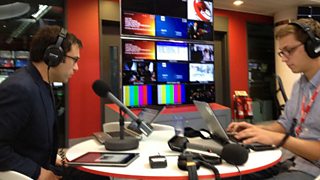
The first thing was to sort out the technicalities. We wanted OS to feel like an outside broadcast from the heart of the newsroom in London’s New Broadcasting House (below). But the rig we needed is more than you’d have if you were on location.
I need wireless headphones and a wireless mic - so do the people who join me on air - and the producer in charge of our newsroom location needs to hear output and be able to talk to the studio. (The lead sound engineer and the output editor are four floors up.)
Both the producer and I need ENPS (the electronic news production system we use to produce, edit, time, organise and run news broadcasts). We’ve got two small laptops for this - and I need an iPad, too, so that when I go wandering the team can still get information to me.
It took quite a few pilots to get the work flow right, and for some time communication between me, the engineer, the editor and the newsroom producer wasn’t right. It is now, but only with the help of a mobile phone as the vital ‘co-ord’ line. Jon Goda, our technical liaison manager, and others are working on trying to get something more stable.
Next we wanted to take the style of storytelling that WHYS uses - collecting all available information and sound, and then piecing them together - and allow that to flourish in a newsroom environment. The solution we came up with was what we’re calling a ‘kit of parts’. On one page in ENPS, the producer on a story puts everything they find that could be useful to tell the story. So that means wild track, clips, tweets, wires, live guests and important pieces of context the presenter should include. In the run up to transmission this fills up. Then in the last hour before we broadcast the presenter and editor discuss which elements we want to use.
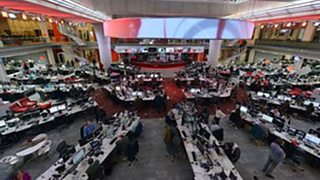
The BBC newsroom in London's New Broadcasting House
We decided that, from one hour before transmission through to coming off air, one producer would focus on collecting new developments from social media. This doesn’t mean Joe Bloggs saying ‘I think this…’ It means new information from journalists, organisations, politicians or anyone relevant to and affected by the story. This would then be placed under the guest’s name in the ‘cue’ page.
It allows me to feed the most up-to-date information into the interviews and two-ways. It shows our willingness to use all possible sources, and takes us as close to real-time news as it’s possible to get. It also allows us to follow our lead story and developing stories through the hour. It doesn’t replace the wires but there is different information on social media that we can certainly use.
OS is a joint production by the teams of WHYS and The Newsroom. One of our aspirations is to tap the very best material in the BBC system. The Newsroom programme team are experts at this and have taught me a great deal. It’s not just about checking Global Newswire (the BBC’s multimedia news agency) - it’s about knowing how Radio 5 live, World Service and Radio 4 have covered stories and what we can clip; knowing what’s been filed by all journalists; and having a comprehensive list of all correspondents and language service reporters on location.
We’re also getting better at turning what colleagues at BBC Monitoring see into information for our listeners. For example, Monitoring picked up that Edward Snowden has a job and we did a two-way minutes after it confirmed that.
Finally, the new programme wants to explain not just what a story is but how we’re covering it and what more we want to find out. This means asking correspondents different questions to those they might get in a standard two-way. And it means directly connecting our audience to our correspondents.
So this week Lyse Doucet and Jeremy Bowen answered questions we’d collected on Twitter. We asked Celia Hadden in Beijing about the practicalities of reporting the Tiananmen Square attack, as well as for the latest information. We’re also experimenting with connecting editors in bureaux to discuss on air their editorial agenda for the coming days/weeks. All of these things work best when we take sufficient time to explain to our contributors exactly what we’re looking for (like on any programme I guess).
We’re at the end of the first week. Of course we have plenty to work on, but already OS feels like a distinct addition to the World Service output. It was also the week that our senior stablemate Newshour celebrated its 25th birthday and WHYS hit the eight-year mark. If we do half as well I’ll be thrilled.
The Outside Source television programme will be on BBC World News early next year.
Outside Source, 11.06 GMT, BBC World Service, or listen to past episodes here.
Presenting skills
