1 year anniversary for Indian languages

Ankur Jain / Ashish Dikshit / Atul Sangar and Ram Mohan
Editors, BBC News Gujarati, Marathi, Punjabi and Telugu
Tagged with:
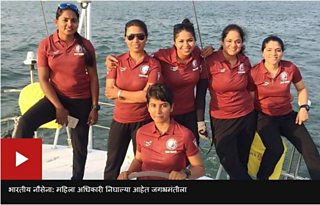
Six women officers of the Indian Navy sail around the world; image via BBC News Marathi
Many people treated the news of the BBC’s plan to launch four new language services in India as a rumour.
Today, the four new services – Gujarati, Marathi, Punjabi and Telugu – celebrate their first anniversary, busting rumours and showcasing a range of original and bold stories. Their mission statement is to produce creative, credible and disruptive journalism.
Ankur Jain, Editor, BBC Gujarati
We began this journey a year ago with our heads firmly on our shoulders and fire in our hearts. In this one year BBC Gujarati has translated that into narrating stories that have inspired and triggered debates.
Starting with a news website, BBC News Gujarati now produces a 30-minute daily TV bulletin on GSTV (Gujarat Samachar Television) showcasing BBC’s original journalism from India and across the world.
With stories like GujaratOnWheels, Gir Cows In Brazil, Gujaratis In Pakistan, Gandhi In China and others, BBC Gujarati’s journalism has stood out and made a mark.
Our fearless and even-handed reporting of stories around caste violence and elections helped establish us.
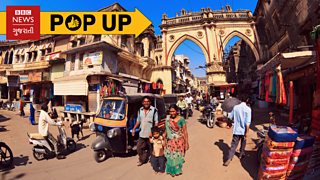
BBC News Gujarati in Ahmedabad using an autorickshaw to ask people what kind of stories they want to read online
Ashish Dikshit, Editor, BBC Marathi
Taking a cue from Maharashtra’s strong tradition of social reformers, BBC Marathi pays great attention to the coverage of women, their issues and their successes.
From women naval officers who circumnavigated the world, to a tribal woman who preserves her indigenous seeds, BBC Marathi has always put women first.
Another deficit that we are trying to address is the coverage of global stories which are hardly told on local media. On BBC Vishwa, the first digital TV bulletin in India, we focus on top international stories, which is also the strength of the BBC World Service.
In the last one year, BBC Marathi has done detailed and hard-hitting ground reports of major stories like the Bhima Koregaon riot, has introduced new formats of storytelling like digital videos and has tried hard to make stories relevant to younger audiences.

A vehicle burnt during a caste riot at Bhima Koregaon in central south India; BBC News Marathi provided hard-hitting reports from ground zero
Atul Sangar, Editor, BBC Punjabi
It has been a very challenging and action-packed year. BBC Punjabi is a digital service, filling a crucial gap in the crowded Punjabi media landscape.
BBC Punjabi is coming to be recognised as an impartial, balanced and bold media platform for Punjabis - whether living in the Indian Punjab or the diaspora settled in the UK, North America, Europe or elsewhere.
We have made huge efforts to connect Punjabi speakers of India and Pakistan through our stories. While the rest of the media has been harping on the bitter India-Pakistan relations, BBC Punjabi has highlighted the less talked about cultural connections between the two sides, to a huge audience response.
A hugely impactful story recently was an interview with Pakistan’s Information Minister who announced that Pakistan was ready to allow Indian Sikhs access to a shrine inside Pakistan. The interview was repeatedly quoted by an Indian Punjab Minister.
Our role lies in connecting with the youth, especially engaging women and giving an expression to important gender stories.
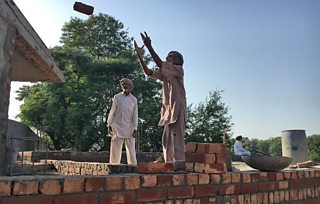
Hindus and Sikhs in a Punjab village help to build a mosque; image via BBC News Punjabi
Ram Mohan, Editor, BBC Telugu
When BBC Telugu started its journey on 2 October 2017 – Gandhi’s birth anniversary – we took a pledge to give the Telugu people a trusted media platform with original, impactful journalism that gives a global perspective to the Telugu audience and takes Telugu perspectives to the world.
Apart from providing a credible media alternative, we are trying to shape the overall news agenda in our region. In the last one year, we have done several stories that the competition has never bothered to report.
That’s why many of our stories have been picked up by major media platforms, establishing our uniqueness in a crowded market.
Many of our stories are related to lives of women and the changes that are happening in Indian society. The Vice President of India, Central Information Commissioner and many popular Telugu personalities have written blogs for us.
Our TV bulletin BBC Prapancham is telecast on ETV Andhra Pradesh and ETV Telangana at 10.30pm on weeknights. We are planning to launch BBC Click soon.
It has just been a year, but our baby steps show that we are moving in right direction.
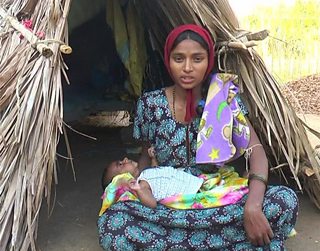
An old custom in remote areas of South India forces new mothers and women with periods to stay outside villages in thatched huts without basic needs; image via BBC News Telugu
