Key points
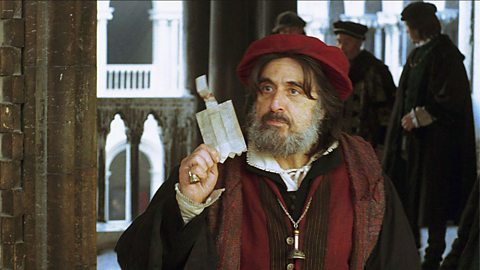
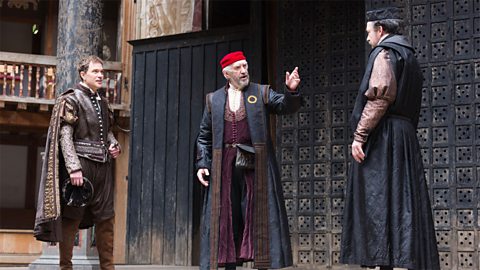
The Merchant of Venice is a play by William Shakespeare that tells the story of a merchant called Antonio and a moneylender called Shylock.
Themes are the main ideas that appear repeatedly in a play. Some of the important themes in The Merchant of Venice are:
Money - the significance of wealth and how it can affect people and relationships.
Justice - the idea of what is fair and how this can differ from person to person.
Love - romantic love, family relationships and the love between friends feature in the play.
Prejudice - many characters are prejudiced against Shylock because of his Jewish faith.
Did you know?
Shakespeare often uses similar themes across his plays. For example, the theme of love is also important in Romeo and Juliet as well as in Much Ado About Nothing.
Money
Watch this video about money in The Merchant of Venice:
Narrator: Money. Take a look at some now. Paper money has the words ‘I promise’ on it. What happens if you don’t keep a promise? What if you promised to watch the toast? And you didn’t. What if you promised to feed the neighbour’s cat while they were on holiday? And you didn’t. And pizza’s not good for cats. You’ll be in trouble.
You see, keeping promises is how money and business works. Money’s just a symbol. Shakespeare understood that money means different things to different people. Bassanio has no money, but wants to borrow more to risk it on wooing Portia.
Money is precious to Shylock, but so is his honour and need for revenge. And Portia is extremely wealthy. She’s inherited her money and is happy to give it away. But she keeps her promise to her dead father, only marrying he that can open the right box.
She could be on her own banknote. Shakespeare knew that you could tell a lot about a person by how they are with money. Introduce money into a plot and you find out what people really value.

Money plays an important role in the play and causes lots of issues. Even the title, which refers to Antonio being a merchant, tells the audience that he makes money by trading.
At the start of the play, Antonio’s friend Bassanio does not have enough money to visit Portia as a potential suitor. He asks Antonio for help, which leads Antonio to take his ill-fated loan from Shylock.
Shylock is presented as greedy and obsessed with money because he charges high interest rates on his loans. This is an Hostility or prejudice towards Jewish people. view of Jewish people. On the other hand, when Jessica steals his ring he is more upset because it was given to him by his wife before she died rather than because of how much money it is worth.
Justice
Watch this video about justice in The Merchant of Venice:
Narrator: Justice. ‘What is justice?’ Let’s ask ROBO-JUDGE 5000.
ROBO-JUDGE 5000: “Justice!”
Narrator: Yes, that’s right. Justice!
ROBO-JUDGE 5000: “Justice!”
Narrator: Ok. Here’s the first case. Accused of skipping the bus queue. Well, ROBO-JUDGE 5000, what do you think?
ROBO-JUDGE 5000: “Justice!”
Narrator: I’m not a legal expert, but I think she’s entitled to appeal. In The Merchant of Venice, Shakespeare asks us to think about justice, punishment and mercy. Shylock thinks that if he’s merciful, people will think him foolish and weak. But he’s confident that justice is on his side. After all, Antonio agreed to the contract. There wasn’t any small print.
That looks like a shopping list, not a loan agreement. And Antonio accepts that justice must be done, even if he dies as a result. But it’s the law itself that gets Shylock in the end. Since Shylock shows no mercy, Portia reveals herself to be merciless in the courtroom. She asks him where his small print is! Because blood isn’t mentioned, his contract is null and void.
You should always read the small print. Even when it isn’t there. That’s why we have lawyers. Shakespeare asks us ‘what is justice?’ Is it following the law no matter where it leads? Or knowing when to cut someone a little slack?
The play makes the audience consider what is right and what is wrong. Antonio thinks that Shylock is wrong and greedy to charge such high rates of interest on loans. On the other hand, Shylock believes that Antonio only charges low interest rates to take business away from him. Shylock believes that Antonio does this because he is Holding hostile or prejudiced views against Jewish people..
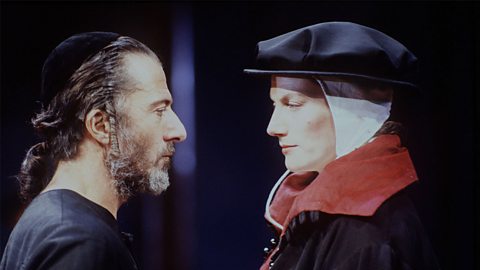
Shylock is given the chance to have his loan repaid, twice the original amount, but he still wants Antonio’s flesh. Shylock thinks this is just because it honours the contract that Antonio signed, although Shylock is also motivated by a hatred for Antonio.
Antonio is resigned to his fate because he willingly signed the contract, and agrees to give Shylock a pound of his flesh.
Portia and Antonio punish Shylock by taking away his money and pressuring him to convert to Christianity. They see this as just and fair because Shylock wanted to kill Antonio. Shylock sees this as unjust and thinks it is enough that he is being denied the money owed to him under the contract. He sees the pressure to convert to Christianity as an unfair attack on his Jewish faith.
Why does Antonio dislike Shylock?

Antonio criticises Shylock for offering loans with high interest rates. However, Shylock says that Antonio only offers low interest rates to take business away from him because he is Jewish.
Love
Watch this video about love in The Merchant of Venice:
Narrator: Love. With all the talk of pounds of flesh, it’s easy to forget that The Merchant of Venice is a play full of love. That’s not to say that some people don’t love their meat. And I’m sure some people can be quite affectionate surrounded by mince.
Just don’t speak to him about 453 grams of flesh; he’s very attached to Imperial measurements. Doesn’t like metric one bit. Have you got any more tattoos?
Antonio and Bassanio are very close friends. Just think what Antonio is prepared to sacrifice! Portia’s father also loved his daughter, and devised a way to ensure she married the right person. And despite Bassanio’s rather suspect courtship with Portia, they really do end up loving one another. It’s not about the money after all.
Hang on! This butcher has an awfully long arm. We’re still on his arm aren’t we? Thank goodness for that. I never should have asked to see his tattoos!
There are lots of different types of love in the play. Love between friends is shown between Portia and Nerissa, as they talk about everything together. Antonio and Bassanio are also good friends. Antonio is even willing to risk his life to help Bassanio marry Portia.
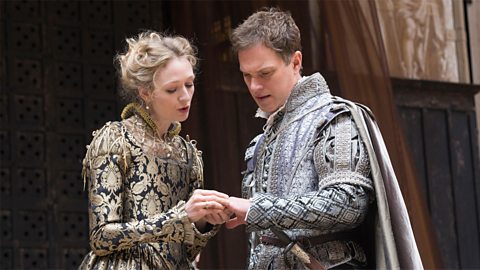
Bassanio and Portia are in love with each other, and Portia is thrilled when Bassanio chooses the correct casket and can propose to her.
Lorenzo and Jessica, Shylock’s daughter, also fall in love - he helps her to run away from her father, and the two get married.
All of this love creates a clear contrast with the hatred in the play, mainly that between Antonio and Shylock.
How does Antonio show his love for Bassanio?
Antonio agrees to Shylock’s deal stating that he will have to give a pound of his flesh if the loan is not repaid. This shows that he is willing to give his life for Bassanio.
At the end of the play, when Antonio thinks that he is going to have to give Shylock the flesh, he tells Bassanio “Grieve not that I am fall’n to this for you” because he does not want Bassanio to blame himself for his death.

Prejudice
There is prejudice towards Shylock because of his Jewish identity. This is antisemitism. It is strongly implied that Antonio dislikes Shylock because he is Jewish. He often refers to Shylock as “the Jew” and pressures him to convert to Christianity at the end of the play.
Antisemitism was common in Shakespeare’s time. It was often based on misguided religious beliefs such as Jewish people being held responsible for the death of Jesus. Hurtful and false ideas around Jews being obsessed with money and having an evil influence on society were also common. Sometimes, antisemitism resulted in Jewish people facing restrictions, being To send someone away from a country or place as a form of punishment. or murdered.
Another example of prejudice is the way women are treated differently to men. Portia has her life controlled by her late father and cannot choose who she marries. This was common in Shakespeare’s time when women did not have the same rights as men. Read more about women in Shakespeare’s England.
Test your knowledge
Solve the Story!
An exciting new series from the Other Side of the Story, designed to help young people strengthen their media literacy skills.

More on The Merchant of Venice
Find out more by working through a topic