Key points
Portia is one of the main characters in The Merchant of Venice, a play by William Shakespeare.
Her father’s A document stating a person's wishes after they have died. states that she must marry the man who selects the correct casket out of a choice of three.
Portia saves Antonio by disguising herself as a lawyer and defending him in court.
Video - Casting Portia
Watch the video below to see how a director might cast the role of Portia.
Presenter: Portia, one of theatre’s strongest heroines and a crucial piece of casting. No audience is going to root for her unless she’s played by an actor who can embody her many virtues. Tricky. She’s got money and she’s funny. She’s bright and full of fight. She’s a menace to the men of Venice, winning with her wits and not with her… good looks. She’s bored of her situation and she sometimes dresses up as a bloke. Sounds like an ex of mine. This is Casting Portia!
First actress: Hi.
Presenter: She certainly looks the part. Portia is meant to be beautiful.
First actress: By my troth, Nerissa, my little body is… weary of this great world.
Director: You’re very sweet but I need someone with a bit more bite.
First actress: Ok. Thank you.
Presenter: Wetter than a weekend in Wales. Portia is hard core, remember? There, there. It’s ok. Shh.
Second actress: Are we doing this, or what?
Director: And, action.
Second actress: Don't rush me!
I had rather be married to a death’s-head with a bone in his
mouth than either of these. God defend me against these two.
Presenter: She’s definitely nailing Portia’s feisty attitude.
Director: It’s very good, but, erm, could you try something for me?
Presenter: The director’s just giving her a few notes. Let’s see what she does with them.
Director: I didn’t mean it. Your performance was great.
Presenter: I don’t think this is going to work out.
Male actor: Alright?
Director: Erm… I think you’ve made a mistake.
Presenter: Yeah. Those shoes with that handbag?
Male actor: Oh, please, come on, give me a chance.
Presenter: Actually, he’s got a point. Portia does disguise herself as a man and women weren’t allowed to be actors in Shakespeare’s day.
Male actor: God made him, and therefore let him pass for a man.
Hold on. This girl acts like all men are pathetic idiots. I’m not doing this.
Director: Oh, come back! That attitude is perfect. Let’s talk.
Third actress: Yep?
Director: Oh, I’m sorry. Are you the person who was just in here?
Third actress: Yeah.
Director: It’s just, you look totally different.
Third actress: Well, Portia’s a master of disguise. So am I.
Director: Wow. That is amazing. If you can do that every night, you’ll be perfect.
Third actress: Sure thing.
Male actor: Did they buy it?
Third actress: You ruined it.
Director: Get out.
Third actress: Get out.
Male actor: Sorry.
Did you know?
In Shakespeare’s time, it was common for parents to choose who their children married. Portia is happy that Bassanio chooses the correct casket and they can marry, because she already knows him and likes him.
Plot summary
Portia’s key moments
Click through the slideshow to see Portia’s key moments

Image caption, Portia and Nerissa discuss Portia’s marriage prospects. Her father’s will states that she must marry the man who chooses the correct casket out of a choice of three. Portia and Nerissa discuss how nice Bassanio is.


1 of 5
Character traits
Intelligent
Portia’s idea to dress up as a lawyer to rescue Antonio saves his life. Her arguments in court are very convincing and well-thought-out.
Ruthless
When Shylock eventually asks for money instead of the pound of flesh, Portia refuses and says that he must give up everything he owns.
Witty
When the audience first meet Portia she is joking about the potential suitors that she has met so far who have failed to guess the correct casket. The way she jokes and plays on words is clever and funny.
How does Portia’s language show her intelligence?
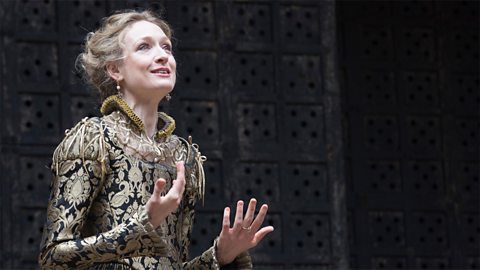
Portia is quick to think and regularly plays on words. When defending Antonio in court, she thinks and speaks like an intelligent lawyer, even though she has had no legal training. When discussing potential suitors with Nerissa, she mocks their arrogance:
…he will fence with his own shadow: if I should marry him, I should marry twenty husbands. If he would despise me, I would forgive him; for if he love me to madness, I shall never requite him.
Relationships
Portia is very good friends with her lady-in-waiting, Nerissa. The two speak about everything and Portia often listens to Nerissa’s advice.
Portia and Bassanio have met once before the play begins and Portia tells Nerissa how much she likes Bassanio. Bassanio likes Portia so much that he lets Antonio take out the loan with Shylock so that he can afford to visit her in Belmont. Portia is overjoyed when Bassanio is the first suitor to choose the correct casket and can ask her to marry him.

Portia wants to save Antonio because he is Bassanio’s friend and she loves Bassanio. This is one of the reasons she is so brutal in her punishment of Shylock for trying to kill Antonio. It is also suggested that Portia may treat Shylock so ruthlessly because she is Hostility or prejudice towards Jewish people..
Listen to a scene
Listen to the audio clip below, which is taken from Act 4, scene 1, and then answer the questions below.
Portia: The quality of mercy is not strained,
It droppeth as the gentle rain from heaven
Upon the place beneath. It is twice blest:
It blesseth him that gives, and him that takes.
'Tis mightiest in the mightiest, it becomes
The throned monarch better than his crown.
His sceptre shows the force of temporal power,
The attribute to awe and majesty,
Wherein doth sit the dread and fear of kings;
But mercy is above this sceptred sway.
It is enthroned in the hearts of kings,
It is an attribute to God himself,
And earthly power doth then show likest God's
When mercy seasons justice. Therefore, Jew,
Though justice be thy plea, consider this:
That in the course of justice, none of us
Should see salvation. We do pray for mercy,
And that same prayer doth teach us all to render
The deeds of mercy. I have spoke thus much
To mitigate the justice of thy plea,
Which if thou follow, this strict court of Venice
Must needs give sentence 'gainst the merchant there.
1. What does Portia compare mercy to?
2. What does Portia mean when she describes mercy as “twice blest”?
Portia compares mercy to the rain when she says “It droppeth as the gentle rain from heaven”. This is a simile, a comparison made using the words like or as.
When Portia describes mercy as “twice blest”, she means that the person who gives mercy is blessed and the person who receives mercy is blessed.
Changes in character
When the audience first meet Portia, she feels helpless in her own life but she has a good friend in Nerissa who gives her advice. She appears willing to her suitors but is secretly determined to marry someone she loves.
Portia becomes more confident as the play progresses. For example, she advises Bassanio to take his time when choosing a casket in an attempt to take control of her own situation.
Towards the end of the play it is Portia, not Bassanio, who takes it into her own hands to save Antonio from his fate and to punish Shylock for his actions. Bassanio and Antonio do not recognise Portia when she is in disguise, and are shocked when she reveals herself.
Video - How would you stage Portia’s reveal?
Watch the video below to see how a director might stage the scene in which Portia reveals herself to have been Balthazar.
Presenter: Here are the directors: 12 divorces, nine law suits and three stints in rehab between them, these guys know what they want and they normally get it. Today, they’re looking for effective ways to disguise the character Portia as a man.
In Act 5, scene 1, Portia reveals that she was the lawyer, Balthazar, to her lover, Bassanio. The directors want the audience to believe his shock at this revelation. Does theatre designer, Graham, have the right idea?
Director 1: OK, Graham, and what’s your name, sir?
Susan: Susan.
Director 2: Graham, Susan, with a disguise that good the audience would really believe the shock Bassanio feels. I love it.
Director 1: Obviously, there’s some quick scene changes in this play. How long does it take to get all this makeup on and off?
Graham: Well, it’s not the fastest process but one would argue that the effect…
Director 1: Answer the question!
Graham: About three hours to get on, two hours to get off.
Director 2: Those sort of timings might work for a film, but never on stage. That’s ridiculous. I’m out.
Director 3: I don’t think I’ve ever met a man called Susan before.
Presenter: Next into the Directors’ Den are two designers with a colour-coded costume idea.
Actress: Here is a letter. Read it at your leisure. There you shall find that Portia was the doctor,
Nerissa there, her clerk.
Director 1: I like it. It’s quite simply simple and simply effective.
Director 2: The audience will know that Portia is disguised as Balthazar so you could argue that we don’t need to try to hide it from them. Well done.
Director 3: Look, I like the idea and I like you two, but blue is simply not your colour, girlfriend. It clashes with your eyes. For that reason, I’m out.
Presenter: Next into the Directors’ Den is theatre designer, Tracey, from Cheam. She wants to try something very traditional with the character of Portia.
Tracey: And, of course, this technique removes the need for a disguise when Portia is pretending to be a man.
Director 2: Tracey, in Shakespeare’s times he had to cast men as women because it wasn’t allowed for women to be actors.
Director 3: You’ve merely created the same problem in the opposite direction. I’m out.
Male actor: I told you we should have waxed my bikini line.
Activity - Order it
What do these key quotations mean?
…all the world desires her;
From the four corners of the earth they come,
To kiss this shrine, this mortal-breathing saint.
The Prince of Morocco
Act 2, scene 7
As the Prince of Morocco decides which casket to choose in order to win Portia’s hand in marriage, he describes Portia as holy and desired by everyone.
One half of me is yours, the other half yours.
Portia
Act 3, scene 2
Portia says this to Bassanio when he comes to choose a casket. It is the second time they have met. She is professing her love to him before telling him to take his time choosing so that they can get married.
This bond doth give thee here no jot of blood.
Portia
Act 4, scene 1
Portia, dressed as a lawyer called Balthazar, gives Shylock false hope by implying that he is entitled to the pound of flesh. However, she offers one of the play’s key plot twists with this simple line which states that Shylock cannot spill a drop of Antonio’s blood.
Test your knowledge
Solve the Story!
An exciting new series from the Other Side of the Story, designed to help young people strengthen their media literacy skills.

More on The Merchant of Venice
Find out more by working through a topic