Key points
Shylock is a main character from The Merchant of Venice, a play by William Shakespeare.
Shylock is discriminated against by most of the characters in the play because he is Jewish.
Shylock lends Bassanio and Antonio money but states that if the loan is not repaid then he will be entitled to a pound of Antonio’s flesh.
Did you know?
The Jew of Malta by Christopher Marlowe was a play written around ten years before The Merchant of Venice, which may have inspired Shakespeare. In the play the main character, Barabas, is discriminated against because he is Jewish, in a similar way to Shylock.
Antisemitism, the hatred of Jewish people, was very common in Europe in the 1500s. Many people held false beliefs about Jews which at this time largely centred on the idea that Jews were outsiders due to their different religion.
Plot summary
Shylock’s key moments
Click through the slideshow to see Shylock’s key moments

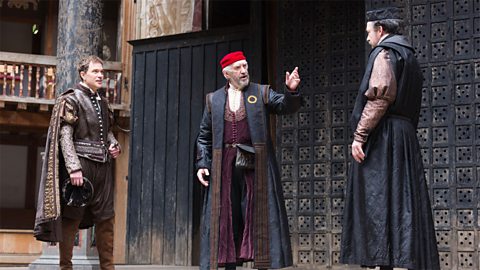
Image caption, Bassanio and Antonio go to Shylock to ask him for a loan. Shylock agrees, but says that Antonio must give him a pound of his flesh if they can’t pay back the loan. They agree.


1 of 5
Character traits
Hard-hearted
When Jessica, Shylock’s daughter, runs away with Lorenzo, Shylock seems more upset about the fact that she took some of his money rather than the fact that his daughter has left.
Stubborn
Shylock becomes obsessed with getting the pound of flesh from Antonio, despite knowing that it will kill him. Even when Bassanio offers Shylock double the amount Shylock loaned, he refuses, which shows how determined and stubborn he is.
Discriminated against
In many ways Shylock is presented as the villain of the play. However, he is also discriminated against by characters such as Antonio because he is Jewish.
How is Shylock presented both positively and negatively in the play?

Shylock is presented as greedy and ruthless because he charges high rates of interest on his loans, meaning that those he lends to have to pay back much more than they borrowed. He is also willing to murder Antonio for revenge.
However, lots of the characters, including Antonio, treat Shylock badly because he is Jewish. Viewed in this context, it is understandable that Shylock would dislike characters who discriminate against him.
Relationships
Shylock has a friendship with Tubal who is also Jewish and a moneylender. However, most of Shylock’s other relationships are very negative or unsuccessful. For example, his own daughter, Jessica, runs away with some of Shylock’s jewels and converts to Christianity.
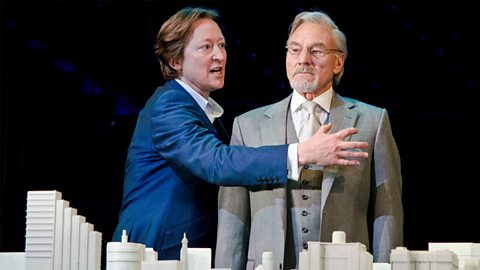
Antonio is Shylock’s enemy. Antonio says that he does not like Shylock because he charges high rates of interest on loans. Shylock claims that Antonio makes his life miserable because he is Jewish.
The rest of the characters do not treat Shylock any better. For example, Portia does everything she can to punish Shylock at the end of the play by taking all of his money away from him. Antonio then pressures Shylock into converting to Christianity.
Listen to a scene
Listen to the audio clip below, which is taken from Act 3, scene 1, and then answer the questions below. In this scene, Shylock makes a speech about how Antonio has discriminated against him for being Jewish.
Salarino: But tell us, do you hear whether Antonio have had any
loss at sea or no?
Shylock: There I have another bad match: a bankrupt, a
prodigal, who dare scarce show his head on the
Rialto, a beggar-- that was used to come so smug upon
the mart. Let him look to his bond. He was wont to
call me usurer; let him look to his bond. He was
wont to lend money for a Christian courtesy; let him
look to his bond.
Salarino: Why, I am sure if he forfeit thou wilt not take
his flesh. What’s that good for?
Shylock: To bait fish withal: if it will feed nothing else,
it will feed my revenge. He hath disgraced me, and
hindered me half a million, laughed at my losses,
mocked at my gains, scorned my nation, thwarted my
bargains, cooled my friends, heated mine
enemies - and what's his reason? I am a Jew. Hath
not a Jew eyes? Hath not a Jew hands, organs,
dimensions, senses, affections, passions? Fed with
the same food, hurt with the same weapons, subject
to the same diseases, healed by the same means,
warmed and cooled by the same winter and summer, as
a Christian is? If you prick us, do we not bleed?
If you tickle us, do we not laugh? If you poison
us, do we not die? And if you wrong us, shall we not
revenge? If we are like you in the rest, we will
resemble you in that. If a Jew wrong a Christian,
what is his humility? Revenge. If a Christian
wrong a Jew, what should his sufferance be by
Christian example? Why, revenge! The villainy you
teach me I will execute, and it shall go hard but I
will better the instruction.
1. What does Shylock say he will use Antonio’s flesh for?
2. Who is the “we” that Shylock refers to here?
Shylock says he will use Antonio’s flesh for fish bait.
When Shylock says “we” he is referring to himself and other Jewish people. He highlights how all humans are essentially the same.
Changes in character

At the beginning of the play, Shylock is presented as hard-hearted and focused on wealth. However, the audience sees an emotional side to him as the play goes on. For example, in Act 3 he delivers a powerful speech on the discrimination that he has been subjected to for being Jewish.
When Jessica runs away, Shylock seems more upset about the money she took than the loss of his daughter. However, when Jessica sells the ring she stole from him, he states that he would not have given it away for any amount of money. This is because it was given to him by his late wife.
Shylock is again presented as cruel and merciless when he is determined to get the pound of flesh from Antonio, even if this means Antonio dying. By the end of the play, however, the audience may feel sympathy for Shylock because he has had his money taken away from him and is forced to convert to Christianity.
Activity - Order it
What do these key quotations mean?
‘My daughter! O my ducats! O my daughter,
Fled with a Christian! O my Christian ducats!
Justice, the law, my ducats, and my daughter!’
Solanio
Act 2, scene 8
Here, Solanio is mocking Shylock’s upset at Jessica running away. He makes fun of Shylock for being more upset about his money being taken, and Jessica running away with a Christian, than the loss of his daughter.
He hath disgraced me, and hindered me half a million; laughed at my losses, mocked at my gains, scorned my nation, thwarted my bargains, cooled my friends, heated mine enemies; and what’s his reason? I am a Jew.
Shylock
Act 3, scene 1
Shylock describes Antonio’s antisemitic reasons for treating him badly. He also describes what Antonio has done to him, such as “thwarting [his] bargains”, which means offering lower interest rates than Shylock to take away his business.
I pray you, give me leave to go from hence;
I am not well. Send the deed after me
And I will sign it.
Shylock
Act 4, scene 1
These are the last lines that Shylock speaks in the play. Here, the audience sees him begging to be allowed to leave. Having lost his wealth and his religion, he appears to have given up fighting.
Test your knowledge
Solve the Story!
An exciting new series from the Other Side of the Story, designed to help young people strengthen their media literacy skills.

More on The Merchant of Venice
Find out more by working through a topic