Key points
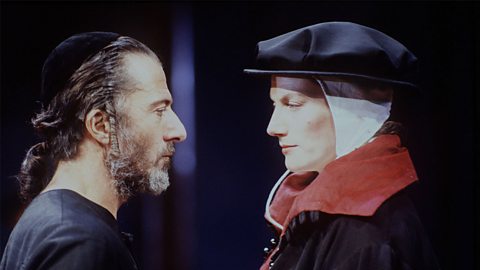
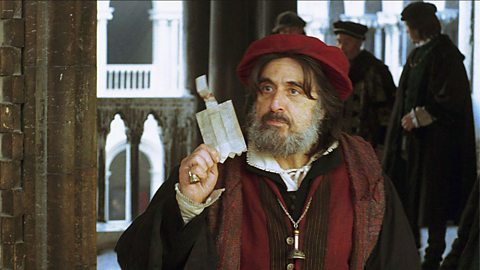
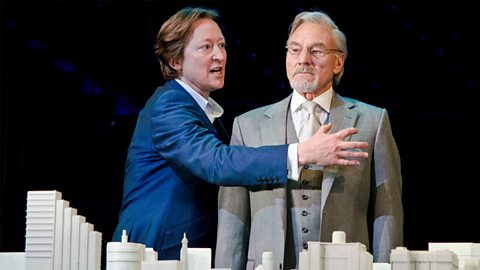
The Merchant of Venice is a play by William Shakespeare that tells the story of a merchant called Antonio and a moneylender called Shylock.
Antonio takes out a loan from Shylock on the condition that, if he cannot pay him back, he has to give him a pound of his flesh.
The play is usually classed as a comedy, although it does also contain some tragic elements.
Video about the plot of The Merchant of Venice
Watch the following video to learn about the plot of The Merchant of Venice:
Narrator:The Merchant of Venus!?!? Wow! Get you Shakespeare! You usually set plays in Italy! This is about a guy who uses his pal as a credit card, and about another guy that wants to literally cut up that credit card. Yeah. It’s a play about religious intolerance, fish bait and losing your ring to a cross-dressing lawyer.
This is an exciting place! A big trading station where all the merchants hang out. There’s Antonio, a merchant whose cash is all tied up in ships halfway across the galaxy. Which is a pity because his buddy Bassanio asks him for 3000 ducats, so he can wow some rich chick called Portia.
What’s her story? Well, her Dad died leaving her super-rich, but she can’t choose her husband. Her dad set up some stupid guessing game where her suitors have to choose the right box. Was he Noel Edmonds? “Choose the box you will!” Back to these guys. Antonio agrees to guarantee Bassanio’s loan, and they go to see a rich merchant called Shylock.
Shylock is an alien! Wow! Is he an alien? Hey! What are you? A Jew? And that’s why they treat you like an alien? That is nasty. Sorry buddy. I am shocked, but we’ve got to get back to the action on Venus.
Anyway, Shylock says “Sure you can have 3000 duckies, but if you don’t pay me back, then I get a pound of Antonio’s flesh.” And whaddayaknow! Antonio’s ships are all lost and the poor guy is broke. He can’t pay back the 3000, so Shylock demands his pound of flesh.
Meanwhile Bassanio chooses the right box and marries Portia. Bassanio hears the news about Antonio and runs to help him in court. Portia hears too, which is just as well, because she dresses up as a man-lawyer and goes to court and saves the day with the old ‘If you can get your pound of flesh without spilling any blood, then you can have it', defence. But of course, he can’t.
So Antonio is saved, Shylock ruined. Then Portia in disguise says to Bassanio my legal fee is your wedding ring, and he hands it over. Later, she says, duh. That was me you dummy. I forgive you. And everyone is happy. Except Shylock.
Hey Shylock, why are they so nasty to you on Venus? Whaat!?? It’s not Venus! It’s Venice!?!? Hundreds of years ago!? Well, at least that explains why they were so bigoted. The Merchant of Venice. Yeah yeah, I can see how that could work.
Did you know?
The Merchant of Venice is often called a problem play. This is because it is difficult to put it into one of the three categories most of Shakespeare’s plays fit into: comedy, tragedy and history.
Plot summary
Main characters
Who are the main characters in The Merchant of Venice?
Shylock is an unpopular moneylender who is accused of lending money with unreasonably high interest rates. He is a victim of antisemitism, which is hostility or prejudice towards Jewish people.
Portia is a wealthy woman. Her father’s will states that she can only marry the man who chooses the correct casket from a choice of three.
Antonio is the merchant in the title of the play. He has invested his money in ships which are away at sea.
Bassanio is Antonio’s best friend. He wants to marry Portia so asks Antonio for a loan in order to make the journey to visit her.
Bassanio asks his friend Antonio for a loan
In Venice, a merchant called Antonio and his friend Bassanio discuss their problems. Bassanio wants money to be able to visit Portia, a wealthy heiress who lives in A fictional city not too far away from the real city of Venice.. He has met her once before and hopes to marry her.
Bassanio asks Antonio for a loan. Antonio says that he would lend him the money if he could but all of his wealth is tied up in ships. He suggests Bassanio ask Shylock, a moneylender. Antonio says that he can act as A person who promises to pay back a loan if the person who has taken out the loan cannot pay it back. for the loan.
Portia is bound by her father’s will and cannot marry who she chooses
In Belmont, Portia is also sad because she feels trapped by her late father’s A document stating a person's wishes after they have died. , which says that she has to marry the man who correctly selects one of three caskets.
So far, she does not like any of the men who have tried and failed to choose the correct casket. She and her lady in waiting, Nerissa, think back to when Bassanio visited and they both speak positively about him.
Foreshadowing is when a writer hints about something that will happen later on. What could Shakespeare be foreshadowing here?
The fact that Portia and Nerissa remember Bassanio, just as they are discussing the unsuitability of Portia’s previous suitors, suggests that Bassanio is destined to succeed with the caskets and ask Portia to marry him. The audience already knows - unlike Portia and Nerissa - that he is planning on visiting Portia in Belmont.
Shylock lends the money to Antonio with some gory conditions
Back in Venice, Antonio and Bassanio go to see Shylock about the loan for Bassanio. Because Christianity does not permit moneylending with interest, Antonio offers loans with no interest which takes money away from Shylock and other Jewish moneylenders. This makes Shylock dislike Antonio.
Shylock says that he will lend Bassanio three thousand A currency that originated in Venice and was used across Europe in the medieval era. with no interest. However, Shylock then says that if the loan goes unpaid, he will be entitled to a pound of Antonio’s flesh.
Bassanio encourages Antonio to say no but Antonio agrees.
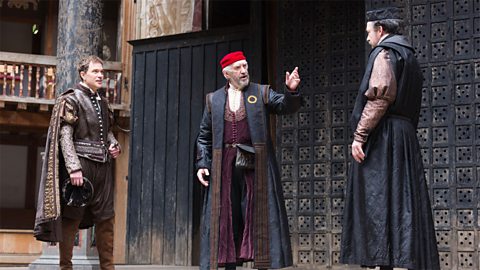
Jessica runs away from home to be with Lorenzo
At Shylock’s house, his servant Launcelot decides he is going to leave Shylock to go and work for Bassanio. On top of this, Shylock’s daughter, Jessica, plans to run away with Antonio’s friend, Lorenzo.
The day after the celebration Bassanio and his friend Gratiano go to Belmont, in the hope that Bassanio can marry Portia.
In Belmont, Portia is visited by the Prince of Morocco who guesses the gold casket, which is incorrect. The Prince of Arragon also visits Portia and chooses the silver casket, which is also wrong.
Did you know?
In Shakespeare’s time, it was very common for a father to choose who his daughter married. This took away women’s freedom to choose their own husband and often meant women had to marry men they didn’t love.
Antonio’s investments are sunk and Shylock demands his arrest
In Venice, Shylock is angry that his daughter, Jessica, has run away. He gives a powerful speech about An opinion that is not based on fact or experience. against Jewish people.
However, he is happy to find out that Antonio’s ships have sunk because it means that he will be paid his debt of flesh.
Shylock’s speech makes the audience consider the impact of Hostility or prejudice towards Jewish people.:
And what's his reason? I am a Jew. Hath not a Jew eyes? Hath not a Jew hands, organs, dimensions, senses, affections, passions, fed with the same food, hurt with the same weapons, subject to the same diseases, healed by the same means, warmed and cooled by the same winter and summer, as a Christian is? If you prick us, do we not bleed? If you tickle us, do we not laugh? If you poison us, do we not die? And if you wrong us, shall we not revenge?
– Shylock,
This speech contains a lot of rhetorical questions. What is a rhetorical question?
A question which aims to create a specific, usually dramatic, effect rather than to receive an answer.
A set of multiple questions in a row that aim to ask one main question.
A question that does not use a question mark.
The answer is 1. A rhetorical question is a question which aims to create a specific, usually dramatic, effect rather than to receive an answer.
Bassanio and Portia get engaged
In Belmont, Bassanio arrives to see Portia and the two declare their love for one another. Bassanio quickly selects the correct casket, which is made of lead. He and Portia celebrate and Gratiano, Bassanio’s friend, says that he has fallen in love with Nerissa.
Portia gives Bassanio a ring as a token of her love and says to him that he must never part with it. Nerissa also gives a ring to Gratiano.
Lorenzo and Jessica join the group. A messenger brings news that Antonio has lost his ships. Bassanio realises that this means that he will have to pay Shylock with a pound of his flesh. Bassanio and Gratiano return to Venice to try and save Antonio’s life.
The word “flesh” appears 23 times in the play. One example is when Antonio, who is in prison, says:
The duke cannot deny the course of law:
For the commodity that strangers have
With us in Venice, if it be denied,
Will much impeach the justice of the state,
Since that the trade and profit of the city
Consisteth of all nations. Therefore, go;
These griefs and losses have so bated me
That I shall hardly spare a pound of flesh
Tomorrow to my bloody creditor.
– Antonio,
Why does Antonio say that the duke will allow Shylock to have a pound of flesh?
Because the duke is good friends with Shylock.
Because the duke must respect legal contracts.
Because the duke is cruel and enjoys the griefs and losses of others.
The answer is 2. Antonio understands that the duke must respect legal contracts.
Portia, disguised as a lawyer, saves Antonio
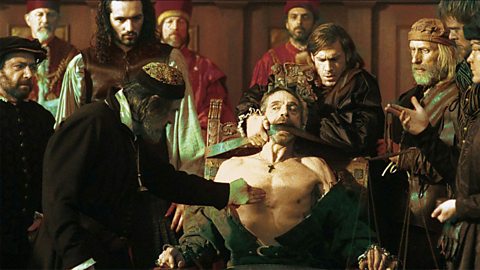
Bassanio goes to Antonio’s trial and offers to pay Shylock double what he is owed but Shylock refuses. He insists on getting his pound of flesh from Antonio.
Portia arrives, disguised as a male lawyer called Balthazar, and says that there is no mention in the contract of Shylock being entitled to any of Antonio’s blood - if he spills even a drop of his blood when removing the flesh, then Shylock’s land and money will be taken away. Shylock realises that he cannot get his pound of flesh so says he will accept money instead. Portia refuses this and says that he must have the pound of flesh or nothing else.
Video - Rehearsing the court scene
Watch the video below to see how a director might stage the court scene.
Presenter: Hello and welcome to The Big Scene. We’re at rehearsals for The Merchant of Venice, Act 4, Scene 1, and the actress playing Portia faces arguably her biggest challenge yet. She’s disguised as a man, pretending to be a lawyer, trying to win over the court and save Antonio’s life and outwit the opposition, team Shylock.
It’s a veritable minefield out there – not literally, of course, because that would be bonkers – but just how the director gets her to tackle this key scene will determine how the audience interprets the entire production. Good luck with that, mate.
Portia: Be merciful. Take thrice thy money. Bid me tear the bond.
Presenter: Well, well, that is embarrassing. Portia might be disguised as a man but she’s tougher than most of them, and no-one wants to see acting like that from a player of her calibre, least of all the boss.
Director: No, no, no. You’ve got to stay strong. Strong. Get up.
Presenter: Exactly. It’s time to sort the men from the boys, or the girls disguised as men, from the weeping boys who are not disguised - no, no. I’ve lost it. I’ve lost it.
Portia: One drop of Christian blood, thy lands and goods
Are by the laws of Venice, confiscate
Unto the state of Venice.
Presenter: Oh, and what on earth is she playing at? This play may be a comedy but you can’t take a scene of this magnitude lightly, and I don’t think the director’s seen the funny side, either.
Director: Why don’t you try it a bit straighter?
Portia: Ok.
Presenter: And there’s clearly been a tactical rethink here. Let’s see how this girl performs now.
Portia: You shall have nothing but the penalty.
Presenter: And this is a clinical performance, showing complete contempt for the opposition there – and, arguably, it works. But the director really wants to see Portia enjoying herself out there.
Director: I need you to give a little bit more, OK? Now, go for it.
Portia: Mm. Ok.
Therefore prepare thee to cut off the flesh.
Shed thou no blood.
Presenter: And what a class act, cool and in control. She knows exactly what she’s doing, making a fool of the opposition and really loving it.
Portia: …thou hast incurred the danger formerly by me rehearsed.
Down, therefore, and beg mercy at the duke.
Presenter: Ah.
Portia: Yes. Woo! Woo! Ah!
Woo-hoo!
Presenter: Oh dear.
Portia: Fly the flag!
Presenter: Now she’s gone just too far. That is disappointing.
Portia: Yes! Come on! Yes!
Shylock accepts defeat but Portia will not let him leave. She states that as punishment for trying to kill a Venetian, everything he owns will be taken away, with half being given to the victim, Antonio, and half to the state.
Antonio adds that if Shylock agrees to convert to Christianity and leaves his money to Jessica and Lorenzo when he dies then he can keep his half of the money. Shylock agrees before leaving.
What does Shylock have to do in the end as punishment for trying to kill Antonio?
Convert to Christianity.
Give half of his money to Antonio.
Give half of his money to the state.
Write a will leaving everything to his daughter, Jessica.
Go to prison.
The answers are 1, 3 and 4. Shylock has to convert to Christianity, give half his money to the state and leave all of his money to his daughter, who has converted to Christianity, when he dies.
Although Portia at first tells him to give half of his money to Antonio, Antonio says he can keep it if he converts to Christianity and leaves his money to Jessica. Shylock is not sent to prison.
Bassanio and Portia argue about the loss of a wedding ring
The Duke says that Antonio should reward Balthazar, who is actually Portia, for ‘his’ help. Portia realises that Bassanio has not recognised her. She plays a trick on him by refusing money and asking for Bassanio’s ring, the one that she gave him, instead. Bassanio refuses at first but is persuaded by Antonio to hand it over.
In Belmont, Bassanio tells Portia that he gave the ring away. She pretends to be upset before giving Bassanio ‘another’ ring, which he immediately recognises as the ring he gave away. Portia reveals that she was the lawyer, Balthazar, and forgives Bassanio.
Activity - Put the events in order
Test your knowledge
Solve the Story!
An exciting new series from the Other Side of the Story, designed to help young people strengthen their media literacy skills.

More on The Merchant of Venice
Find out more by working through a topic