Key points
William Shakespeare was an English actor, poet and playwright who was born in 1564. His plays were written and first performed during the The period of time when a king or queen is on the throne. of The last Tudor monarch, Elizabeth I was queen of England and Ireland from 1558 until her death in 1603. Her father was Henry VIII. and her successor, The first monarch in the Stuart dynasty, James I came to the English throne after the death of his cousin, Elizabeth I. He reigned as the King of Scotland from 1567 until his death in 1625, and as the King of England from 1603 to 1625..
Shakespeare wrote tragedies, like Macbeth and Romeo and Juliet, and also comedies, like The Tempest and Twelfth Night.
During Shakespeare’s lifetime his plays were performed in theatres and became very popular.
Theatres had different seating or standing spaces that depended on How people are divided into groups in society, depending on how important they are believed to be and how much money they have and wealth.
Did you know?
Women were not allowed to act in the theatre, so the female roles in Shakespeare’s plays were performed by men.
Overview of society
The queen was seen as God’s chosen ruler on earth, so was at the top of the social pyramid.
Beneath her were the nobility - the class of people who had A special word before a person’s name that shows their high rank, for example Lord or Lady., wealth, land and power.
The gentry were below the nobility, they would also have wealth and land but not titles.
The class in the middle were made up of A farmer who owned their own land., merchants and craftsmen. They may have run their own business or farmed some land of their own. Shakespeare’s family came from this class – his father had a glove making business and owned property.
Servants, labourers and the poor were at the bottom of society in Shakespeare’s day. These people would earn a living by working for someone else.
Who was on the throne during Shakespeare’s lifetime?
Shakespeare was born during the reign of Elizabeth I, the last Tudor monarch, who reigned from 1558 until 1603. Elizabeth I died without any heirs to succeed her, so her cousin James, who was the King of Scotland, came to the English throne as James I of England. James was the first monarch in the Stuart dynasty. He was still on the throne when Shakespeare died in 1616.
Did you know?
Wearing the wrong clothes in Elizabethan times could lead to a fine, arrest or even imprisonment. This is because clothes in Shakespeare’s time were decided by which class you belonged to.
A set of laws called the ‘Sumptuary Laws’ dictated what materials, colours and styles of clothing you could wear. For example, only those close to the royal family were allowed to wear purple.
Women in Shakespeare’s England
Women were not allowed to perform in plays, so the female roles were taken by men, often younger men who had higher voices. In several of the plays the female characters disguise themselves as men, for example in Twelfth Night and The Merchant of Venice. In these plays the audience would have watched a man pretending to be a woman pretending to be a man.
Women in the 1500s and 1600s had far fewer rights than men. Despite this, some women did have influence and took on important roles. This is reflected in Shakespeare’s plays, where there are examples of women in control. For example, the character of Portia in The Merchant of Venice is a strong, intelligent woman who controls the events of the play.
What were women’s rights like in Shakespeare’s lifetime?
In Shakespeare’s day, most women had far fewer rights than men. It was believed that women belonged to their fathers and then to their husbands. They couldn’t own property unless their husband died. They were also not allowed to attend school or university. Only women from the nobility or gentry were educated.
Women could be married at a young age. This is shown in the play Romeo and Juliet, in which Juliet is 13 years old at the time of her marriage to Romeo. Most women in Shakespeare’s lifetime, however, usually married in their late teens or early 20s.
Given women’s position in Tudor times, how did Elizabeth I rule over England as Queen?
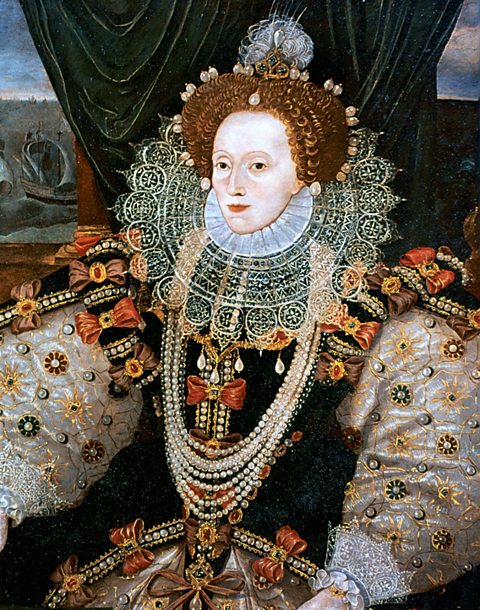
Queen Elizabeth I was a powerful and popular ruler. She was intelligent and spoke several languages fluently. She also loved culture and was a patron of the theatre. She never married and was queen for 45 years. Her royal status gave her power.
Her skills and strength as a ruler helped make her an effective queen, but she was aware that some people thought a female ruler was weaker than a king. During a famous speech, she said:
I know I have the body but of a weak and feeble woman; but I have the heart and stomach of a king, and of a king of England too.
Entertainment in Shakespeare’s England
In London, during the Elizabethan period, the first dedicated theatres appeared. Most people went to the theatre, from the poor to the very rich. It was the most popular form of entertainment in Elizabethan England. These theatres, which were also called playhouses, were visited by every class of people.
Queen Elizabeth I also enjoyed plays and special productions were performed for the royal court. The queen never visited public theatres.
Elizabethan theatres were very different compared to modern theatres. A visit to the theatre was often a noisy and dirty experience, there were no toilets and certain parts of the audience were called the ‘stinkards’ because they smelled badly. With so many people packed together, the theatres were also popular with thieves and pickpockets.
What other forms of entertainment were popular?
Elizabethan London had a variety of entertainment. As well as the theatre, people could attend cock fights, in which two cockerels were made to fight each other, and bear baiting. In bear baiting events, dogs were set against a bear chained to a stake. The bear’s teeth were sometimes pulled out to give the dogs a better chance in the fight.
Gambling was very popular and people watching the fights would often bet on the results. These cruel sports often saw the animals fight to the death. Watching an execution or public beating was another gruesome type of entertainment.
Shakespeare used images from these cruel entertainments in his plays. Macbeth compares himself to a bear shortly before he is killed by Macduff:
They have tied me to a stake; I cannot fly,
But, bear-like I must fight the course.
–
The Globe Theatre
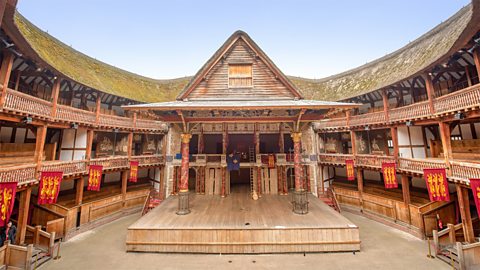
The Globe Theatre was built in 1599 by Shakespeare’s theatre company, the Lord Chamberlain’s Men. It was an open-air theatre and it is believed that it could hold around 3,000 people.
The standing tickets in front of the stage only cost one penny, which meant everyone could afford to experience the theatre. People who stood to watch the play were called groundlings. If the groundlings didn’t like the play, they might shout rude comments at the actors or throw food.
Seats in the gallery were more expensive, and were higher up and covered. The most expensive seats were near the stage. Some people even rented a stool to sit on the stage, which was a popular choice for those who wanted to show off their expensive clothes.
The upper classes were also badly behaved at the theatre. One observer at the time wrote that the An old-fashioned term for a man who wore fashionable clothing. who paid for a stool on stage would often sing, whistle, smoke and spit during the performance.
Activity
Listen to this audio clip, in which a visitor describes his experience of the Globe:
Narrator: 1599. From the diary of Thomas Platter. A contemporary account of a visit to an Elizabethan theatre.
Platter: There are separate galleries, and there one stands more comfortably and, moreover, can sit. But one pays more for it. Thus anyone who remains on the level, standing, pays only one English penny. But, if he wants to sit, he is let in at a farther door, and there he gives another penny. If he desires to sit on a cushion, in the most comfortable place of all, where he not only sees everything well but can also be seen, then he gives yet another English penny at another door. And in the pauses of the comedy, food and drink are carried round amongst the people and one can thus refresh himself at his own cost.
Answer the following questions
How much was a groundling ticket?
Look again at the image of the Globe Theatre. Where do you think the groundlings watched the play?
Who sat in the galleries?
Answers:
The tickets were only one penny, but there was no shelter if it rained.
The groundlings would stand in front of the stage, in the open-air part of the theatre.
People who had more money could sit in the galleries.
Test your knowledge
Play Bitesize secondary games. game
Have fun playing science, maths, history, geography and language games.

More on About Shakespeare
Find out more by working through a topic
- count4 of 5
- count5 of 5
- count1 of 5