Key points
William Shakespeare was an English actor, poet and playwright who was born in 1564. His plays were written and first performed during the reigns of The last Tudor monarch, Elizabeth I was queen of England and Ireland from 1558 until her death in 1603. Her father was Henry VIII. and her successor, The first monarch in the Stuart dynasty, James I came to the English throne after the death of his cousin, Elizabeth I. He reigned as the King of Scotland from 1567 until his death in 1625, and as the King of England from 1603 to 1625..
Shakespeare’s plays include Macbeth, Romeo and Juliet and The Tempest.
During Shakespeare’s time, people had a variety of different beliefs and superstitions. Although most people were Christians, they would also have believed in astrology, folklore, witches and the humours in the body.
The belief in witches is present in Macbeth and there are fairy characters in A Midsummer Night’s Dream.
Video about beliefs and superstitions
Watch this short film about beliefs and superstitions in Shakespeare’s time:
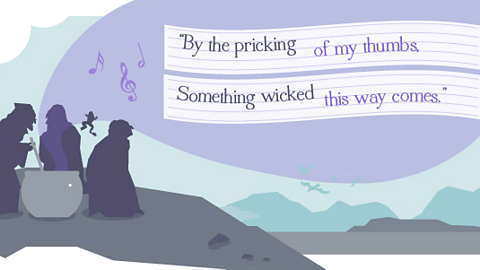
Witch 1: Double, double…
Witch 2: …toil and trouble.
Witch 3: Fire burn…
Witch 1: …and cauldron bubble.
Female presenter: I hate witches.
Witch 1: Thanks very much!
Female presenter: They just sort of freak me out a bit. Of course they’re only actors, but in Elizabethan times…
William Shakespeare: Actors? Are you sure?
Female presenter: Yes, Will, they’re doing your play mate.
William Shakespeare: I knew that.
Female presenter: But in Elizabethan times, most people genuinely believed in witchcraft, making their presence on stage truly terrifying.
William Shakespeare: Sorry, could we do this somewhere else? Just, a bit scary.
Female presenter: You see back then people didn’t know much about science and stuff. Rather than the internet, their belief in magic helped them explain the things they didn’t understand.
William Shakespeare: So what about the terrible storm Prospero’s sorcerer whips up in The Tempest? How does your modern thinking explain that?
Female presenter: A volatile combination of intense high and low atmospheric pressure?
William Shakespeare: You sound ridiculous.
Female presenter: I sound ridiculous?
Male member of the public: Nice hat mate.
Female presenter: I blame the parents.
William Shakespeare: I blame the fairies.
Female presenter: Shakespeare’s plays captivated audiences by reflecting their beliefs and superstitions of the time. From spells in The Tempest to fairies in A Midsummer Night’s Dream.
William Shakespeare: Anybody would think I knew what I was doing.
Female presenter: Of course there are beliefs from Shakespeare’s time that some people still buy into today, like walking under ladders.
William Shakespeare: Oh, oh don’t do that.
Female presenter: Or spilling salt.
William Shakespeare: Are you actually insane? She’s totally out of control.
Female presenter: And even today people believe in fate; the idea that our future is somehow predetermined. Like Shakespeare’s doomed lovers, Romeo and Juliet.
William Shakespeare: It was written in the stars.
Female presenter: It was written in your script.
Fortune teller: You’ll meet a strange man from the past.
William Shakespeare: She’s good.
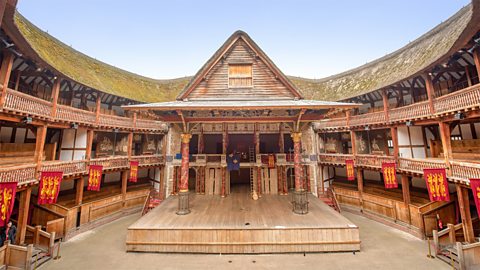
Female presenter:Hamlet, Julius Caesar, Macbeth; all featured one thing Elizabethans really believed in: ghosts. Restless spirits doomed to walk the earth to atone for their sins or demons out for revenge? You’d think we’d know better by now, but some people actually think this theatre is haunted.
William Shakespeare: It’s all in your head mate; along with a bit of help from you guys obviously. Nice one. Hanging with me witches.
Did you know?
People in Shakespeare’s time were very superstitious. Some of these superstitions are still around today. For example, people still say ‘bless you’ when someone sneezes. This dates back to Elizabethan times, to stop the Devil entering your body through your mouth.
What did people believe?
Folklore
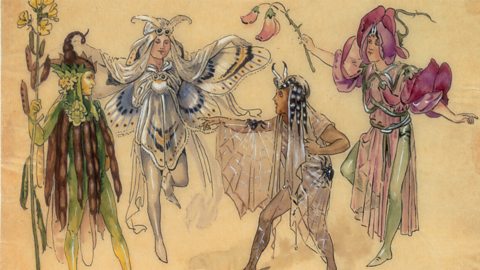
Folklore are the traditions, beliefs and stories passed down by a community. In Shakespeare’s time, folklore was an important part of life. For example, some people believed that fairies and goblins came out at night to play tricks.
These beliefs can be seen clearly in Shakespeare’s play A Midsummer Night’s Dream, in which a world of fairies is created for the audience.
Astrology
Many people in Shakespeare’s lifetime believed in astrology. Astrology is the belief that the position and movement of the stars could influence events on Earth. This interest is still seen in modern times when people read their A forecast of a person’s future..
It was believed that astrologers could predict the future and Queen Elizabeth I even had her own personal astrologer. These beliefs can be seen in lots of Shakespeare’s plays. For example, in Romeo and Juliet the young couple of the title are described as ‘star-crossed lovers’, which means that the position of the stars predicts that their relationship is doomed.
Witchcraft
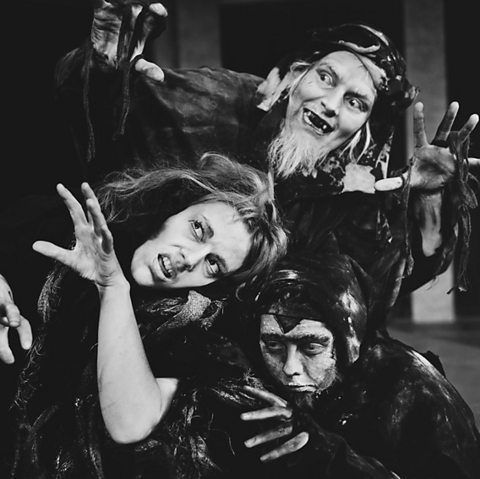
People in the 1500s and 1600s believed in the An event or thing that cannot be explained by nature or science.. The Witches in the play Macbeth would have terrified the audience, who believed in witchcraft and magic.
Queen Elizabeth’s successor, King James I, even wrote a book about witches and believed that a witch created a storm that nearly wrecked his ship. Shakespeare possibly included the Witches in Macbeth to please James I. The Witches manipulate the other characters into disaster.
Religion
Religion was an important part of life in Shakespeare’s day and most people were Christian. The law said that you had to go to church every week and many people went more often. In 1592 Shakespeare’s father was fined for not attending church.
Why were the 1500s a time of religious conflict?
Elizabeth I’s father, Henry VIII, wanted to divorce his first wife because their marriage had not produced a male heir. The Catholic Church did not allow divorce, so in 1534 Henry VIII broke with the Pope and the Catholic Church. This was called the Reformation.
The break with Rome eventually triggered England’s transition into a Protestant country.
By the time Shakespeare was born in 1564, Protestantism was the main religion in England. The queen, who was a Protestant, was the head of the Church of England. However, there were tensions between Protestants and Catholics.
Shakespeare avoids talking directly about Christianity, but throughout his plays there are references to the afterlife. Most people believed that Heaven and Hell were real places.
Which one of these statements is false?
In Shakespeare’s lifetime, religion was not an important part of society.
When Shakespeare was born when Protestantism was the main religion in England.
Shakespeare’s father was fined for not attending church.
Answer: 1 - Religion was an important part of society and a big political issue that affected relations with other countries. Spain, a Catholic country, wanted England to return to Catholicism and the Spanish king sent an Armada - a fleet of ships - which tried to invade.
Because religion was so closely associated with politics, playwrights had to be very careful. Shakespeare avoided talking directly about Christianity, but throughout his plays there are references to Heaven and Hell.
Hamlet, for example, can’t bring himself to kill his uncle while he is praying, because he will go straight to Heaven – the opposite of what Hamlet wants.
The Great Chain of Being
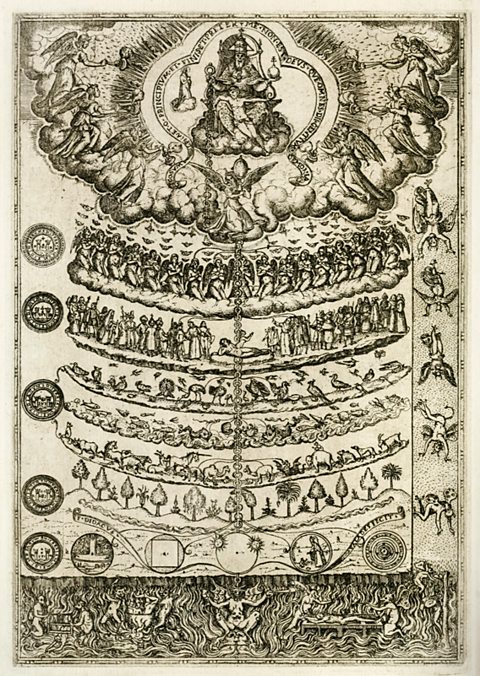
People in the 1500s and 1600s believed that every living thing had its place in the universe, which had been set out by God. This order was called the Great Chain of Being, and it included everything from God and the angels at the top, to humans, animals, plants, rocks and minerals towards the bottom.
The Divine Right of Kings was the belief that the king or queen was in charge because they were God’s chosen representative on earth, and they were only answerable to God.
These beliefs can be found in Shakespeare’s plays. When Macbeth commits the sin of regicide, the killing of a king, he disrupts the Great Chain of Being and the Divine Right of Kings. This affects the natural order of things and terrible storms and earthquakes happen as a result.
The Four Humours
In Shakespeare’s time, people believed that your physical and mental health were controlled by the four humours in your body. Different humours were also linked to personality types, for example:
| Humour | Personality type | Characteristics |
|---|---|---|
| Blood | Sanguine | Jolly, optimistic and fat |
| Yellow bile | Choleric | Short-tempered, red-haired, thin and ambitious |
| Phlegm | Phlegmatic | Slow, pale and lazy |
| Black bile | Melancholic | Thin, yellowish and tends to spend a lot of time thinking and worrying |
It was believed that too much of one humour could make you ill. To fix this imbalance doctors would use leeches for , or encourage the patient to vomit.
These beliefs appear in Shakespeare’s plays. For example, in Romeo and Juliet, Tybalt references choler and ‘gall’, which means bile:
Patience perforce with wilful choler meeting
Makes my flesh tremble in their different greeting.
I will withdraw: but this intrusion shall
Now seeming sweet convert to bitter gall.
–
In Shakespeare’s play Macbeth the main tragic character is very ambitious. Which humour might he be linked to?
Answer: Yellow bile, which would result in a choleric personality. The audience would have recognised Macbeth as a choleric character because of his ambition. He wants to become king so much that he resorts to murder.
Test your knowledge
Play Bitesize secondary games. game
Have fun playing science, maths, history, geography and language games.

More on About Shakespeare
Find out more by working through a topic
- count4 of 5
- count5 of 5
- count1 of 5
- count2 of 5