Key points
William Shakespeare was an English actor, poet and playwright. Some of his most famous plays include Romeo and Juliet, Macbeth and The Tempest.
Shakespeare’s plays were written over 400 years ago, and some of the language can be unfamiliar to modern audiences.
Shakespeare helped transform the English language. Many words and phrases that are commonly used today were first written down by Shakespeare.
Video about Shakespearean language
Watch this video about Shakespeare’s influence on the English language
Female performer: Love looks not with the eyes, but with the mind, and therefore is winged Cupid painted blind.
Female presenter: So beautiful. There’s lots of lovely language in Shakespeare’s plays, but people don’t speak the way that Shakespeare wrote, not in real life, so why is it…
William Shakespeare: Yeah they do. People are always using words and phrases I’ve written.
Female presenter: Like when?
William Shakespeare: Like constantly. You can’t help it, you’ll probably do it any minute now.
Female presenter: Well I’ll bet you I don’t.
William Shakespeare: Bet, that’s one of mine. Henry IV Part 1.
Male theatregoer: Shh!
William Shakespeare: It’s my play mate, I can talk if I want.
Female presenter: So whilst we may use some of Shakespeare’s words and phrases, we certainly don’t speak in blank or rhyming verse, but if we did, it might be quite revealing.
Male theatre staff member: No talking, those are the rules.
William Shakespeare: Yeah, whatevs mate, you don’t run the show here.
Female presenter: You see blank verse is mostly left to nobles or royalty, or those in positions of power.
Male theatre staff member: I asked you once, I’ve tried to be nice. Now stay away; I’m not gonna tell you twice.
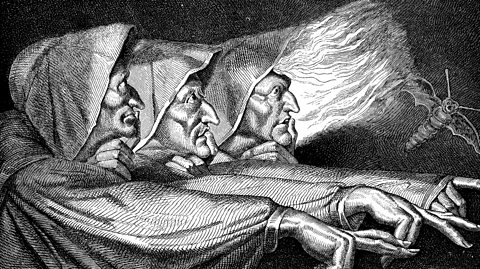
Female presenter: Hold on! Rhyming verse is mostly left to the magical characters like, like witches or fairies.
Oh, that must be his day job! Oh!
The young lovers Romeo and Juliet even speak in rhyming couplets, rhyming each other’s sentences, to show just how in love they are.
Male theatregoer: I reckon that this girl is stalking us.
Female theatregoer: I think you’re right, she’s weird. Let’s get the bus?
Female presenter: Aw, bless.
William Shakespeare: I think he’s punching a bit above his weight.
Female presenter: Well, love is blind.
And most of his characters speak in a rhythm called…
William Shakespeare: Iambic pentameter.
Female presenter: Yes, thank you. Ten syllables to a line with the stress on each alternate syllable.
Female cafe customer 1: Oh my gosh, guess what? Jo and Josh have split.
Female cafe customer 2: He’s way too good for her and she’s a cheat.
Female cafe customer 1: That’s true. But you’re the one he fancies now.
Female cafe customer 2: Don’t give me jokes, that boy is so bare fit.
William Shakespeare: If music be the food of love, play on. Oh she doth teach the torches to burn bright. Now is the winter of our…
Female presenter: Yes, thank you, we get the point. A juicy bit of gossip there in iambic pentameter. But when a character is speaking in prose or ordinary speech, it might mean a number of things. They might be of a low- a lower status or it might mean that something chaotic and unusual is happening.
Male production staff member: Hi guys, I got your coffees. A macchiato and a latte with…
Female presenter: We’re filming.
Male production staff member: …skimmed milk.
Member of film crew: Cut. What the hell do you think you’re doing? We’re in the middle of a take here you worthless- Cut, I said cut!
Female presenter: Oh, now that is an eyeball popping, puke inducing rant of remorseless savagery. I’m surprised there wasn’t a scuffle.
William Shakespeare: D’you think he’ll calm down?
Female presenter: Well, it’ll take some grovelling. He’s very hot-blooded.
William Shakespeare: I’m sorry.
Female presenter: No, d’you know what? I’m quite impressed. Hob-nob? You didn’t invent the hob-nob?!
William Shakespeare: The phrase, not the biscuit.
Female presenter: Oh. Right come on, let’s go before I catch a cold. Blimey, this is unreal.
William Shakespeare: Mm.
What do the following words mean?
Blank verse
Rhyming couplet
Iambic pentameter
Prose
Blank verse - a type of poetry with a regular rhythm but no rhyme
Rhyming couplet - two lines that have rhyming words at the end
Iambic pentameter - a line of verse with ten beats, alternating between five stressed beats and five unstressed beats
Prose - written or spoken language that has no rhythm or rhyme
Did you know?
Shakespeare contributed 1,700 words to the English language.
How did Shakespeare influence language?
Shakespeare often invented new words or used existing words in a different way. Many of his plays are the first record of a word or phrase being used in the English language, for example:
Bedroom - A Midsummer Night’s Dream
To gossip - The Comedy of Errors
Cruel to be kind - Hamlet
Elbow room - King John
Insults
Shakespeare loved playing with language, and many of his plays contain creative insults, for example:
“Thou cream faced loon” - Macbeth
“Out of my sight! Thou dost infect mine eyes!” - Richard III
Did you know?
Shakespeare’s plays have been translated into over 80 languages. In 2012, as part of the celebrations for the Olympic Games in London, 37 international acting companies presented all 37 of Shakespeare’s plays in 37 different languages.
Speaking in verse and prose
Shakespeare used rhythm and rhyme in his plays for many different purposes. A strong rhythm gives the language energy. Rhythm and rhyme is also used to distinguish between certain types of characters.
Blank verse
Most of Shakespeare’s plays are written in blank verse. Blank verse is a type of poetry with a regular rhythm but no rhyme.
Rhythm
The rhythm is usually iambic pentameter, which is a line with ten beats, five stressed and five unstressed (da-DUM, da-DUM, da-DUM, da-DUM, da-DUM). This rhythm has a sound like natural speech and tends to be used by educated or high status characters.
Rhyme
Sometimes characters speak in rhyming couplets, which are two lines that have rhyming words at the end. Couplets could signal the end of a scene, or they might be included to create a particular effect, like emphasis or a moment of tension.
Prose
Prose has no rhythm or rhyme. We can tell when Shakespeare is using prose in his plays because the text appears as a block on the page, instead of shorter lines that each start with a capital letter. Comic characters or characters of a low status tend to speak in prose.
Did Shakespeare always stick to these language rules?
No. There are times in Shakespeare’s plays when characters of high status use prose, which is normally spoken by low status characters. In the play Hamlet, for example, Hamlet, who is a prince, speaks in prose to express madness. In the same play there are examples of low status characters speaking in verse, that is, lines that contain either rhythm or rhyme, to show the audience they are acting the parts of royalty.
Activity
The following lines are all from the play A Midsummer Night’s Dream. Are they examples of prose, blank verse or rhyming couplets?
- “Hippolyta, I woo’d thee with my sword,
And won thy love, doing thee injuries;
But I will wed thee in another key,
With pomp, with triumph and with revelling.”
Blank verse - these lines are written in iambic pentameter, so although they do not rhyme, they do have a regular rhythm.
- “A very good piece of work, I assure you, and a merry. Now, good Peter Quince, call forth your actors by the scroll. Masters, spread yourselves.”
Prose - these lines have no regular rhythm and they do not rhyme.
- “In that same place thou hast appointed me,
To-morrow truly will I meet with thee.”
Rhyming couplets - these lines both end with words that rhyme.
Imagery
Shakespeare’s plays are full of bold and striking imagery. Imagery is when a writer uses words to create vivid images for the reader or audience.
Some of the types of imagery Shakespeare used include:
Describing something as something that it is not, for example “all the world's a stage”.
A description that compares two things using the words like or as.
To give human qualities to something that isn't human.
The choice of imagery is often linked to the themes of the play. Shakespeare often used groups of images to highlight an important theme or idea.
For example, in Romeo and Juliet there are lots of images linked to the stars and planets to highlight the theme of fate.
Listening activity
In this audio clip from A Midsummer Night’s Dream, the character Helena is upset about love. She uses imagery comparing love to a boy. This kind of metaphor is called personification because love is given human characteristics in the description.
Love looks not with the eyes, but with the mind,
And therefore is winged Cupid painted blind.
Nor hath Love’s mind of any judgement taste;
Wings, and no eyes, figure unheedy haste;
And therefore is love said to be a child
Because in choice he is so oft beguiled.
As waggish boys in game themselves forswear,
So the boy Love is perjured everywhere.
What is the name of the rhyme scheme used in this extract?
The rhyme scheme in this extract is rhyming couplets. The words at the end of each two lines rhyme.
Getting to grips with the language
Useful words to know
Shakespeare’s language can be tricky to understand.
Many of Shakespeare’s words are unfamiliar to a modern audience, for example the word ‘sans’ means ‘without’. Some words that are familiar may have a different meaning, for example the word ‘want’ means ‘lack’ in Shakespeare’s language.
Here are some other useful words to know with their modern-day translation:
| Shakespearean language | Modern-day translation |
|---|---|
| art | are |
| aught | anything |
| dost | do |
| doth | does |
| hence | from here |
| oft | often |
| nay | no |
| wast | were |
| whence | from where |
| wherefore | why |
| yea | even |
Pronouns
A pronoun is a word that takes the place of a noun in a sentence, for example ‘they’ or ‘it’. Pronouns are used in an interesting way in Shakespeare’s plays.
Thou and thee, which mean ‘you’, and thy and thine, which mean ‘your’, are used in an informal way to address someone in Shakespeare’s plays. Examples of when these pronouns might be used include:
Family members talking to each other
Close friends talking to each other
Talking to a character of lower status
You and your, on the other hand, are more formal ways of addressing someone. Examples of when these pronouns might be used include:
A cold and distant relationship
Talking to a noble or royal character
Contractions
Contractions were common in Shakespeare’s time, and they appear frequently in the plays. These words or phrases can look strange, but it’s useful to remember that the apostrophe just shows that there is a missing letter or letters.
| ne’er | never |
| e’en | even |
| o’er | over |
| ’tis | it is |
| ’twas | it was |
| ’ere | before |
Listening activity
Listen to this audio clip from the play Macbeth, in which a captain describes Macbeth’s violent fighting on the battlefield.
For brave Macbeth — well he deserves that name —
Disdaining Fortune, with his brandish’d steel,
Which smoked with bloody execution,
Like Valour’s minion carved out his passage
Till he faced the slave,
Which ne’er shook hands, nor bade farewell to him,
Till he unseam’d him from the nave to th’ chaps
And fixed his head upon our battlements.
Click below to reveal what the bold words mean.
“Till he faced the slave;
Which ne’er shook hands, nor bade farewell to him,
Till he unseam’d him from the nave to the chaps,
And fix’d his head upon our battlements.”
ne’er – never
unseam’d – unseamed (this means to cut open)
fix’d – fixed
chaps – the cheek or jaw
nave - the belly button
Test your knowledge
Play Bitesize secondary games. game
Have fun playing science, maths, history, geography and language games.

More on About Shakespeare
Find out more by working through a topic
- count5 of 5
- count1 of 5

- count2 of 5