Overview of Crossing the Loch by Kathleen Jamie
- Crossing the Loch by Kathleen Jamie describes an adventurous journey home from the pub across a Scottish loch late at night.
- The speaker addresses their companion who was with them at the time. They have a close relationship that has left a lasting memory with the speaker.
- The reader shares a reminiscence of shared experience.
- There is a clear feeling of fond nostalgia as well as a recognition of the foolish nature of this youthful adventure.
This poem explores themes of:
- memory and reflection
- journey and transition
- the wonder of nature
Looking for some quick revision? Try one of the interactive Kathleen Jamie quizzes for Higher English.
You can read Crossing the Loch by Kathleen Jamie on the Scottish Poetry Library website.
Form and structure of Crossing the Loch
Crossing the Loch is divided into four stanzas. The first two stanzas each have seven lines and the last two have nine lines each.
Kathleen Jamie writes in Poetry that doesn't have an intentional rhythm or rhyme, but instead can sound more like speech with a regularity of rhythm, which:
- captures the speaking voice of the narrator
- mirrors the rhythm of the oars moving through the water
Stanza 1
From the opening word “Remember”, it is clear that the speaker is recalling a memory - in this case, one particular boat trip after a late night at the pub. The beginning of this journey is carefree, the memory seemingly a fond one.
Stanza 2
The two companions become quiet as the focus becomes the sounds of the oars as they move on the loch. As the journey proceeds, the speaker becomes afraid as they experience the cold and the knowledge of their surroundings. They become aware of potential dangers on the water and in their surroundings.
Stanza 3
The speaker questions who "rowed" and who was quiet. They wonder who first noticed the loch’s amazing emission of light which brings to mind the early voyages of the saints and the magic of the light on the water. There is an air of mystery and an awareness of much earlier times and previous travellers crossing this loch.
Stanza 4
The speaker recognises the foolish nature of this crossing from the past. As they move through the present and the potential of the future, where new relationships and children feature, they recall the confidence of their youth as they landed safely at the cottage shore.
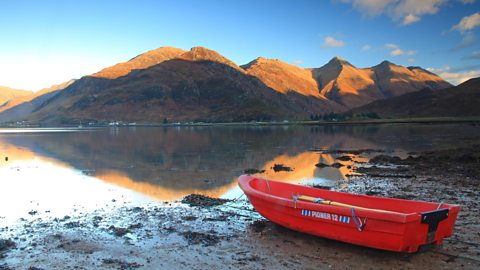 Image source, Andreas Byrne / Alamy
Stanza one
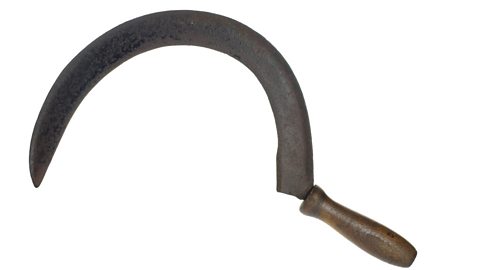 Image source, Witold Krasowski
The poem Crossing the Loch begins with a quiet, conversational question:
Remember how we rowed toward the cottage / on the sickle-shaped bay
The reader is introduced to the theme of memory and reflection right away. Jamie establishes a reflective, intimate tone, inviting the reader into a shared memory between close companions.
A sickle is a curved blade, typically used for harvesting or reaping crops. The description of the bay as “sickle-shaped” therefore suggests the curved shape of the bay. However, this metaphor also conveys the agricultural nature of this loch setting, where the speaker is harvesting their memories of this journey, just as a sickle harvests grain crops.
Image source, Witold Krasowskiafter the pub / loosed us through its swinging doors
The use of the word “loosed” gives the sense of the two companions being released, set free without a care into the open, wild space of the loch. The “swinging” doors of the pub suggest children playing and this adds to the carefree mood at this point.
This opening stanza is one long interrogative sentence, in which the active verbs – “pushed”, “lipped” and “mouthed” – give a sense of the effort involved in setting out across the loch.
till water lipped the sides / as though the loch mouthed ‘boat’?
The water and the loch are A type of imagery in which non-human objects, animals or ideas are given human characteristics. in the use of the parts of the human face, in a form of A figure of speech in which a part is made to represent the whole or vice versa.. The impression is almost that the loch is inviting the boat towards it. Overall, the first stanza creates a sense of excitement for what lies ahead, and spontaneity as the adventure begins.
Stanza two
The second stanza of Crossing the Loch opens with a simple sentence which feeds into the theme of memory and reflection:
I forget who rowed.
The speaker does not remember the practical details of the journey, like who rowed the boat, but they do recall how the journey made them feel. This is followed by a change in mood as things start to take a more serious turn:
Our jokes hushed.
Jamie uses another short sentence to tell the reader that the “jokes” and giddiness of being set loose from the pub has abruptly stopped. Instead, the “jokes” have been replaced with a quietness, as perhaps the pair have realised the danger of their situation. Their quietness is contrasted with:
The oars’ splash, creak, and the spill / of the loch reached long into the night.
The When a word sounds like the word it is describing. For example, ‘buzz’ or ‘hiss’.“splash”, “creak” and “spill” coming from the loch itself To place two or more ideas/images close together to create further meaning for an audience. the "hushed" tones.
There is also a slightly eerie quality to “reached long into the night” which signals the beginning of the speaker’s fear.
Out in the race I was scared:
The positioning of the setting at the start of this sentence gives a sense of danger. This is combined with the use of the word “race”, indicating a strong rapid current of water, travelling at speed. This helps to clarify why the speaker is now “scared”.
The use of the colon introduces a list of three more sinister features which have given rise to the fear.
the cold shawl of breeze, / and hunched hills;
Not only is the breeze “cold”, but the use of the word “shawl” suggests an inescapable covering of head and shoulders. The hills are “hunched” with the The repetition of the same sounds or consonants in two more words nearby each other. suggesting that even the surrounding landscape is arched to protect themselves from danger.
The water itself seems to conceal nuclear submarines, nightmares lurking below, real and metaphorical:
…what the water held / of deadheads, ticking nuclear hulls.
The word “deadheads” (referring to something sunken or semi-submerged here) suggests the hidden nature of the danger. The The present participle in English ends in -ing, which is used to form continuous tenses. For example, ‘singing’ and ‘walking’.“ticking” could suggest both time passing but also the sound of a bomb getting closer to detonating. This helps conveys the ever-present danger of the “nuclear hulls” which resonate with the earlier “hills”.
Video - Colons and semi-colons
In the second stanza, Kathleen Jamie uses:
- a colon to introduce a list of the loch's dangers - “Out in the race I was scared:”
- a semi-colon to connect the different elements of this list - “…and hunched hills; what the water held / of deadheads…”
Revise how and why writers use this type of punctuation in this short revision video for Higher English.
What are colons and semicolons? How and why would you use them?
Colons and semicolons
Punctuation marks that help show relationships between phrases within a sentence.
Colons can introduce an explanation.
“Life is like a box of chocolates: you never know what you’re gonna get.”
What follows the colon explains why life is like a box of chocolates.
A semicolon can link two related phrases.
“He picked the strawberry cream; his favourite.”
Semicolons are a bit like a soft full stop. They allow two related phrases to flow together; instead of them being separate sentences.
Some writers shy away from semicolons, while others, like Robert Louis Stevenson, scatter them generously throughout their writing.
In ‘Strange Case of Dr Jekyll and Mr Hyde’, Stevenson compares the two characters: “Jekyll had more than a father's interest; Hyde had more than a son's indifference.”
Grammatically, this semicolon could be replaced with a full stop and would still make sense, but Jekyll and Hyde are really the same person, and as Stevenson compares both their similarities and differences, it’s more effective to join these two phrases using a semicolon.
Later, Stevenson further explores the idea of duality:
“I have been doomed to such a dreadful shipwreck: that man is not truly one, but truly two”
Here, a colon is used to introduce an explanation, and expand on the idea of the shipwreck.
The ‘dreadful shipwreck’ Stevenson refers to is the burden of Dr Jekyll’s split personality, and the fact that eventually, it’ll destroy him.
Colons and semicolons have many uses: explanations, quotes, lists. Not just eyes for your smiley faces!
Stanza three
The third stanza of Crossing the Loch opens with another question that continues the earlier doubt about this memory. The speaker asks who was the rower and who was quiet:
Who rowed, and who kept their peace?
The word “rowed” has a dual meaning here. It suggests the literal rowing of the boat but also potential arguments, suggesting the discomfort of the two companions. This contrasts with the word choice “peace”, which suggests one friend keeping quiet while the other vents anger or frustration. Peace also contrasts with the image of nuclear threat from the previous stanza.
The words “salt-air and stars” make the memory more real by suggesting what can be smelled or tasted, and what can be seen on the journey. The The repeated use of the ‘s’ sound in the beginning, middle or end of nearby words. of the words suggests the sound of the waves on the loch, creating a quite peaceful atmosphere. However “hauled […] deep into their lungs” reminds us of the effort involved in rowing across the water. And the companions’ earlier fears remain – they “were not reassured”.
Surprisingly, at this point, the experience takes on a magical quality as the speaker questions who first noticed the loch’s “phosphorescence”. This reference to an emission of light leads to a vivid A simile is a word or phrase used to make a comparison for dramatic effect, using 'like' or 'as'.:
like a twittering nest / washed from the rushes
This suggests small birds in a nest washed out from the safety of the shore. The image compares the companions to baby birds, who could be in danger and out of their depth. “Twittering” creates an idea of rapid, meaningless chatter, as if the pair do not have words for what they can see. This comparison leads the speaker back to the history of Christianity and the arrival on Scotland’s shores of a “small boat of saints”. They were “astonished”, as these pilgrims were awestruck by the immensity of the unknowable universe around them.
Similarly, the speaker and their companion are drawn to the:
magic dart of our bow wave
A “bow wave” is the wave created at the front of a boat as it moves through water. The “magic” appearance of the bow wave could be the result of the glow of the water. The description continues the sense of awe and wonder at the natural world. It perhaps suggests the direction the boat is taking is being decided by forces beyond their control. Like the image of a nest, they are drifting without being able to choose their course. The use of the word “dart” suggests something fast and precise moving through the loch, echoing the “race” from stanza two.
Stanza four
The speaker begins the final stanza by reflecting on their experience. There is recognition of how reckless it was, as they could have capsized and drowned.
It was surely foolhardy, such a broad loch, a tide,
The use of the word “foolhardy” is suggestive of their youthful impulsiveness and the scale of their recklessness is emphasised by “broad” and “tide” - highlighting how perilous the journey across the loch is, and possibly also the journey from youth to adulthood.
This danger is Two things placed side by side to highlight their differences. with safety in the next line that begins:
but we live
This juxtaposition of danger with safety helps relieve tension as their journey is coming to an end. The poem moves back to the present. There is a sense of relief that this is a memory, as we know the companions made it safely across the loch. The speaker reflects on how their lives have changed since:
and even had children / to women and men we had yet to meet
The fact they have children with partners “we had yet to meet” stresses that they had no idea of where their lives would lead them. Jamie compares the journey of moving through the loch to the passage of time and suggests both a physical and symbolic journey:
- a physical journey from the dangers of the loch to the safety of the shore
- a symbolic journey from youthful confidence (or perhaps arrogance) to adult humility (as shown by the speaker's reflections)
The theme of memory and youthful confidence is continued:
that night we set out, calling our own
“that night” places the reader firmly back in the speaker's memory while the phrase “calling our own” suggests a youthful claim over nature and experience. All the bravado of the young is remembered.
Jamie uses vivid imagery again to evoke the wild landscape.
the sky and salt-water, wounded hills / dark-starred by blaeberries,
The Personification is when a writer gives human characteristics to something that isn’t human. of “wounded hills” suggests even the physical landscape is marked and worn away by nature and the passages of time. Both nature and people are left forever changed by the passage of time.
Yet these wounds are To place two or more ideas/images close together to create further meaning for an audience. with the metaphor “dark-starred by blaeberries”. This <glossaryterm id=” zg6jrmn “>oxymoron suggests wild blueberries glinting on the hillsides. The image links to the glitter of stars above, and the phosphorescence of the water, suggesting land, sea and sky are all one.
the glimmering anklets / we wore in the shallows
This playful description likely refers to reflections as they wade through the water. As the poem ends, the travellers and the boat arrive safely ashore:
as we shipped oars and jumped, / to draw the boat safe, high at the cottage shore.
We reach safety and comfort in the final line as the “cottage” mentioned in the very first line has been reached. The words “safe”, “cottage” and “shore” create a sense of comfort and domesticity, which contrasts with the dangers of the wild loch. This is further emphasised by the word “high” which puts physical space between the couple and the loch.
What are the themes in Crossing the Loch?
Memory and reflection
Crossing the Loch is a recollection of a youthful, possibly reckless, journey. Kathleen Jamie writes in Poetry that doesn't have an intentional rhythm or rhyme, but instead can sound more like speech with a regular rhythm, which suits the reflective tone. The conversational style, as seen in the opening question, draws the reader into this shared memory:
Remember how we rowed toward the cottage / on the sickle-shaped bay…
The poem explores how memory shapes identity and how past experiences continue to resonate in the present. The speaker looks back with a mix of awe, nostalgia, and humility.
Journey and transition
Kathleen Jamie reflects on an adventurous journey late at night. The crossing of the loch is both literal and symbolic.
The journey captures the tension between risk and discovery. There is a clear recognition of the foolish nature of this youthful loch crossing. An underlying discomfort highlights the recklessness of being in this cold setting ("the cold shawl of breeze") where there may be "nuclear" danger and the potential to not survive the dark waters.
The journey across the loch seems to symbolise the journey to adulthood or to finding one’s place in the world. After setting out from one safe place, the youthful companions travel through a world at once mysterious, awe-inspiring, and frightening, before reaching a safer place – home as represented by the cottage, family as represented by a partner and children.
The wonder of nature
Nature is portrayed as vast, beautiful, and sometimes intimidating. The loch, sky, hills, and water are described with reverence, emphasising the speaker’s deep connection to the natural world and its power to inspire awe and introspection. There is a sense of wonder at the remembered moment of magic:
we watched water shine / on our fingers and oars, / the magic dart of our bow wave?
By means of The repeated use of the ‘s’ sound in the beginning, middle or end of nearby words. the speaker evokes and links the senses, “salt-air and stars”, “phosphorescence”, suggesting all of nature acting together, surrounding the companions on their journey. The safe arrival at "the cottage shore" allows the speaker to be thankful for survival, while also marvelling at the surrounding world.
Comparing Crossing the Loch to other Kathleen Jamie poems
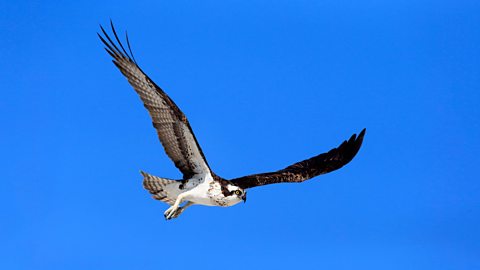
The speaker in this poem recalls a dangerous journey. The speaker in Ospreys also reflects on a journey: the changes and fluctuations of the birds’ very long journey from Senegal to Scotland. While some of the dangers in Crossing the Loch are imagined or at worst potential, the dangers in Ospreys (blizzards, winds, road traffic) are all too real.
Many of Jamie's poems consider the relationship between people and nature. For example, the human wonder for the natural world in Crossing the Loch is also conveyed in Ospreys. The speaker in Ospreys admires the birds for their constancy in returning to their habitual breeding ground. The final sense of relief in both poems display a similar note of praise for the glories of nature. The locals have waited and hoped for (and been rewarded by) the safe return of the ospreys, just as the speaker in Crossing the Loch is grateful for a safe arrival at journey’s end.
This relationship between people and nature is also explored in What the Clyde said, after COP26, particularly the damaging impact that human carelessness has on nature. This poem suggests that any relationship between humans and nature is strained:
If asked - but you never ask - / I’d answer in tongues
The fact that the Clyde would “answer in tongues” suggests that communication is difficult; they are not speaking a common language. On the other hand, the water in Crossing the Loch is personified in a way that suggests the loch is inviting the boat and the people towards it (“lipped the sides” and “mouthed ‘boat’”). Despite its attempt, the people are “scared”, “not reassured”, and “astonished” by nature, suggesting an estranged relationship. It may be a relationship full of awe and wonder, but it is not familiar or comfortable.
Likewise, Mr and Mrs Scotland are Dead considers that humans have lost a relationship and closeness with nature that they once had:
those days when he knew intimately / the thin roads of his country, hedgerows / hanged with small black brambles' hearts;
This line paints a nostalgic picture of rural Scotland and connects the character of Mr Scotland to the land. The poem suggests that this close relationship between humanity and nature has been lost in a more individualistic society. Both Crossing the Loch and Mr and Mrs Scotland are Dead also use beautiful, almost whimsical, imagery to talk about nature. The “small black brambles' hearts” from Mr and Mrs Scotland are Dead are similar to the “salt-air and stars” or “dark-starred by blaeberries” in this poem.
Crossing the Loch and Song of Sunday are both rich in personal memory, evoking moments from youth and family life. Song of Sunday looks back at a child’s memory of the routine of life in an ordinary home on a Sunday, whereas Crossing the Loch looks back to a moment in the speaker's youth. In both poems it is a past which is only now a memory.
In contrast, The Morrow-bird deals with a vision of the past, but it is vast: one of the earth forming and the history of mankind, to herald a view of the future, and what it will look like if we do not act. The reflection here is not a personal memory, but the whole evolution of how we came to be here.
Revise Crossing the Loch by Kathleen Jamie
Revise Crossing the Loch and other poems by Kathleen Jamie with interactive quizzes for Higher English.
Quizzes - Kathleen Jamie. quiz
Test your understanding of set texts by Kathleen Jamie with a series of interactive quizzes for National 5 English.

More on Kathleen Jamie
Find out more by working through a topic
- count2 of 7
- count3 of 7
- count4 of 7
- count5 of 7