Overview of Mr and Mrs Scotland Are Dead
- Mr and Mrs Scotland Are Dead describes Kathleen Jamie’s visit to a landfill site (a 'dump' or a 'tip').
- There she discovers an assortment of discarded items which relate to the lives of the now dead owners, whose surname conjures up both individual citizens and an entire nation.
- The speaker, a Ordinary, everyday language and dialect.“we”, debates whether to save these items which will then be thrown out by some future person or leave them to reflect the end of a particular era.
The poem explores themes of:
- memory
- identity and cultural change
- environmental harm
Kathleen Jamie has said:
'Mr and Mrs Scotland Are Dead' concerns things I found on a local dump – where I shouldn’t have been because one’s not allowed to play on the dump but I’m a grown-up woman and I can go there if I want. I found a lot of personal effects and of course I couldn’t resist but look at them, and there were letters, cards and what have you – and they were addressed to “Mr and Mrs Scotland” and I thought, “Thank you God.”
This is a state of the nation poem if you like.
(Source: The Poetry Archive)
Looking for some quick revision? Try one of the interactive Kathleen Jamie quizzes for Higher English.
You can read Mr and Mrs Scotland Are Dead by Kathleen Jamie on the Scottish Poetry Library website.
Form and structure of Mr and Mrs Scotland Are Dead
Mr and Mrs Scotland Are Dead is divided into three sections of slightly decreasing length:
- thirteen lines
- twelve lines
- eleven lines
It is written in the form of a When a character speaks for an extended period of time, revealing thoughts, feelings, and motivations to another character or the audience., in which Jamie uses clipped A line of poetry that has four metric feet or beats in it. to give stability before turning to Poetry that doesn't have an intentional rhythm or rhyme, but instead can sound more like speech.
Section one
The setting is the landfill site, where the speaker finds unwanted objects that recall life in mid-twentieth century Scotland. Messages on postcards from popular Scottish destinations tell of a past that has gone, as have the now dead couple of they are addressed to, Mr and Mrs Scotland.
Section two
The speaker starts to question why these discarded objects could not have been burnt rather than dumped. The selected items seem to have served their purpose and no longer have any potential use. They indicate specific points in Mr and Mrs Scotland’s lives which became no longer relevant as time passed.
Section three
The speaker is uncertain what to do and asks four questions about whether to salvage these discarded items or leave them to be destroyed. They acknowledge that saving these objects is perhaps only postponing their destruction, leaving that job for someone else to deal with once the speaker themselves has died.
Section one
 Image source, Mark Boulton / Alamy
Mr and Mrs Scotland Are Dead opens in the bleak setting of the formally named “civic amenity landfill site”.
The melancholy of the opening lines gain their emphasis from the use of the Scots word “coup” for tip and “the dump beyond the cemetery”. This both compares the discarded objects with their dead owners, and implies a state beyond death. The collection of discarded objects which belonged to the couple in the title are beyond recovery. There is a vivid image created in the inanimate “old ladies’ bag” juxtaposed to the personified “open mouthed, spew”.
her stiff / old ladies' bags, open mouthed, spew
The time setting of the postcards (1960) and the towns (Peebles, Largs and Carnoustie) are suggestive of an age which has passed. Whatever glamour there may have been, from the “tinted” colouring applied to the cards, has been obliterated by the “dirt” of the dump.
There is a fatalistic quality to the line:
Mr and Mrs Scotland, here is the hand you were dealt.
The fragments, still legible from the postcards, are written in italics and are bland and ordinary in their references to:
- the weather - “fair but cool, showery”
- the surroundings - “the lovely scenery”
- a local Peebles beauty contest - “The Beltane Queen was crowned today.”
- inquiries after the recipient’s wellbeing - “Jean asks kindly”
The final line of this section leaves no room for doubt, and the opening “But” makes clear that there is no going back to the world of Mr and Mrs Scotland.
But Mr and Mrs Scotland are dead.
Image source, Mark Boulton / AlamySection two
The speaker begins to question why these items were not destroyed rather than taken to landfill:
Couldn't he have burned them?
The A question that doesn't need an answer and is asked for dramatic effect or to make a point. hints at the speaker's disbelief at the undignified ending for the postcards. This suggests that perhaps even destruction by fire would be preferred to lying amongst the rubbish in the landfill. The image of burning can be compared to cremation, just as the landfill has been compared to burial in a cemetery. The mention of the objects being “released” suggests this quick destruction would be cleaner and better than being left to rot, as the idea of decay is clear in the “sweet-stinking anorak”.
There is a sense of lack of care in the “tossed” and “toppled” amidst a hotchpotch of clothing, domestic appliances and reference books which are probably no longer relevant in a world which has moved on. The people who owned these items, and the items themselves are relics of the past that society appears to have discarded.
tossed between a toppled fridge / and sweet-stinking anorak
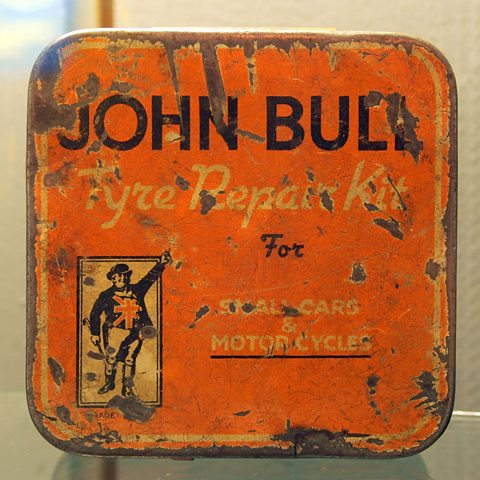 Image source, Alamy Images
The use of run-on lines creates audible interest:
this pattern for a cable knit […] Dictionary for Mothers […] John Bull Puncture Repair Kit
The list evokes a bygone age of domesticity and traditional gender roles:
- the “cable knit pattern” suggests homemaking, care, and craft, and a time where people often made their own clothes
- the “Dictionary for Mothers” is symbolic of maternal anxiety and responsibility
- “Mr Scotland's John Bull Puncture Repair Kit” represents a stereotypical masculine practicality, but also gives us an interesting contrast, placing the word “Scotland” directly next to “John Bull” a traditional personification of England.
There is also a remembrance of a Scottish past, where:
- Mrs Scotland sought advice from a dictionary rather than the internet
- Mr Scotland was a skilled worker with his own tools in a world before society became increasingly technological
Image source, Alamy ImagesA close connection to the countryside and the world of nature has also disappeared:
those days when he knew intimately / the thin roads of his country, hedgerows / hanged with small black brambles' hearts;
This line is nostalgic and paints a vivid picture of rural Scotland, connecting Mr Scotland to the land. The “brambles’ hearts” metaphor, alongside the word choice “intimately”, suggests a tender, almost romantic connection to nature.
As this section ends, there is a sense that there is a sorrow for a way of life which has gone.
SCOTLAND, SCOTLAND, stamped on their tired handles.
The tools with “their tired handles” are symbolic of the nation's industrial past, when products made in Scotland were shipped all round the world. The word choice “tired”, in particular, suggest a lack of vitality and youthfulness. These items no longer have a place in modern society. The capitalised repetition of “SCOTLAND SCOTLAND” represents so much more than one couple’s passing. This whole way of life, the society and country that they knew and represent, is no more.
Video - What is a rhetorical question?
The speaker uses rhetorical questions like "Couldn't he have burned them?" throughout Mr and Mrs Scotland Are Dead to encourage the reader to consider the past and its role in the present.
Brush up on your understanding of rhetorical questions and why writers use them with this short Higher English revision video.
What is a rhetorical question? How and why would you use it?
Rhetorical questions
A question that is asked to make a point rather than to get an answer.
If you’ve ever been home late, you might have been met with this rhetorical question:
"What time do you call this?”
The person asking doesn’t really want an answer.
They’re making a point that you’ve arrived home at an unacceptable time.
Rhetorical questions can also be persuasive.
"Who wouldn’t want to be a millionaire?”
This rhetorical question assumes that money is attractive and that it would be unusual not to want it.
Rhetorical questions can draw readers in, by encouraging them to think in more detail about the wider points being made by the writer.
In 'The Crucible', Arthur Miller explores the Salem witch trials where many innocent people were accused of witchcraft.
The character Proctor cries out in court:
“Is the accuser always holy now? Were they born this morning as clean as God’s fingers?”
It is obvious that the accusers aren’t completely holy, that they haven’t just been born and they aren’t completely clean and without sin.
His unanswerable questions are designed to make those listening at the trial - and the reader - question the nature of hypocrisy.
Rhetorical questions can make a point, persuade, and express disbelief.
So, why not use them yourself?
Section three
The four simple opening words of this section encapsulates the speaker’s dilemma:
Do we take them?
The speaker, again, reflects on the value of the items and there is a sense of shame in leaving them in the landfill. They wonder if they should take them “before the bulldozer comes”.
There is an obvious disparity between the size of the bulldozer and the tiny personal effects of “his shaving brush, her button tin”. But there is also a gap between the machine built for work and the small intimate items, used daily, that make up a home. The brutality of the destruction is highlighted in the brusque “shove aside”.
Do we save this toolbox, these old-fashioned views”
The speaker acknowledges the difficulty in deciding on a course of action in calling with honesty the views “old-fashioned”. The mementos they consider taking aren’t just the belongings of people who have died, they are symbols of a whole society. The toolbox can represent how we used to live; “old-fashioned views” reflects past attitudes and opinions. The speaker is questioning whether to try and hold onto the past when the world has moved on.
And then?
The poem ends with the speaker’s frank assessment of what will happen if we try and salvage the objects and way of life they represent. They look to a future where all that has happened to the artefacts is that they’ve been left as unwanted junk in “kitchen drawers”. One day it will be left to someone else - “that person” - to do the “sweeping up, the turning out”, repeating the process of discarding unwanted items. It seems inevitable that they must one day be discarded. Is the speaker suggesting it might as well be now?
There is a return to the melancholy of the opening in that this job will one day be done without care or feeling – “this perfunctory rite”.
What are the themes in Mr and Mrs Scotland Are Dead?
Memory and reflection
Mr and Mrs Scotland are Dead is steeped in both personal and collective memory.
Jamie evokes the lives of a Scottish couple (Mr and Mrs Scotland) through intimate, discarded objects found in a landfill: knitting patterns, repair kits, tools, and domestic manuals. These items are not just remnants of individual lives but symbols of a bygone age: the habits, values, and routines of a previous generation.
While the speaker’s tone suggests reverence and melancholy, there is also a hard honesty in the descriptions that shows a realisation that these objects no longer have a place. The speaker reflects on whether these memories deserve preservation:
Do we take them?
The landfill becomes a metaphorical graveyard (emphasised by the inclusion of “the cemetery”) where memories are buried under consumer waste.
Identity and cultural change
Jamie uses the personal identities of Mr and Mrs Scotland to explore changing national and cultural identity.
In the possessions discarded at the landfill site, a picture emerges of the lifestyle of an ordinary Scottish couple who lived in the middle of the twentieth century. It is a time which has passed – a time when holidays were to local destinations, a time when the pastimes of knitting, sewing, country cycles and personal joiners’ tools were part of the everyday fabric of Scottish life. The landfill is symbolic of how modern society discards not only objects but also traditions, values, and ways of life. But there is also a realisation that change must happen and that sometimes we must give up the past, that quickly destroying old ways (“old-fashioned views”) might bring “release”.
“Mr and Mrs Scotland” are symbolic figures, representing a traditional Scottish identity rooted in craftsmanship, domestic life, and connection to the land.
In this way, the poem captures a moment of cultural transition. The landfill is symbolic of how modern society discards not only objects but also traditions, values, and ways of life.
Do we save this toolbox, these old-fashioned views / addressed, after all, to Mr and Mrs Scotland?
Environmental harm
The setting (a landfill) is central to the poem’s environmental message. It is, by definition, a place of decay, excess, and neglect, where even cherished belongings are reduced to waste. The imagery of “grey curl of smoke” and “sweet-stinking anorak” suggests pollution and rot, reinforcing the theme of environmental harm.
Kathleen Jamie contemplates the pollution caused by the dumping of these objects on the tip rather than destroying them.
It is difficult to see the value in their being kept except as a snapshot of a bygone age. This leads to a contemplation of the human tendency to hoard, and the cycle begins again when someone (after our deaths) has to discard the objects we have kept.
Comparing Mr and Mrs Scotland to other Kathleen Jamie poems
Song of Sunday can be compared to this poem as both poems look back to a Scotland of the past. In Mr and Mrs Scotland Are Dead it is through the objects which have been thrown away that there is a picture of the past in Scotland. In Song of Sunday the monotonous routine followed every Sunday in Scotland through the eyes of a child captures domestic life in the past – a past which no longer exists.
In both poems, the past is critiqued as "driech" and "loveless", or "old-fashioned", better to have been "released" by burning. Neither poem is romantic about the past. There is a sense that we should let go of the past and strive to do something better.
The reflection on potential environmental harm caused by the dumping of unwanted items in landfill in this poem can also be seen in The Morrow-bird and What the Clyde said, after COP26. There is a concern in all three poems with what the future may hold, if we do not act responsibly and think about the best interests of the planet.
This poem can also be linked to Crossing the Loch as they both explore the theme of memory and the passing of time. In Mr and Mrs Scotland Are Dead, personal and cultural memory is evoked through the discarded domestic items found in a landfill (postcards, tools, knitting patterns). These objects speak to a vanished way of life and the speaker reflects on their value in society. In Crossing the Loch, the speaker recalls a youthful, possibly reckless, journey across a loch, now viewed through the lens of adult reflection and gratitude for survival. In both poems, the speakers use rhetorical questions to invite the reader to contemplate the past and its role in the present.
Like Mr and Mrs Scotland Are Dead, the poem Ospreys reflects on the connection between people and nature. This poem reflects on the closeness between humanity and nature in a less individualistic society:
those days when he knew intimately / the thin roads of his country, hedgerows / hanged with small black brambles' hearts;
While this relationship has ended following Mr Scotland's death, the locals in Ospreys seem to have retained a closeness with nature as they anticipate and then celebrate the return of the ospreys. There is a clear note of admiration in the speaker’s voice as the ospreys’ journey and arrival is described. There is further connection through the objects collected over Mr and Mrs Scotland's lives, and the "sticks and fishbones" that the ospreys will reuse to rebuild their nests.
Revise Mr and Mrs Scotland Are Dead by Kathleen Jamie
Revise Mr and Mrs Scotland Are Dead and other poems by Kathleen Jamie with interactive quizzes for Higher English.
Quizzes - Kathleen Jamie. quiz
Test your understanding of set texts by Kathleen Jamie with a series of interactive quizzes for National 5 English.

More on Kathleen Jamie
Find out more by working through a topic
- count4 of 7

- count5 of 7

- count6 of 7

- count7 of 7