Overview of Song of Sunday by Kathleen Jamie
- Song on Sunday by Kathleen Jamie focuses on a typical Sunday in Scotland, as Jamie remembers it from her childhood.
- The speaker in the poem recalls a day of unending tedium, where the same rituals are performed unfailingly every Sunday.
- The monotonous retelling of the speaker's day is broken up with a reimagining of Sleeping Beauty.
The poem looks at themes of:
- memory and reflection
- ordinary life and domesticity
Looking for some quick revision? Try one of the interactive Kathleen Jamie quizzes for Higher English.
You can read Song of Sunday by Kathleen Jamie on the Scottish Poetry Library website.
Form and structure in Song of Sunday
Song of Sunday is divided into three unequal sections of eleven, eighteen and fifteen lines.
There are many run-on lines (When the sentence runs onto the next line instead of neatly finishing at the end with a full stop or comma, occurs a few times in the poem. One such example is in lines two, three and four, when she refers to “the depth and breadth and height/ My soul can reach when feeling out of sight/ for the ends…” – it is as if the love she describes is so vast it cannot be neatly contained by the structure of the lines, instead bursting forth and spilling onto the next line.), mostly written in Poetry that doesn't have an intentional rhythm or rhyme, but instead can sound more like speech with an occasional rhyme towards the end.
Section one
The poem opens with an immediate reference to the bleakness of the “driech” day. There is a sense that the speaker goes through the same routine every Sunday. There is the preparation in the morning for the soup, while the speaker carefully follows advice given while sorting her stamps to be added to her collection.
Section two
Almost like the chorus of a song, the speaker recalls the female preparations for the Sunday roast. The lines oscillate as the speaker italicises an imagined scenario, where there is an accident with a paring knife and the scene is paused. The father is remembered having a Sunday rest, while the young sister plays dolls with a neighbouring child. As in a fairy-tale, the speaker sees the family as if they are trapped in a spell and imagines that if she could travel back in time she would wake them with a kiss.
Section three
The preparations being complete, the family meal is eaten. Sunday television is watched. The speaker returns to her stamps, which are now ready to be inserted in her album. After assigning more unusual stamps, she turns to those of Great Britain. She tends this patch in her album with great care, as instructed. The neat, orderly day comes to a predictable conclusion with the insertion of the uniform stamps, and the call to bed.
Section one
The opening line provides a bleak picture of a Scottish Sunday:
A dreich day, and nothing to do / bar watch starlings fluchter
It is clear that the “Song” of the title is more a A heartfelt expression of sorrow, usually in verse or song., than anything joyful. The use of the Scots words “dreich” (dreary, bleak) and “fluchter” (flutter, flap) help to firmly establish the Scottish setting. The song begins with the passive role of spectator observing starlings, which, in contrast to the human, are getting excited “over soup bones” left out for them.
All forenoon broth-barley, marrowfat peas / swelled in a kitchen jug
The slow passage of time is indicated in the words “All forenoon”, where the only action is the slow chemical reaction of the soup ingredients (“swelled”).
The speaker is performing the parallel action of soaking stamps. The envelopes, in keeping with the sedateness of the day, are Personification is when a writer gives human characteristics to something that isn’t human. as “polite”. The The repeated use of the ‘s’ sound in the beginning, middle or end of nearby words. of “soggy” and “stuck” suggest a stagnant state in keeping with the lethargy of Sunday:
neither soggy nor stuck
The child is warned to take care with the Ordinary, everyday language and dialect.:
watch and not tear them, wait at peace.
It is a day for quiet activities and having to be patient as the time passes slowly. The thought of a "tear" in a stamp seems symbolic of a desire for nothing to go wrong, or possibly for anything out of the ordinary to happen.
Section two
In the second section of the poem, Jamie uses shorter lines and indentation, which visually breaks the stanza into fragments. This fragmentary layout and lack of punctuation mimics An uninterrupted flow of a character’s thoughts.. The shorter lines of the chorus convey the unvarying weekly routine of a Sunday. The conversational tone captures the speaker’s voice in short flow-on lines, also known as The use of run on sentences with no punctuation at the end of lines or across stanzas..
The opening makes clear that every Sunday was exactly the same:
There’d aye be women / In the kitchen,
“Aye” is a Scots word for “always”. This suggests that the women do exactly the same kitchen chores on Sunday each week.
The meat and the “tatties” are subjected to cruel and thoughtless rituals:
tatties / peeled lovelessly, blinded / pale and drowned.
The speaker Personification is when a writer gives human characteristics to something that isn’t human. the potatoes and suggests there is no joy in the tasks but rather a kind of mindless punishment. The speaker seems to subtly criticise the traditional roles assigned to women at this time, as well as suggesting this weekly ritual of preparing a meal for the family is something to be got through and endured, rather than a genuine reflection of care and love.
With the introduction of italics, the speaker begins to imagine a modern retelling of Sleeping Beauty that takes place on an ordinary Sunday (an A quick reference - often to an image, character or place - from a work of literature or music or mythology.). However, instead of pricking her finger on a spinning wheel, the speaker imagines that one of the women:
nicked herself / with a paring knife
A spell is cast and “the house froze”. The speaker suggests that the household are unconscious, trapped within their Sunday routine. But like the prince in the original story, the girl comes to the rescue in dramatic fashion
hacking back in / through privet and rowan
The choice of shrub and tree is significant. The privet, used for hedges, marks off boundaries. The rowan is steeped in folklore and has long been believed to have protective magical properties.
In keeping with the drowsy nature of the day, the father is “mid stretch and yawn”, while the young sister is innocently playing dolls with the girl next door.
The speaker wonders if, as in the fairy-tale, she could wake them with a kiss:
with something alien / and lovely / as a kiss.
There is a striking use of the juxtaposition with contrasting adjectives (“alien” and “lovely”) to describe the kiss. “Alien” implies unfamiliarity and otherness meanwhile “lovely” suggests beauty and tenderness. This gesture of genuine feeling is contrasted with the ""loveless"* routine of the day.
The imagined incident is set within a clear sense of time and the present – “aye”, “now” and “only now”. This song belongs firmly within the framework of so many remembered Sundays.
Video - What is allusion?
The imagined scene in section two is an allusion to the fairy tale Sleeping Beauty. A small injury is followed by an enchanted sleep, which is only broken by something as "lovely / as a kiss."
Revise what allusion is and how writers use it with this short Higher English revision video.
What is allusion? How and why would you use it?
Allusion
Hinting at or making an indirect reference to a well-known person, place, event or idea.
A lot of the time, allusions refer to another piece of writing.
“When it came to spending money, he was a total Scrooge.”
Scrooge is a rich banker in Charles Dickens’ novel, A Christmas Carol.
He’s well known for being stingy with his money.
So, describing someone as a ‘total Scrooge’ alludes to the idea that they’re overly careful with their cash.
“She had so much homework, but the football tempted her from the garden - a forbidden fruit”
Can you figure out the allusion?
This is a reference to the forbidden fruit that Adam and Eve are tempted to eat in the Garden of Eden.
Here, the football is a very tempting distraction from homework.
You’ll find a lot of allusion that points to the Bible, or to legends and mythology.
Biblical allusion is also used by Norman MacCaig in his poem ‘Assisi’.
"A rush of tourists, clucking contentedly, fluttered after him as he scattered the grain of the Word.”
A group of tourists follow a priest who preaches the Gospel, but they all ignore a beggar who sits on the church steps.
“Grain of the Word” is an allusion to the Parable of the Sower, a story in which Jesus encourages the spreading of the word of God like you might scatter seeds.
Some seeds will grow into something great, but some land on infertile ground and don’t grow.
MacCaig’s allusion is deliberately ironic.
It implies that the true meaning of the gospel is lost on the tourists as they ignore the beggar.
Now you understand allusion, it can never be your Achilles Heel – your weakness.
Section three
The use of the rhyme in the opening two lines (“eat”, “meat”) matches the regular pattern of each Sunday:
and we’d be called to eat / what’s put in front of us: potatoes, meat
Everything is regimented, from the compulsory eating of the food to the permission needed to leave the table. Nothing varies from one Sunday to the next with the same wildlife and religious worship on television. As with the food, there is no choice - all there is to watch is what is put in front of you.
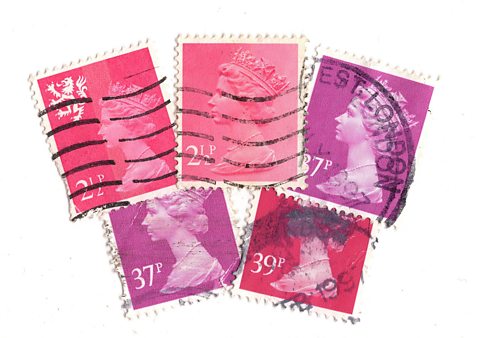 Image source, Alamy Images
My stamps were dry
The speaker’s day returns to the stamps now ready to be inserted in the album. The "dry" stamps is both literal and symbolic - it suggests the stamps are dull and lifeless, as if they lack moisture or life. An occasional example from abroad (USA or "Magyar Poste" (Hungarian Post Office)) is seen as "exotic" amongst the many stamps from home. There is a suggestion that in other parts of the world life is more exciting and colourful, while UK stamps, like the "tuppenny-ha’penny pinks" are ordinary, standard, and uniform. However there is a certain pride in “the wee lion / rampant in a corner” to indicate Scotland (the Royal Banner of the Royal Arms of Scotland is known as the 'Lion Rampant').
Duty still calls in the form of homework before she turns her attention to placing her UK stamps in her album. She turns to the ‘Great Britain’ page of the collection. The quotation marks in the poem may indicate a distancing from this description and title. The sense of disconnection is also suggested by turning to the page "as I was shown". As with the other activities of the day, the speaker seems to be going through the motions, with no other choices available.
fold and align the edges / with the orderly squares.
The sense of neatness matches other phrases like "polite", "at peace" which have described the day. Everything is subdued and organised, with no sense of energy or passion. The act of placing the stamps so carefully in their album implies a certainty in the past which may look rather outdated as the poet looks back.
The three one-word sentences give a brisk ending to the poem – a Sunday is a day the speaker is pleased to have finished:
Press. ‘Bedtime!’ There.
The parental instruction “Bedtime!” comes as a relief. There is a finality about the last word “There.” which shows that, like the stamp album, the speaker's memory of the day is complete. Like a story or a spell, there is a sense that the speaker is glad the day, and the past it represents, is over.
Image source, Alamy ImagesWhat are the themes in Song of Sunday?
Memory and reflection
In this A poem in which the speaker addresses the reader directly. A dramatic monologue usually involves a fictional speaker who may not necessarily speak the views of the poet., the speaker looks back on the Sundays of their childhood, which always took exactly the same form. Using the dramatic monologue form allows Jamie to explore this personal memory of the speaker and create a confessional tone. Intimacy is very important in this poem as the scene is so domestic, the rituals are mundane but they are preserved with clarity and described with care.
The title refers to a song, which contributes to the idea of the events being remembered and immortalised in a song or a ballad.
The fairy tale nature of the italicised central portion of the poem is also reminiscent of the stories we all know from childhood.
and spellbound, the house froze –
The poem begins and ends with references to Sunday routines, creating a circular structure. This structure adds to the overall impression of the way our memory of events works, reinforcing the idea of ritual and repetition.
Ordinary life and domesticity
 Image source, Alamy Images
The preparations for the Sunday meal take exactly the same form each week.
There’d aye be women / In the kitchen,
This plays an important part in the song of the title which acts as a kind of refrain and reinforces the repetitive nature of life for this young girl in this domestic setting. The speaker does not portray domesticity as idyllic and warm, but as emotionally detached. The potatoes are “peeled lovelessly,” and the women’s presence in the kitchen is habitual rather than joyful.
The poem subtly critiques traditional gender roles. The women are “aye” confined to the kitchen, performing repetitive tasks. These tasks are associated with words like “lashed”, “lovelessly”, and “blinded pale”. Meanwhile the father is caught “mid stretch and yawn,” and the speaker's younger sister plays with dolls.
The allusion to Sleeping Beauty is interesting as fairy tales typically follow very traditional gender stereotypes. In this poem, the speaker subverts the traditional roles, it is not the typical prince that is imagined coming to the rescue. The poem also links women's confinement to domestic chores to pain/discomfort. Instead of a spinning wheel, the woman “nicked herself / with a paring knife”.
The line “spellbound, the house froze” captures a moment of suspended domestic life. The speaker’s desire to “wake them / with something alien / and lovely / as a kiss” implies a yearning to disrupt or transcend these patterns. The narrator revisits the domestic scenes of their childhood in detail but does not romanticise them. There’s a tension between the familiar (the “lovely”“kiss”) and the unknown (“alien”), between the comfort of routine and the desire for an imaginative escape outside the confines of domestic monotony.
The preparation of the stamps mirrors the food preparations. The actions are merely going through the motions of what has been shown and the result is neat and standardised, "dry" and uninteresting. Finishing the task brings a sense of completion in the last section of the poem, suggesting the speaker has moved on from this type of Sunday.
Image source, Alamy ImagesComparing Song of Sunday to other Kathleen Jamie poems
Song of Sunday looks back at a child’s routine of life in an ordinary home on a Sunday. Similarly, Mr and Mrs Scotland Are Dead looks back to a traditional Scottish past. Both poems share a similar domestic feel through the activities carried out in one and the objects discarded in the other. In both poems, the past is critiqued as "driech" and "loveless", or "old-fashioned", better to have been "released" by burning.
The everyday objects found on the landfill site are a reminder of an ordinary domestic life lived by the characters Mr and Mrs Scotland. Similarly, the Sunday routine of the stamp collection and the preparations for exactly the same meal every week tell of an unvarying routine.
Jamie's poem Crossing the Loch is also a recollection of youth:
Remember how we rowed toward the cottage / on the sickle-shaped bay…
Both poems are rich in personal memory, recalling moments from the speaker's youth. However, in Crossing the Loch, there is a feeling of fond nostalgia and adventure, whereas the tone in Song of Sunday is more emotionally detached, perhaps sharing the understanding of how monotonous children can find an uneventful day.
The Morrow-bird and What the Clyde said, after COP26 are also poems which reflect on the past, but they take on a wider, more universal point of view of history, rather than the domestic or personal view that we see in Song of Sunday.
The Morrow-bird starts with the powerful image of a glacier and ends in the present chamber of the Scottish Parliament. It emphasises that all things pass and change, but the bird's stark vision of the future needs to be addressed with action. Similarly, the Clyde in What the Clyde said, after COP26? looks back fondly on the successful days of the past, when it was the site of a world-leading shipbuilding industry, and considers all the changes that it has seen throughout history.
There is a similar sense of regret in the past in What the Clyde said after COP-26 and The Morrow-Bird, although the scope of these poems is national or global, rather than domestic, and the regret is about environmental damage, rather than small, contained lives and opinions that perhaps did not fulfil emotional or some other potential.
Song of Sunday can also be linked to Ospreys as they both view seemingly ordinary events through an extraordinary lens. In Song of Sunday, the speaker turns the monotonous preparations of the Sunday meal into a fantastical fairy tale. In Ospreys, the birds migrate every year so in some ways, it is a completely normal occurrence, but the speaker celebrates this journey with awe and wonder.
Revise Song of Sunday by Kathleen Jamie
Revise Song of Sunday and other poems by Kathleen Jamie with interactive quizzes for Higher English.
Quizzes - Kathleen Jamie. quiz
Test your understanding of set texts by Kathleen Jamie with a series of interactive quizzes for National 5 English.

More on Kathleen Jamie
Find out more by working through a topic
- count6 of 7

- count7 of 7

- count1 of 7

- count2 of 7