Overview of Ospreys by Kathleen Jamie
- Ospreys by Kathleen Jamie is a poem about birds returning to Scotland, showing how nature comes back year after year.
- The speaker, like many other locals, has eagerly awaited the return of the ospreys from Senegal to their nest in Scotland.
- There is a clear affection for these birds, as the speaker uses a familiar Ordinary, everyday language and dialect. manner to welcome them back.
The poem explores themes of resilience and the wonder of nature.
You can read Ospreys by Kathleen Jamie on the Scottish Poetry Library website.
What is an osprey?
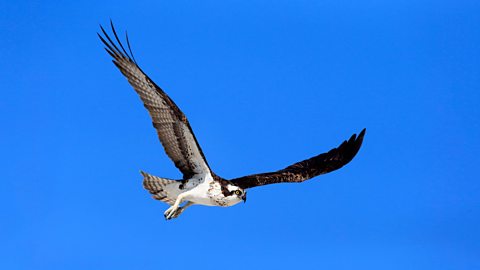 Image source, Alamy Images
- Ospreys are spectacular fish-eating birds of prey.
- They are migratory birds that spend winter in Africa before travelling to Scotland or other parts of Europe where they breed and raise chicks between March and September.
- Ospreys tend to breed for life, although the male and female migrate separately.
- They became extinct in Scotland in the early 20th Century, through a combination of hunting, loss of habitat, and the impact of pesticides.
- They first returned to Scotland in the 1950s. The first pair bred again successfully in the 1970s and since then numbers have grown
More to learn
Image source, Alamy ImagesForm and structure of Ospreys
Ospreys by Kathleen Jamie is part of a A fourteen-line poem, usually with ten syllables in each line. sequence called Five Tay Sonnets.
The poem has a varied and uneven rhythm, with use of A break in poetic rhythm in the middle of the line: a momentary pause. through one long opening sentence showing the journey of the birds. The final stanza ends with an address to the birds from the speaker and the local people.
There is a broken line in the third stanza, which gives the impression of the poem being fifteen lines rather than the usual fourteen. It can be read in this way; we would call this an A sonnet that intentionally breaks traditional rules for effect.. However, we can also interpret from the layout (the line break is also indented) that the line itself is "half toppled away". This is a device to mirror and highlight this phrase in the poem. We are also told it is a sonnet by its inclusion in Jamie's sequence (Five Tay Sonnets).
The poem is divided into four sections.
Stanza one
In the opening three lines, the speaker addresses the ospreys immediately and directly. The speaker comments on the difficult journey which the birds have experienced from Senegal to make it to Scotland.
Stanza two
These two lines are a A section of a poem which appears incomplete or detached. It may evoke discontinuity, ambiguity, or emotion. which chronicle the last stage of the journey before the ospreys’ arrival at their destination.
Stanza three
Here the speaker describes the exact setting of the nest to which the ospreys are returning. Jamie draws a comparison between the nesting site and the weather-beaten condition of the local humans. The layout of the poem here also reflects the rickety nature of the nest, and the people.
Stanza four
In the final six lines, the speaker encourages the ospreys to settle back in, make themselves at home and be only concerned about themselves. Meanwhile, the local population are delighted that the ospreys have returned.
Stanza one
In the opening lines, the speaker addresses the ospreys directly in a Ordinary, everyday language and dialect. manner:
You'll be wondering why you bothered:
The opening words give the sense of the birds’ journey having been more trouble than it was worth. Imbuing the ospreys with a human mentality allows the reader to identify with the birds from the start. The use of the colon sets up the long description of the hazards of the flight.
beating / up from Senegal, just to hit a teuchit storm
The use of the words “beating up” conveys the violent nature of the crossing which the ospreys have made. This difficulty is then compounded by “just to hit”. This suggests the birds are facing a fight or a battle. The word “beating” also reflects the beating of wings and the sense of overcoming a challenge.
The violent descriptions are followed by the list of weather disasters:
just to hit a teuchit storm - / late March blizzards and raw winds - before the tilt
“a teuchit storm” is a Scots phrase for a period of bleak wintry weather. The harshness of the combination of consonants and vowels in “teuchit” produces a glottal stop in keeping with the severity of the conditions described. The run-on line between the end of this section and the start of the next captures the force of the “tilt” involved in the birds’ flight.
The word “tilt” can also be seen to continue the imagery of battle. It suggests charging into combat (this term was used in jousting) as well as the bird literally tilting to change direction and head away from the line of the A9.
This poem is full of movement and Jamie uses her line breaks deftly to convey this.
Video - What is word choice?
Considering word choice is an important part of analysing any piece of writing. In the first section of Ospreys, Jamie uses words like “beating up”, “a teuchit storm” and “tilt” to emphasise the difficult nature of the birds' crossing.
Brush up on your understanding of word choice and its impact with this short Higher English revision video.
What is word choice? Why is it important?
Word choice can have a massive impact on your writing.
Words are like ingredients: even a small change in the recipe can affect the finished dish.
"They had a warm laugh"
But what if "they had a hearty laugh"?
Even though these sentences pretty much tell us the same thing, the words have different effects.
‘Warm’ suggests the laugh is friendly.
‘Hearty’ suggests it is wholesome, passionate and sincere.
When you choose a word you need to think about its denotation.
That's what it literally means.
But you should also think about its connotations - ideas or feelings that the word might suggest or hint at.
"Feeling dizzy, she slid her hand along her head"
This just tells us what happened. But what if:
"Feeling dizzy, she slid her hand along her skull”
The skull is the bone structure in your head. This is the denotation - what it definitely is.
But the connotations of skull are fear, mortality and even death.
These connotations suggest that the dizziness she is experiencing is serious.
In the poem 'The Circle’, Don Patterson watches his son painting the planets in the solar system.
“He draws around his upturned cup, his hand shakes, and he screws it up.”
Patterson could have easily written “he messes it up” but “screws it up” is a far more interesting choice.
These words are really informal compared to his word choice in the rest of the poem.
This helps him capture the reality and rawness of a young boy’s frustration.
At the same time, “screw” suggests a circular motion, another reference to circular shapes within the poem.
It also suggests scrunching up paper and throwing it away.
Word choice is a really important part of writing.
It’s an invaluable part of writing.
It’s crucial!
Stanza two
In the middle of this long opening sentence (over three stanzas), these fragmentary, punctuated two lines give a sense of a list of directional instructions in short phrases as the mating ospreys make it back to their previous nest. Each segment adds a little more to the long sentence which mirrors the birds’ long flight.
across the A9, to arrive, mere /hours apart, at the self-same riverside
The feat of arrival “mere hours apart” of the two ospreys is highlighted further by the emphatic “self-same”, boldly alliterative and with two stressed syllables, to convey the magnificence of their experience.
Stanza three
As this very long sentence continues, the opening “Scots pine” draws emphasis to the ospreys’ destination:
Scots pine, and possess again the sticks and fishbones
The use of the verb “possess” conveys clearly the birds’ dominance and power, while “the sticks and fishbones/of last year’s nest” give the sense of continuity which their return provides.
Likewise, the phrase “still here” suggests the continuity of the nest used by the birds year after year. “Pretty much” continues the friendly, colloquial tone. However, it brings a sense of the nest having struggled through another winter, having aged and not being quite what it once was.
The poet’s comparison of the weather-beaten state of the nest to the state of the humans helps to explain why the poet feels we can identify so closely with the ospreys. The compound adjectives, combining When a word sounds like the word it is describing. For example, ‘buzz’ or ‘hiss’. and A sound feature; the repetition of the same sounds (mainly consonants) usually at the beginning of words., “gale-battered, winter-worn”, increase our admiration for the task ahead.
like the rest of us - gale-battered, winter-worn,
The line is broken here, with its concluding The omission of a word or words usually indicated by three dots. capturing the precarious state of the nest:
half toppled away…
This phrase suggests the battered nest that is only just hanging together. It also echoes the previous emphasis of the word “tilt” at the end of the opening stanza, highlighting the uneven movement of the birds.
Stanza four
This section opens with a reminder of the nursery rhyme 'Rock-a-bye Baby', which suggests the osprey chicks to come.
So redd up your cradle, on the tree-top, / claim your teind from the shining
The use of the Scots words (“redd” and “teind”) is in keeping with the nest’s Scottish setting.
The focus here is on the actions of the ospreys:
- the tidying up of their nest. "Redd up" means to tidy up and suggests the birds are tending to their home.
- the “claim” of a “teind”. The word “teind” refers to a ‘tithe’, which typically refers to giving 10% of one's income or produce, traditionally to a religious organisation. This suggests the birds are taking a tenth of what is considered their rightful possession, as the returning tenants of the nest.
In contrast to the earlier difficulties, a rich source of food is now on offer from the bounty of the landscape. The “shining estates of the firth” and “the trout-stocked loch” offer rich pickings for the ospreys. This tells the reader the loch is managed by humans on an estate, as opposed to a wild source of food.
The speaker then asks a A question that doesn't need an answer and is asked for dramatic effect or to make a point.:
What do you care?
This question seems to compare human ideas of ownership with the ospreys who represent nature. The birds do not concern themselves with the same issues as humans, such as ownership and possession. The ospreys don’t care who claims to own the rivers, lochs, or the fish in them. “Either way” they have access to food and will take what is there with “delight”:
with the delight expressed on the birds’ return.
There is also a suggestion of relief that ties in with the continued reflection of the difficulty of the journey and the conditions the birds come back to
The dismissive “Either way” leads to the one certainty, with which the poem ends. The speaker knows that the ospreys’ return will be greeted with quiet joy by the locals as conveyed in the phrase “a few glad whispers”. A colon introduces the summative local words –
that’s them, baith o’them, they’re in
The poem ends on a celebratory note with the delight expressed on the birds’ return.
What are the themes in Ospreys?
Resilience
From the start of Kathleen Jamie’s Ospreys, it is clear that the ospreys have had to endure so many dangers to make it back to their nesting site in Scotland.
A very long journey from Senegal, “late March blizzards”, “raw winds” and crossing a busy motorway have all to be negotiated before the rebuilding of their gale-battered nest awaits them on arrival. There is no hint of hesitation – the ospreys simply do what needs to be done.
This is presented in a very plain way by the speaker ("You'll be wondering why you bothered"), which highlights that that is nature's way - birds make these hard journeys every year and as remarkable as it might be to us, and the speaker, it is just their way of life. The resilience of their existence is completely normal.
The wonder of nature
Connected to this resilience, Ospreys is a poem that celebrates the beauty and wonder of nature, showing how these birds return each year to the same place in Scotland.
There is a clear note of admiration in the speaker’s voice as the ospreys’ journey and arrival is described.
The surroundings of the “Scots pine”, “the shining estates of the firth” and “the trout-stocked loch” are mentioned as unchanging features of this awe-inspiring landscape.
Even the final words, spoken by locals, convey the sense of admiring wonder and relief at the birds’ safe return which has been long anticipated. They are part of local life, a thing worth waiting for in the year.
that's them, baith o' them, they're in.
Comparing Ospreys to other Kathleen Jamie poems
In both this poem and Crossing the Loch there is a dangerous journey to be negotiated. In both, with resilience, the travellers arrive safely at their destination. Resilience in both poems results in relief at survival, either from the speaker in the Crossing the Loch or the locals witnessing the birds’ return in Ospreys.
The features of the landscape which inspire wonder in both poems are a mixture of beauty and danger. The ospreys still face the difficult task of rebuilding their nest amid nature’s bounty in the surrounding water. The speaker in Crossing the Loch is aware of the hidden dangers (and potential for disaster) in the boat crossing but is also aware of the magical quality of the light playing on the water.
Several of the poems by Jamie explore nature in some way, like The Morrow-bird. This poem “begin[s] with a glacier” and spans millennia, imagining the evolution of landscape. Both Ospreys and The Morrow-bird use birds as a symbol to explore a deeper meaning. In this poem, ospreys are symbolic of endurance and in The Morrow-bird, the morrow-bird is a prophetic voice.
What the Clyde said, after COP26 also focuses on nature. Both of these poems describe Scotland's landscapes, as well as the impact of extreme weather. In Ospreys, the birds are contending with “a teuchit storm -/ late March blizzards and raw winds”. In What the Clyde said, after COP26, the River Clyde considers the damage caused by the “storm rains”.
Like Ospreys, the poem Mr and Mrs Scotland Are Dead reflects on a close connection between people and nature, but in this case this relationship has eroded:
those days when he knew intimately / the thin roads of his country, hedgerows / hanged with small black brambles' hearts;
This line paints a nostalgic picture of rural Scotland and connects the character of Mr Scotland to the land. The locals in Ospreys seem to have retained this relationship with nature as they anticipate and then celebrate the return of the ospreys.
This poem can also be linked to Song of Sunday as they both view seemingly mundane, ordinary events through an extraordinary lens. In Song of Sunday, the speaker turns the monotonous preparations of the Sunday meal into a fantastical fairy tale. In Ospreys, the birds migrate every year so in some ways, it is a completely normal occurrence, but the speaker looks at their journey with awe and wonder.
Revise Ospreys by Kathleen Jamie
Revise Ospreys and other poems by Kathleen Jamie with interactive quizzes for Higher English.
Quizzes - Kathleen Jamie. quiz
Test your understanding of set texts by Kathleen Jamie with a series of interactive quizzes for National 5 English.

More on Kathleen Jamie
Find out more by working through a topic
- count5 of 7

- count6 of 7

- count7 of 7

- count1 of 7