Equivalent fractions and decimals

Fractions and decimals are linked. They are both ways of representing parts of a whole.
Even though they look different, fractions can have the same value as decimals and decimals can have the same value as fractions.
These are called equivalent fractions and decimals.
Sometimes it is better to present the answer to calculations in decimals, and sometimes it is better in fractions.
Activity: Equivalent fractions and decimals
Complete this interactive activity to understand equivalent fractions and decimals. Then put your knowledge to the test.
Tenths
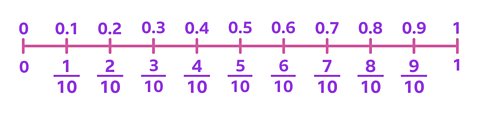
0.1 is the same as \(\frac {1} {10}\)
This number line shows that \(\frac {1} {10}\) and 0.1 are equivalent. They have the same value, even though they look different.
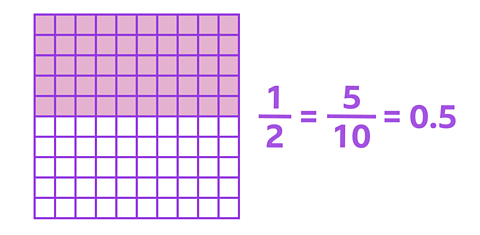
When finding fractions of a whole that is not divided into 10, such as \(\frac {1} {2}\), you can use a 100 grid.
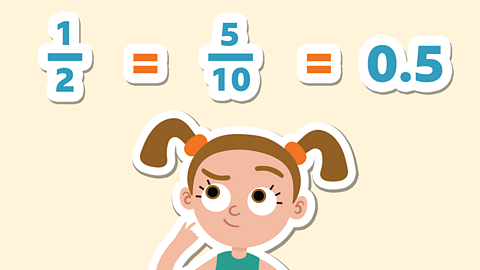
This grid has been divided in half. There are 5 tens in each half, so \(\frac {1} {2}\) is the same as \(\frac {5} {10}\) and the same as 0.5.
Hundredths
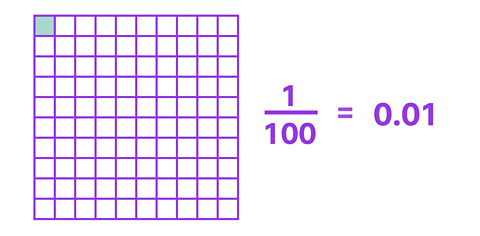
This one hundred grid is a whole that has been divided into one hundred squares.
As a decimal, \(\frac {1} {100}\) is written as 0.01.
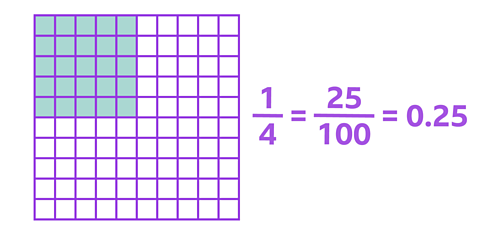
In the following grid 25 squares have been shaded:
That's twenty five hundredths, or two tenths and five hundredths.
As a fraction is it written as \(\frac {25} {100}\).
As a decimal, it is written as 0.25.
\(\frac {25} {100}\) is also equivalent to \(\frac {1} {4}\), so \(\frac {1} {4}\) is equivalent to 0.25.
Thousandths
Each square in this one hundred grid is divided into tens.
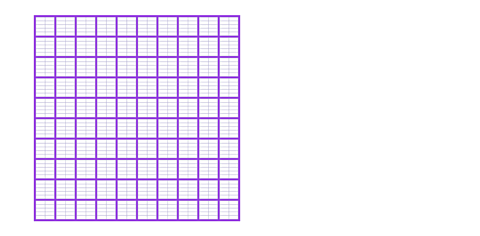
Now the whole has been divided into thousandths.
As a decimal, \(\frac {1} {1000}\) is written as as 0.001.
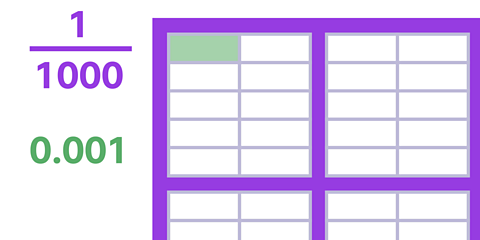
In the next image, the shaded part represents \(\frac {8} {1000}\) in fractions and 0.008 in decimals.
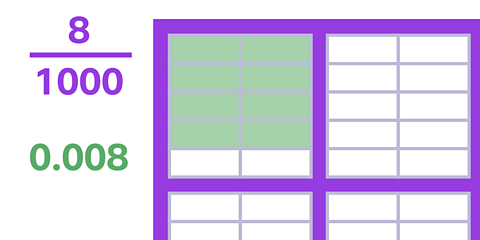
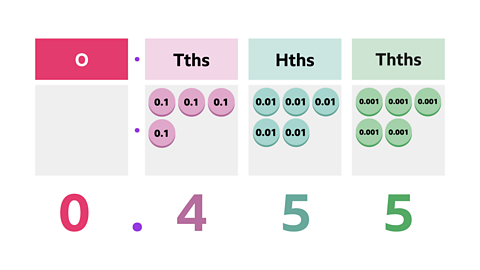
Place value tables and counters can help when working with thousandths.

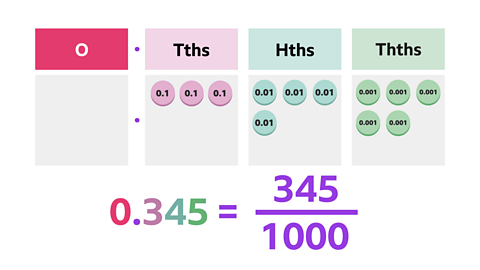
1 of 2
Example 1
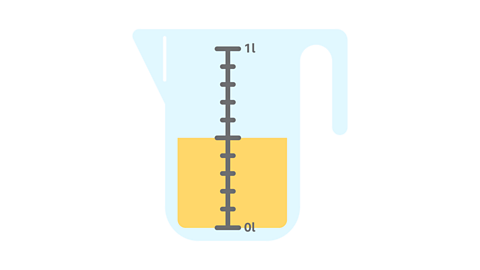
Here is a jug that is half full.
How can you represent this in fractions and decimals?
✓In decimals it is 0.5 litres
In fractions it is \(\frac {5} {10}\) of a litre - or if you recognised the equivalent fraction - it is \(\frac {1} {2}\) a litre.
Which do you think sounds better - fractions or decimals when using litres?

Example 2
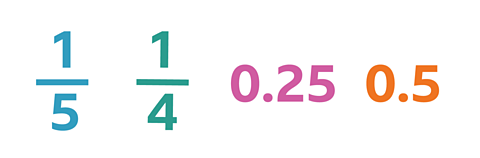
Put these decimals and fractions in order, from smallest to largest.
\(\frac {1} {5}\), \(\frac {1} {4}\), 0.5, 0.25
You may need to convert them into equivalent fractions or decimals. Some of the fractions and decimals may have the same value.
✓ The correct answer could be arranged like this:
\(\frac{1}{5}\) → 0.25 → \(\frac{1}{4}\) → 0.5
Or like this:
\(\frac{1}{5}\) → \(\frac{1}{4}\) → 0.25 → 0.5
Did you spot that 0.25 is equivalent to \(\frac{1}{4}\)?
\(\frac{1}{5}\) is the smallest value and is equivalent to 0.2.
0.25 and \(\frac{1}{4}\) are equivalent. They are both larger than \(\frac{1}{5}\).
0.5 is the largest value and is equivalent to \(\frac{1}{2}\).
Example 3
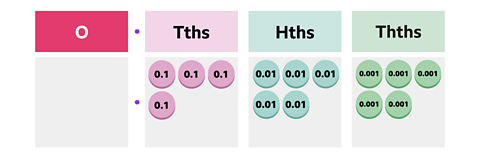
What decimal number is represented by the place value counters?
Can you also represent it using a fraction?
✓It is 0.455.
As a fraction, it is \(\frac {455} {1000}\) or you may have used an equivalent fraction \(\frac {91} {500}\)
More on Fractions
Find out more by working through a topic
- count12 of 17
- count13 of 17
- count14 of 17

- count15 of 17