Quick version
There were two main reasons for Irish migration to Scotland during the 1800s:
- search for employment
- escape from poverty and hunger
Initially, migration for employment was seasonal as Irish workers travelled to Scotland to work bringing in harvests. Later, the Industrial Revolution utilised greater numbers of Irish workers:
- as labour force in mills and factories
- to build infrastructure such as canals and railways
The greatest driver of mass Irish migration was the Potato Famine of 1845 to 1849. Over one million Irish people emigrated to avoid starvation and poverty. Several hundred thousand Irish migrants settled in Scotland.
- most Irish migrants settled in western Scotland
- cities such as Glasgow saw population share of settled Irish migrants rise dramatically between 1841 and 1851
Video - Irish immigration to Scotland
Discover more about the experience of Irish migrants in Scotland in this Higher history film.
Hundreds of thousands of Irish immigrants arrived in Scotland in the mid1800s. They didn’t always receive a warm welcome…
“A moral and social plague!”
They “cling to their rags, their faith and their filth!”
“They have deprived thousands of the working people of Scotland ofwork!”
The new arrivals these commentators were concerned about hadn’t hadmuch choice but to leave Ireland…
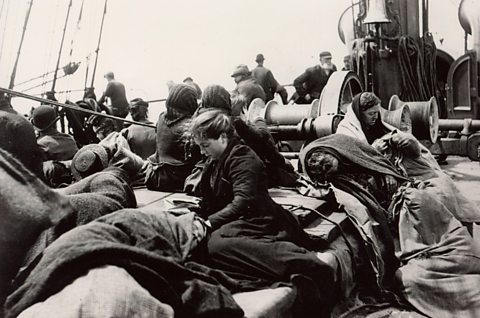
The potato famine, or ‘Great Hunger’, resulted in over a million Irish peoplestarving or dying from disease. Another million headed overseas.
They were mostly Catholics who spoke Irish Gaelic.
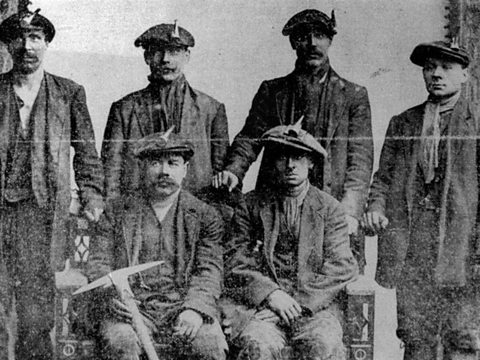
Heading to Dundee, Edinburgh, and Glasgow, they took unskilled labouringwork wherever they could find it - working in mines, iron works, and asnavvies, digging canals and laying railway track.
By the 1850s, the Gorbals in Glasgow had become an Irish ghetto, as it wasthe only place that most could afford. It was overcrowded, unsanitary andrife with disease.
Tensions between the Irish and Scottish mounted - starting with religiousprejudice, and heightened by fear of disease, with the Scots calling typhus‘the Irish fever’, and cholera ‘the Irish disease’. Irish families were often seenas ‘spongers’ supported by local taxpayers.
And the 1870s saw further tensions, when Irish Protestants began crossingthe water…
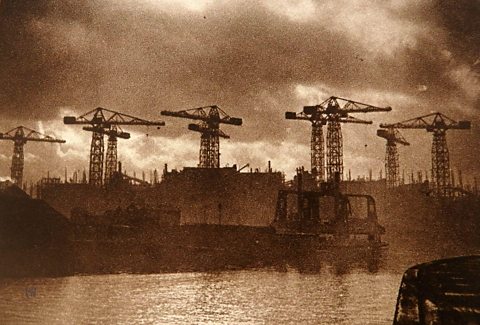
Better educated and skilled, Protestant workers were actively recruited bythe Scottish weaving, shipbuilding and iron industries – which paid thembetter wages than they could find in Ireland.
Catholics were excluded from better paying jobs, and sometimes subjectto violence… Hate and suspicion built up on both sides of the sectariandivide.
Catholics depended heavily on the Church for community and practicalhelp, such as letter writing or job applications.
Church community funds were used to feed the children of immigrantsand to set up football clubs, such as Celtic.
Irish Protestants set up Orange Order lodges, and became loyal to rivalfootball club Rangers.
But tensions gradually eased, as Irish communities became established inScots society. In the years that followed, new waves of immigrants arrived –Italian, Jewish, and Lithuanian – often facing the same challenges as theIrish who’d come before them.
Learn in more depth
Reasons for Irish immigration to Scotland
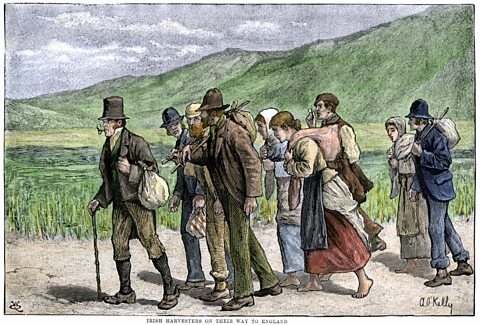 Image source, ALAMY/North Wind Picture Archives
 There were multiple stages of Irish immigration to Scotland.
Early immigration tended to be work-related, limited in numbers, and short term in nature:
- immigration prior to the mid 1800s was largely Irish workers brought over to help with seasonal harvests
- large numbers of Irish workers built the British canal and railway networks
Mass migration and long term settlement of Irish immigrants in Scotland began during the Irish Potato Famine (from 1845) as millions of Irish people sought to escape poverty, homelessness and hunger in Ireland.
Image source, ALAMY/North Wind Picture Archives What push factors led to Irish emigration?
Ireland’s population doubled between 1800 and 1850:
- In 1800 the population was 4,500,000.
- By 1841 the population had risen to over 8 million.
This reduced how much land was available and Ireland struggled to produce enough food to feed the population.
The Irish Potato Famine
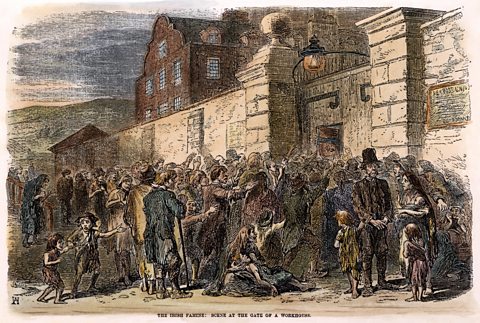 Image source, ALAMY/The Granger Collection
By the 1800s, the potato had become the staple crop grown in Ireland. Most small-scale arable farmers grew the crop as it was suited to Irish soils and provided a welcome source of nutrition.
In 1845, a fungus (Phytophthora infestans) affecting the potato crop arrived in Ireland. The potato fungus quickly swept across the whole country and devastated whole harvests for several years. The effects of the failed harvests were devastating as millions were left hungry.
It is believed that over a million people died from starvation and disease, and that at least another million emigrated to escape poverty and hunger.
Of those that left Ireland, some did so voluntarily while others were cleared off the land by landlords who were unable or unwilling to pay for the upkeep of their starving tenants.
Of those that left Ireland, hundreds of thousands left for long-distance destinations, such as America. Hundreds of thousands more lacked the funds or opportunity to travel across the Atlantic. For many of these emigrants, Scotland was closer and more achievable.
Image source, ALAMY/The Granger CollectionImpact of the Irish Potato Famine on Scotland
The Potato Famine had a major impact, causing over one million Irish people to leave Ireland.
While most went to America, Scotland became a significant destination, particularly for those who could not afford transatlantic passage.
During 1848, Glasgow saw an average weekly inflow of over 1,000 Irish immigrants. The Irish population in Scotland increased by 90% between 1841 and 1851.
What pull factors led to Irish immigration?
A major pull factor that influenced the decision of Irish migrants to choose Scotland was proximity. Scotland was close to Ireland and travel expenses were less than to America or Canada.
For many years Irish workers had travelled for seasonal work on Scottish farms to earn money at harvest time. Although this was temporary employment and they generally returned home at the end of the season, it meant that Scotland was a familiar destination for many Irish people.
Also, many Irish people also already had family living in Scotland who could help them find work and accommodation.
Work opportunities for Irish migrants in Scotland
During the 1800s, Scotland had been transformed by the Industrial Revolution. The expanding British Empire allowed for increased trading opportunities and new markets to export Scottish made goods.
Due to the rapid growth of factories and foundries, Scotland had a shortage of workers and many industries in Scotland recruited Irish migrants.
Higher wages for Irish migrants in Scotland
During this period, most work in Ireland was agricultural and therefore seasonal. The factories and mills of Scotland offered a different and more lucrative form of employment.
Wages in Scottish mills and factories were higher than those available working the land in Ireland. In some cases they could be six times higher. Employment was also more all-year round with regular hours and so more money could be made.
There was already a history of skilled Protestant Irish textile workers being recruited to work in Scottish mills, and as the Industrial Revolution developed greater numbers of Irish workers found employment.
Housing availability for Irish migrants in Scotland
In Glasgow and Dundee there was a surplus of housing available. For unskilled workers, Scottish tenements typically offered a higher standard of living compared to the basic homes they had left behind in Ireland.
Later, larger numbers of Irish immigration driven by factors such as the Potato Famine increased pressure on Scottish housing and led to cramped and unsanitary conditions in cities such as Glasgow.
Skilled Irish workers – generally Protestant – could expect better wages and better living and housing conditions.
Irish settlement in Scotland
Irish immigrants tended to settle near their arrival points on the west coast of Scotland. As such, Scottish areas closest to Ireland saw the largest numbers of Irish immigrants.
The 1841 Scottish population census showed:
- Wigtownshire's population was 16.5% Irish
- Glasgow population was almost 29% Irish
Nationally, the Scottish census data shows the increase in Irish-born residents of Scotland between the 1841 and 1851 census.
| Year | Irish population | Percentage of Scotland's population |
|---|---|---|
| 1841 | 126,321 | 4.8 |
| 1851 | 207,367 | 7.2 |
Most Irish immigrants came from the province of Ulster, meaning that while the majority were Catholic, there was a substantial minority (around 20-25%) that were Protestant.
Irish employment in Scotland
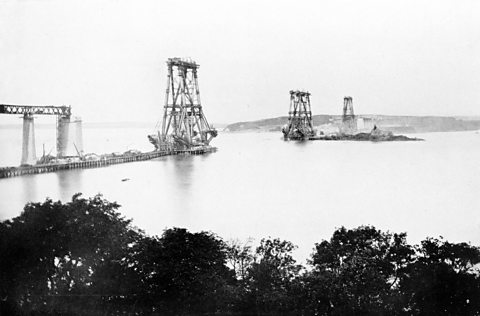 Image source, ALAMY/Archivist
 Most of the Irish immigrants who came to Scotland were unskilled labourers. Often lower paid than Scottish workers, Irish immigrants provided a labour force for the pits, factories and mills that powered the Industrial Revolution.
The need for labour in the textile mills elsewhere in Scotland led to the establishment of Irish communities in Scottish cities such as Dundee.
Irish workers provided the crucial labour force required to dig the canals that criss-crossed the industrial areas of Britain. This workers became known as Navigators – better known as Navvies. Many of these same workers then moved on to build the earthworks, tunnels and embankments needed for the railway network.
Irish labour was also heavily involved in building key Scottish infrastructure projects such as the construction of the Forth Rail Bridge, Glasgow's subway system, and the expansion of Scotland's ports.
Scottish shipbuilding also benefitted from recruiting skilled workers from Irish shipyards in Belfast.
Image source, ALAMY/Archivist Test what you have learned
Quiz
Recap what you have learned
Early in the 1800s, Irish migration to Scotland was typically temporary. Irish labourers travelled to Scotland to find work bringing in harvests of crops before returned home to Ireland.
The labour requirements of the Industrial Revolution led to greater levels of migration to industrial areas of Scotland. Irish labour provided a workforce for:
- factories, mills, and mines in southern, western and central Scotland
- crucial infrastructure building work such as canals and the railways
The greatest factor driving Irish migration to Scotland was the Potato Famine of 1845-1849.
- Over one million Irish people migrated from Ireland
- Several hundred thousand Irish migrants settled in Scotland
- most Irish migrants settled in western Scotland
- the majority of the Irish migrants escaping poverty and starvation in Ireland settled in Scotland for the long term
More on Migration and Empire
Find out more by working through a topic
- count6 of 13