Quick version
Italian migrants came to Scotland in the late 1800s to escape poverty and a lack of economic opportunity.
- many migrants intended to travel on to America
- thousands of Italians ended up in Scotland long-term rather than travelling on
- Italians formed notable communities in Glasgow and Edinburgh
Italian migrants tended to set up their own businesses – such as cafés, fish and chip shops, and ice cream parlours.
Italian communities struggled to assimilate into Scottish society:
- they worked long hours and did not mix with other communities
- there were concerns Italian-owned cafés were leading Scotland's youth into anti-social behaviour
Schools, colleges and community groups were established to promote and protect Italian language and culture. During the 1920s and 30s many of these schools and institutions were used to spread the fascist ideology of Benito Mussolini.
The outbreak of WWII and Italy allying with Germany led to concerns about the loyalty of Italian migrants in Scotland.
Video – Italian migration to Scotland
Find out about the experiences of Lithuanian, Italian, and Jewish immigrants in Scotland.
In the late 1800s and early 1900s many people in Southern and Eastern Europe became migrants to escape poverty and persecution at home.
Many dreamed of a new life in the USA. Others made Scotland their home.
From the 1880s, thousands of Italians, escaping the poverty of their home country, had settled across Scotland. Many set up small businesses – pushing barrows around the streets selling a delicacy that was new to the Scots public – ice cream.
They did good business, and expanded – opening ice cream shops, cafes, and fish and chip shops.
Scots Italian communities stayed close to each other – businesses were family run, and ‘marrying out’ was discouraged.
The café parlours became a popular part of Scots society – but some saw them as a problem.
For the United Free Church, they were a dangerous Catholic influence, and a threat to Scottish morals – “young people of both sexes congregate there after legitimate hours and sometimes misbehave themselves”
In the late 1800s, a new wave of migrants arrived in Scotland. They were Jewish communities who were escaping violent religious persecution in the Russian Empire.
Most set up in trades - as tailors, furniture makers, or jewellers. They spoke only Yiddish – and for a time, the Jewish area of the Gorbals was full of Yiddish signs and even Yiddish newspapers. But with newer generations, born and bred in Scotland, the language faded away.
Italian and Jewish immigrants were subject to some racial stereotyping and harassment. But as people who set up their own businesses, they weren’t seen as competing for jobs.
The Lithuanian immigrants who came to Scotland between 1890 and 1914, were also escaping persecution in Russia, particularly because of their Catholic faith.
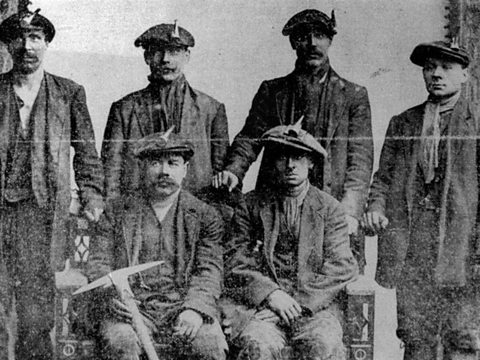
Many started working in the mines of Lanarkshire and Ayrshire. Some Scots saw them as stealing jobs and undercutting wages, and they faced hostility.
As one man, born in 1903, remembered: “we were all called Poles back then. I think my worst time was at school, when I was bullied and asked, time after time, ‘What’s your name? Tell us your name. Go home to your own country’ ”.
But over time, they earned respect as hard workers, and joined with Scots miners in trades unions to fight for better working conditions.
Blamed, insulted, then accepted – the experience of immigrants was often challenging. But as they struggled to create more prosperous lives, they also brought experience and diversity to Scotland, making it a richer nation.
Learn in more depth
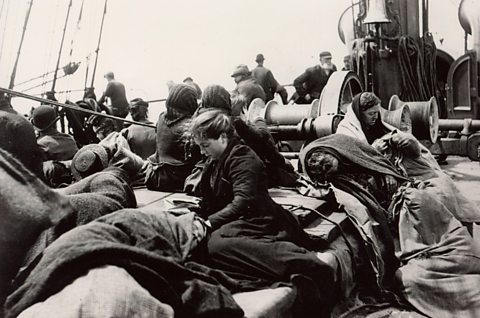 Image source, ALAMY/colaimages
 Between 1891 and 1911 the Italian-born population in Scotland grew by nearly 400%.
Most of the early Italian immigrants arrived in Scotland from Tuscany in the North West of Italy. The vast majority were young men, They had left Italy to escape poverty, economic depression, and famine in their homeland.
Just like Lithuanian immigrants, many Italians saw Scotland as a stopping point en route to a new life in America. While many did travel on to America, some Italian migrants settled in Scotland.
The numbers of Italian immigrants in Scotland increased dramatically in the late 19th and early 20th centuries when America tightened their immigration policies to limit immigration into the US.
In 1933, a census carried out by the Italian government listed 6,000 individual Italians living in Scotland.
Image source, ALAMY/colaimages Italians living and working in Scotland
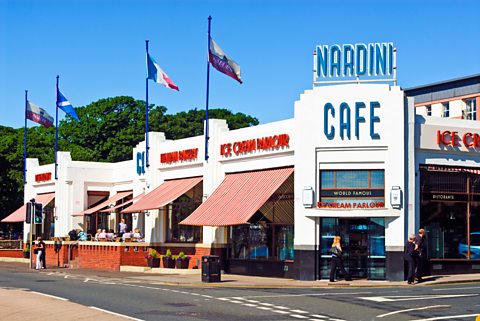 Image source, ALAMY/Dave Pattison
Early Italian migrants found it hard to find employment in Scotland. Few spoke English, and there were not established Italian communities in Scottish towns and cities to help new migrants assimilate.
Most Italian migrants in Scotland became self-employed. They worked as street vendors:
- some sold religious statues door-to-door
- others sold chips or ice-cream in the street.
Some then moved into more formal catering businesses, setting up:
- ice cream parlours
- cafés
- fish and chip shops
In 1903 there were 89 cafés in Glasgow. By 1905 there were 336.
These shops and restaurants were established in the working class areas of the cities, where the migrants settled. However, by the 1920s they had developed into much larger – even luxury – establishments in city centres.
There are many famous Italian businesses in Scottish society. Nardinis in Largs boasted a beautiful Art Deco tea room that became an attraction for many Scots. Valvona & Crolla is a famous delicatessen based in Edinburgh.
Another business Italians established in numbers was hairdressing and barber shops. In 1928, the Italian College of Hairdressers was opened in Glasgow to cater for migrants from Italy so they could open businesses in Scotland.
Image source, ALAMY/Dave PattisonWhere did Italian migrants settle in Scotland?
As Italian businesses took off in the 1900s, the men who had originally left Italy alone in search of work were often joined by their families. As a result, the number of Italian immigrants and their descendants dramatically increased.
Although Italian communities could be found all over Scotland, the majority of Italian settlement was in Glasgow, in areas such as Partick and the West End, and in Edinburgh, mainly in the Grassmarket area. Some Italians settled in coastal towns, such as Ayr and Largs.
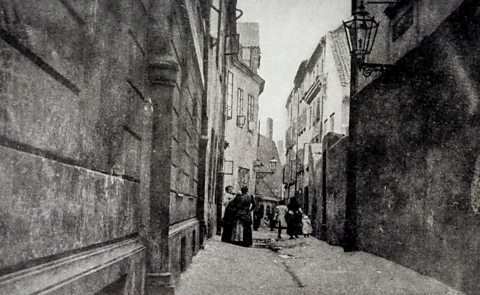
Like other immigrant groups, Italians mostly settled in the poorest areas, the only places they could afford. The housing was often poor, overcrowded and with little or no sanitation.
Italians who ran successful businesses were able to move to better quality housing, however many remained living in close-knit communities in the areas they had initially settled in.
By 1905 it is estimated that there were around 5,000 Italian Immigrants in Glasgow alone – making it the third largest Italian community in Britain.
How did Italians assimilate into Scottish society
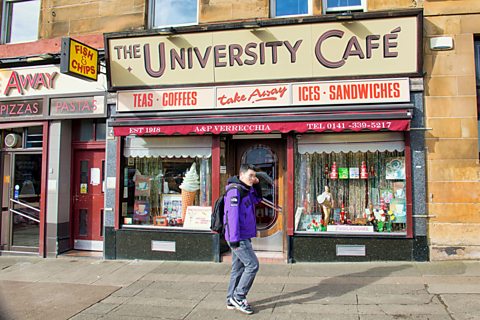 Image source, Gerard Ferry / Alamy
Initially, it was difficult for Italian migrants to assimilate into Scottish society.
Many migrants believed that their life in Scotland was only temporary and that, eventually, they would return home to Italy. This belief shaped the experience of many migrants in Scotland.
Italian migrants were also devoutly Catholic. This separated them from the predominantly Protestant Scots population and made assimilation harder for Italian arrivals to Scotland.
The Italian community in Glasgow attempted but struggled to establish their own specific cultural and societal institutions. Attempts were made to establish their own Italian parish churches. This failed and Italians had to attended church with wider Catholic communities. Attempts were also made to set up a school for Italians in 1908 with the aim of preserving the Italian language.
Briefly, there was an Italian language newspaper, La Scozia. Launched in 1908, it aimed to help preserve and foster Italian culture and traditions in Scotland. The paper struggled, however, and folded after 48 issues.
In Italian households Italian was spoken and Italian food was the staple diet. Religious festivals common in northern Italy were passionately observed.
Marriage into the wider Scottish population was difficult due to language and culture differences. Also, during the early part of the 20th century, Italians were encouraged to marry only other Italians.
During this period, the Italian community in Scotland was insular. Italians tended to work long and anti-social hours. It was not uncommon for them to work 14 hour days, seven days a week and this resulted in very little social contact with people from outside the Italian community
Image source, Gerard Ferry / AlamyHow did Scots react to Italian migrants?
Initially, Italian migrants were well-received. Their tendency to be self-employed and run their own businesses meant that they were not seen as competition for Scottish workers. Over time, though, issues did arise.
The long opening hours of Italian businesses – especially on Sundays – was condemned by some church leaders. They believed that the ice cream parlours and cafés run by Italians were attracting and corrupting Scottish youth.
In 1906, the British Women's Temperance Association (the a group that usually fought against the use of alcohol) campaigned against the Sunday trading of ice cream parlours in Scotland. Italian parlours were also blamed for:
- encouraging Scottish children to smoke
- tempting Scots youths to attend late night dances
- leading women into prostitution
- an increase in teenage pregnancies
By 1907, the Italians had begun to win the favour of the Temperance Movement. The Temperance Refreshment Traders Defence Association was established (an organisation consisting solely of Italians) to reaffirm their commitment not to supply alcoholic drinks. The slow acceptance of new foods and cultures also helped to improve the situation for many Italians by the 1920s.
Fascism and Italians in Scotland
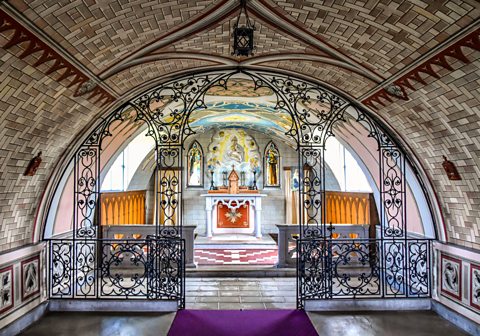 Image source, ALAMY/Ruth Craine
During the 1920s and 1930s, a number of Italians in Scotland took up membership of Benito Mussolini's National Fascist Party. Most of these members lived in the Italian communities of Leith – where the Italian Fascist Party was established in 1924.
Mussolini's fascist regime sought to promote and protect Italian culture among expatriate communities abroad such as Scotland. The existence of Italian schools and community institutions such as social clubs in these overseas countries promoted a sense of patriotism and cultural pride, but allowed the easy spread of fascist ideology through many of these institutions.
Further, organisations supported by or sympathetic to Mussolini's Fascist Party, known as Fascio, established other schools and institutions abroad. One such place was Glasgow's Casa d'Italia. Sumptuously decorated in the Italian style, the building served as a club and meeting place for the city's Italian community.
Scots Italians organised support for Mussolini's government, including during Italy's war with Abyssinia (Ethiopia) in 1935 - 1937. In general, support for fascism was not strong in wider Scottish society, and this lead to tension between native Scots and Scots Italian communities.
Image source, ALAMY/Ruth CraineTest what you have learned
Quiz
Recap what you have learned
Italian migrants came to Scotland in the late 1800s to escape poverty and a lack of economic opportunity.
- thousands of Italians ended up in Scotland long-term rather than travelling on to America
- Italians formed notable communities in Glasgow and Edinburgh
- Italian migrants tended to set up their own businesses – such as cafés, fish and chip shops, and ice cream parlours
Italian communities struggled to assimilate into Scottish society:
- they worked long hours and did not mix with other communities
- there were concerns Italian-owned cafés were leading Scotland's youth into anti-social behaviour
Schools, colleges and community groups were established to promote and protect Italian language and culture. During the 1920s and 30s many of these schools and institutions were used to spread the fascist ideology of Benito Mussolini.
The outbreak of WWII and Italy allying with Germany led to concerns about the loyalty of Italian migrants in Scotland.
More on Migration and Empire
Find out more by working through a topic
- count8 of 13