Quick version
The largest phase of Jewish migration occurred from the late 1800s as Jews fled persecution in the Russian Empire. A later wave arrived to escape Nazi persecution in the 1930s.
- Jewish communities were established in Scottish cities such as Glasgow and Edinburgh
- the largest community was in the Gorbals, Glasgow
- at first, most Jewish migrants spoke Yiddish and knew little to no English
Jewish communities were largely self-sufficient. Jewish people largely set up their own businesses and provided their own social welfare.
While they did face some discrimination, Jewish communities largely successfully integrated into Scottish society,
As they assimilated, distinct Jewish areas of cities disappeared as Jewish people dispersed to more affluent areas further out.
Learn in more depth
Jewish migration to Scotland
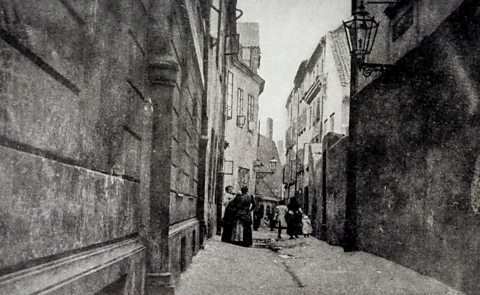 Image source, ALAMY/PhotoStock-Israel
Jewish migration to Scotland occurred in distinct phases.
Jewish immigration to Scotland began in the early 19th Century with migrants arriving from continental Europe, for example from Germany and the Netherlands. Jewish people began settling in Edinburgh from 1816 and in Glasgow from 1823.
Most of the Jewish arrivals who settled in Scotland before around 1870 were families who had succeeded in businesses such as jewellery and tailoring. Students were also attracted to Scottish universities, from which they were able to graduate without taking a religious oath (A requirement in English universities until 1871).
However, It was only after 1870 that Jewish immigration to Scotland reached significant levels. Large numbers of Jewish immigrants arrived in the last decades of the 19th century as Jewish people in the lands controlled by the Russian Empire, such as Latvia, Estonia, and Lithuania, fled west to escape persecution.
- 1881 – there were 225 Russians in Scotland (3.5% of the total foreign population of Scotland)
- 1901 – the Russian population was 6102 (24.7% of the total foreign population in Glasgow)
In official documents, Jewish migrants were often listed by their nationality of origin and most of these Russians would have been Jewish people escaping persecution in the Russian Empire.
The influx of Jewish settlers was intensified by the Nazi persecutions of Jewish communities in Germany during the 1930s.
Image source, ALAMY/PhotoStock-IsraelThe growth of Jewish communities in Scotland
Initial Jewish migrants were relatively wealthy and as such settled in the affluent area of Garnethill in Glasgow – Garnethill Synagogue was the first purpose-built Scottish synagogue in 1879. Many of these migrants were well-educated and spoke English. As such, assimilation into Scottish society was relatively easy.
Later waves of Jewish migrants escaping persecution in their homeland tended to be financially poorer and most did not speak English. Coming from Russian Empire territories, they typically spoke Polish, Russian or Lithuanian as well as Yiddish.
A sign of this change was the fact that the main centre of Jewish settlement moved from wealthy Garnethill to the poorer area of then Gorbals on the southern side of the Clyde.
Glasgow's Jewish community
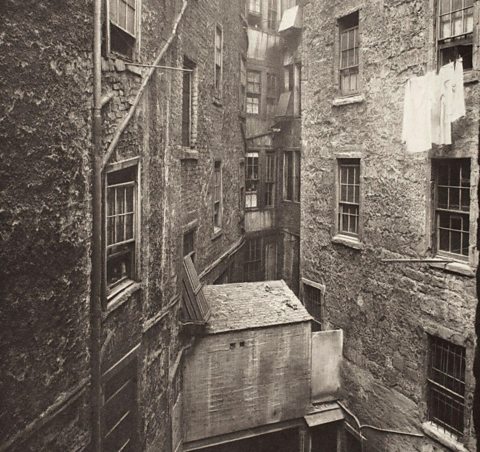 Image source, ALAMY/Heritage Image Partnership Ltd
 By 1914, there were 10,000 Jewish people living in Glasgow. This comprised around 90% of the whole Jewish population of Scotland. The vast majority lived in the Gorbals, although there were also smaller Jewish communities in Edinburgh, Dundee, Falkirk, Greenock and Ayr.
For subsequent waves of migrants, the Gorbals were seen as a "safe" option as they would be welcomed and supported by the existing community. The Gorbals had two synagogues, a school for religious education, a reading room, and more than 60 Jewish stores.
Before the existence of the Welfare State, organisations such as the Glasgow Hebrew Philanthropic Society, the Glasgow Jewish Board of Guardians, the Benevolent Loan Society, and the Boot and Clothing Guild, assisted newly arrived Jewish migrants to find housing, employment, food and clothing, and medical care.
Outside of institutions, individuals helped new arrivals. From 1930, Sophie Geneen ran a kosher hotel in the Gorbals that provided shelter to new arrivals including refugees escaping persecution in Nazi Germany. The hotel was a community hub that hosted civic functions and Mrs Geneen also helped to raise money to provide dowries for Jewish brides whose families lacked the funds to provide them.
Image source, ALAMY/Heritage Image Partnership Ltd Edinburgh's Jewish community
In Edinburgh, the growth of a Jewish community was more disparate. Older, wealthier and more assimilated Jewish residents lived and worshipped separately from newer, poorer arrivals.
It took the efforts of Dr. Salis Daiches, Rabbi of the Edinburgh Hebrew Congregation and himself a migrant born in the Russian Empire territory of Lithuania, to establish a more unified Jewish community that was better integrated into Scottish society.
Dr. Daiches also engaged with the broader non-Jewish Scottish society and regularly took part in public debates. He became known as a respected public intellectual and did much to help the assimilation of the Jewish community in Edinburgh.
Work and life for Jewish migrants in Scotland
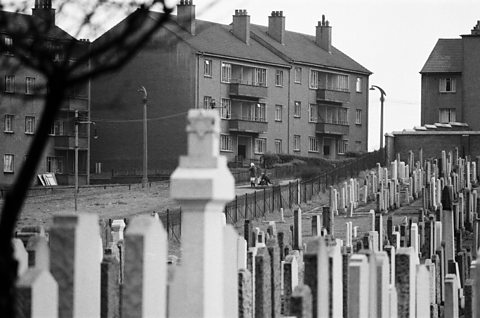 Image source, ALAMY/Trinity Mirror/Mirrorpix
As with some other migrant groups, such as Italian migrants, Jewish migrants generally did not compete directly with Scots in the labour market.
Many of them possessed skills that they had developed in industrial cities in Europe and were able to utilize them in Scotland. Many others ran or worked in Jewish owned businesses as tailors or cigarette makers. It was typical for Jewish employees to work long hours, six days a week for little pay.
This meant that the Jewish immigrant economy was remarkably self-sufficient.
In addition, Jewish communities developed their own welfare systems that ensured that Jewish people in hardship did not become a burden to the taxpayers or the Poor Law. Affluent members of the Jewish community, professional guilds (such as the clothing guild), and Jewish businesses often funded these welfare measures.
Jewish communities also had their own newspapers and publications. Early on, these papers were established by Jewish migrants and printed in their home language of Yiddish. Later, as Jewish communities became more assimilated, Jewish newspapers tended to be printed in English as knowledge of Yiddish declined.
- Hillel Mayer Langman, a Lithuanian migrant, published the Jewish Times between 1901 and 1903.
- Other Lithuanian immigrants, the Golombok brothers, published the Glasgow Jewish Evening Times from 1914.
- The Golombok brothers also published the Jewish Weekly Times and the Yiddish language Die Glasgow Yiddishe Shtimme (The Glasgow Jewish Voice) in the 1920s.
Image source, ALAMY/Trinity Mirror/MirrorpixReaction of the Scots to Jewish migrants
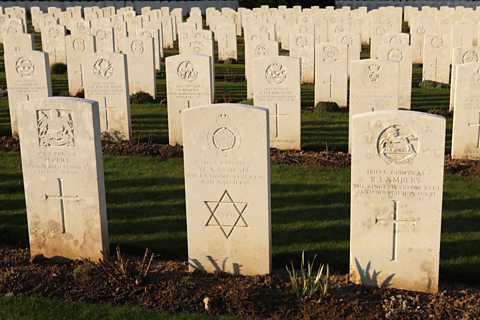 Image source, S. Forster/Alamy
Jewish migrants did experience prejudice and bigotry in Scotland. It was not unheard of for landlords to refuse to rent to Jewish people, and some employers discriminated against Jewish people.
During the early decades of the 20th century, Scotland was still a very religious country and some Christian denominations were angered that Jewish businesses were open and trading on Sundays – the Christian Sabbath.
After the outbreak of WW1, Yiddish speaking Jewish communities faced suspicion and prejudice after being mistakenly identified as being German.
Throughout the rise of European fascism during the 1920s and 1930s, Scotland's Jewish communities were building closer ties with Christian churches and were more pro-active in countering fascist propaganda and anti-Semitism aimed at Jewish people.
The rise of Nazism in Germany in the run up to WWII and the arrival of Jewish migrants escaping clear persecution won sympathy from the wider Scottish public. That Jewish men fought and died alongside fellow Scots as part of the British Army during the war also fostered good relations and acceptance.
Jewish acceptance into Scottish society was aided by the self-sufficiency of the community. They did not compete with Scots for jobs and they were not seen as a drain on social welfare spending.
In Glasgow, many cultural and sporting institutions for split along traditional sectarian lines – some catering for Catholics, others for Protestants. It was not unusual for Jewish to be barred from all. Because of discrimination, Scottish Jewish people founded their own golf club in Bonnyton, East Ayrshire in 1950s.
Right wing anti-Semitic organizations, such as the British Union of Fascists, did not have a strong presence in Scotland and, on the larger scale, Jewish migrants were able to establish successful communities in Scottish cities.
Image source, S. Forster/AlamyJewish assimilation into Scottish society
Initially Jewish communities remained separate from wider Scottish society. Early migrants spoke little to no English and maintained recognisably Jewish and European traditions.
By the 1920s, there were signs of social and cultural assimilation. Yiddish, once spoken in most homes, was dying out and Yiddish newspapers began to go out of business. By 1928 there remained only The Jewish Echo which was published in English.
After WWI the tradition of Jewish involvement in medicine and law was becoming established and went on to make a substantial contribution to Scottish society. In the early 1920s there were already nearly a dozen Jewish medical students in Glasgow alone.
By this time some of the best known businesses in Glasgow, such as Morrisons the dressmakers and Goldbergs retailers, were Jewish-owned. Jewish businesses contributed to the local and national economy.
Scottish Jews contributed to the war effort in World War One, with over one hundred Jewish men killed in military service.
As Jewish people became established in Scotland there was a steady drift from the Gorbals to the richer suburbs in the south of the city. As such, distinct Jewish communities, such as areas of the Gorbals, largely disappeared.
Test what you have learned
Quiz
Recap what you have learned
The largest phase of Jewish migration occurred from the late 1800s as Jews fled persecution in the Russian Empire. A later wave arrived to escape Nazi persecution in the 1930s.
- Jewish communities were established in Scottish cities such as Glasgow and Edinburgh.
- The largest community was in the Gorbals, Glasgow.
- Jewish communities were largely self-sufficient. Jews largely set up their own businesses and provided their own welfare.
While they did face some discrimination, Jewish communities largely successfully integrated into Scottish society.
More on Migration and Empire
Find out more by working through a topic
- count12 of 13