Quick version
- Lithuanians migrated to Scotland in the mid-1800s due to persecution in their homeland in the Russian Empire and due to severe famines in the 1890s
- Most Lithuanians planned on travelling to a new life in America, but around 6,000 settled in Scotland, finding work in coal mines and other heavy industries
- Significant Lithuanian communities formed in Lanarkshire, with Catholic Lithuanians in Bellshill and Jewish Lithuanians in Glasgow's Gorbals area
- Lithuanians faced hostility due to cultural differences, competition for jobs, and religious tensions
- Scots feared Lithuanians were being used by companies as 'strike-breakers'
- Lithuanian’s faced difficulty is maintaining their identity, but Lithuanian priests, language classes, and cultural events helped protect the culture
- The 1914 Aliens Restrictions Act and the 1917 Anglo-Russian Military Convention led to deportations and the eventual decline of distinct Lithuanian communities in Scotland
- Decline in heavy industry led to the break up of communities and Lithuanian’s largely disappeared as a distinct group
Video: Lithuanians, Jewish, and Italians in Scotland
Find out about the experiences of Lithuanian, Italian, and Jewish immigrants in Scotland.
In the late 1800s and early 1900s many people in Southern and Eastern Europe became migrants to escape poverty and persecution at home.
Many dreamed of a new life in the USA. Others made Scotland their home.
From the 1880s, thousands of Italians, escaping the poverty of their home country, had settled across Scotland. Many set up small businesses – pushing barrows around the streets selling a delicacy that was new to the Scots public – ice cream.
They did good business, and expanded – opening ice cream shops, cafes, and fish and chip shops.
Scots Italian communities stayed close to each other – businesses were family run, and ‘marrying out’ was discouraged.
The café parlours became a popular part of Scots society – but some saw them as a problem.
For the United Free Church, they were a dangerous Catholic influence, and a threat to Scottish morals – “young people of both sexes congregate there after legitimate hours and sometimes misbehave themselves”
In the late 1800s, a new wave of migrants arrived in Scotland. They were Jewish communities who were escaping violent religious persecution in the Russian Empire.
Most set up in trades - as tailors, furniture makers, or jewellers. They spoke only Yiddish – and for a time, the Jewish area of the Gorbals was full of Yiddish signs and even Yiddish newspapers. But with newer generations, born and bred in Scotland, the language faded away.
Italian and Jewish immigrants were subject to some racial stereotyping and harassment. But as people who set up their own businesses, they weren’t seen as competing for jobs.
The Lithuanian immigrants who came to Scotland between 1890 and 1914, were also escaping persecution in Russia, particularly because of their Catholic faith.
Many started working in the mines of Lanarkshire and Ayrshire. Some Scots saw them as stealing jobs and undercutting wages, and they faced hostility.
As one man, born in 1903, remembered: “we were all called Poles back then. I think my worst time was at school, when I was bullied and asked, time after time, ‘What’s your name? Tell us your name. Go home to your own country’ ”.
But over time, they earned respect as hard workers, and joined with Scots miners in trades unions to fight for better working conditions.
Blamed, insulted, then accepted – the experience of immigrants was often challenging. But as they struggled to create more prosperous lives, they also brought experience and diversity to Scotland, making it a richer nation.
Learn in more depth
The mass migration of Lithuanians began in the mid 1800s.
During this period, Lithuania was a part of the Russian Empire. A failed Polish and Lithuanian uprising against Russian rule in the 1860s led to severe crackdowns on Lithuanian language and culture. Hardships during this period led to increased migration from Lithuania.
A later wave of migration occurred from the early 1890s after a severe famine caused around a quarter of the population of Lithuania – around 650,000 people – to emigrate.
Other waves of migrants from Lithuanian were Jews escaping religious persecution in the Russian Empire.
Lithuanian arrival in Scotland
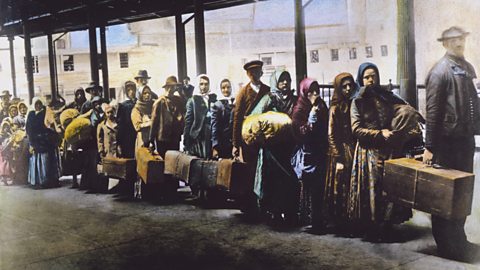 Image source, ALAMY/The Granger Collection
As with many other European immigrants, America – and in particular New York – was seen as the ideal place to begin their new life free from poverty and repression.
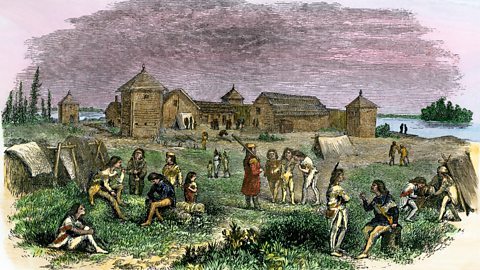
Scotland was often a stepping stone. Migrants arrived at ports in the east of Scotland and then departed from ports in the west of Scotland to cross the Atlantic to the new world.
Despite this, as many as 6,000 Lithuanians settled in Scotland in the late 19th and early 20th centuries.
Some already had jobs secured in Scotland before making their voyage. Like Scotland, Lithuania had coal mines and miners could find work in this industry. Others unexpectedly found themselves in Scotland for the long term:
- some migrants found that they could not afford the onward journey to America
- some found work and decided to settle in Scotland
- others were deceived into thinking that they had arrived in America when in fact they were in Scotland
Image source, ALAMY/The Granger CollectionLithuanians communities in Scotland
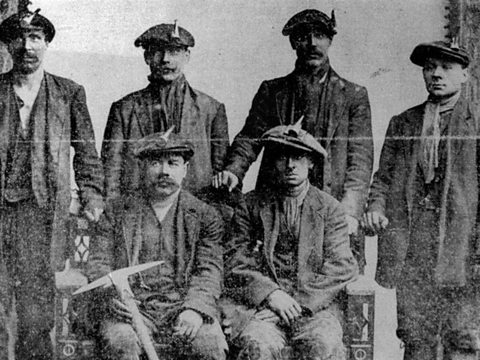 Image source, ALAMY/History and Art Collection
Many Lithuanian immigrants arrived in Scotland having been pursued by agents of major Scottish iron and steel companies, such as Bairds at Coatbridge and Dixons of Glasgow.
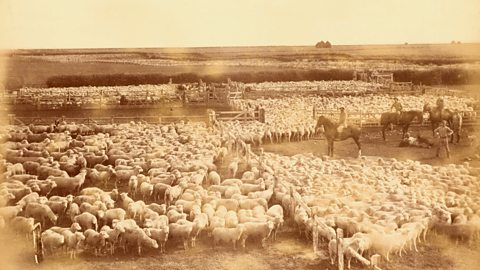
Recruited by these firms to come to Scotland to dig for coal in company-owned coal mines, significant communities of Lithuanians grew in the coal fields of Lanarkshire. The mostly Catholic Lithuanian population tended to settle in areas such as Bellshill in Lanarkshire.
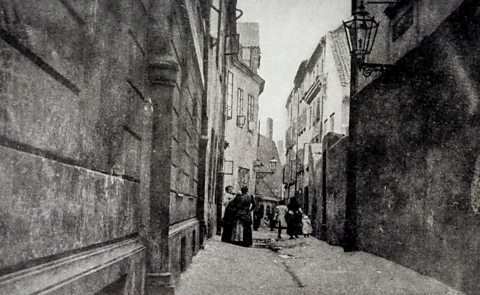
There was a smaller contingent of Jewish Lithuanians, too. As there was an established Jewish community in the Gorbals area of Glasgow, Jewish Lithuanians tended to settle there.
Image source, ALAMY/History and Art CollectionScottish reaction to Lithuanian immigration
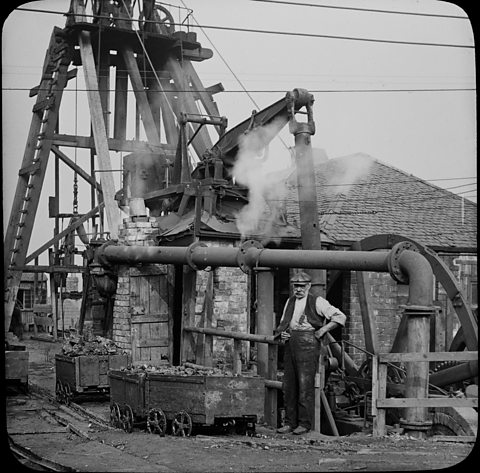 Image source, ALAMY/Clarence O. Becker Archive
Initially the Lithuanian migrants were not welcomed as the Scottish people looked towards them with anger and contempt.
As well as cultural clashes, the Lithuanians were seen as unwelcome competition in the work sector as they were willing to work for lower wages than the Scottish workers.
Many Scots believed that Lithuanians had been deliberately recruited by Merry & Cunninghame, owners of ironworks and coalmines in Coatbridge.
Scottish workers feared that these Lithuanian migrants would be used to replace them during strikes and industrial disputes. For this reason Lithuanian workers developed a reputation as strike-breakers.
Keir Hardie, founding figure of the Labour movement and a former mining trade union leader, had this to say about Lithuanians employed in Scottish industry:
Messrs. Merry and Cunninghame have introduced a number of Russian Poles to Glengarnock Ironworks. What object they have in doing so is beyond human ken unless it is, as stated by a speaker at Irvine, to teach men how to live on garlic and oil, or introduce the Black Death, so as to get rid of the surplus labourers.
– Keir Hardie
The fact that most Lithuanians did not speak English also led to concerns. The Scottish Miners’ Federation expressed fears that not being able to communicate with Scots workers made industrial accidents more likely.
The incoming Catholic immigrants only added to the opposition from Protestant communities in Scotland. The Lanarkshire coal fields had a tradition of sectarian rivalry, and this impacted on Lithuanians – not only were they foreigners, they were also Catholic.
John Wilson, Liberal MP and former miner and trade unionist, said this of Lithuanians in Scotland:
[I do not believe it] proper that this country should be the dumping ground for all the paupers of Europe.
– John Wilson, MP
During the economic depression of the early 1900s, continued Lithuanian migration led to additional tensions with Scots as competition for jobs increased and wages declined.
Image source, ALAMY/Clarence O. Becker ArchiveThe experience of Lithuanians in Scotland
 Image source, Daily Herald Archive / Getty Images
Initially, assimilation into Scottish culture was difficult for Lithuanian migrants due to issues such as language barriers and different cultural traditions.
The presence of Lithuanian priests and ministers within Catholic churches helped to preserve a sense of Lithuanian identity. The first Lithuanian Priest in a Catholic Church in Scotland was Father John Czuberkis - who served from 1904 - 1911, in Mosshead, Lanarkshire.
The church also helped to promote the use of their own tongue through language classes and the production of their own newspaper Iseiviu Draugas (Immigrant's Friend).
Lithuanian communities mainly remained separate and distinct. While they did not tend to live in ghettos, the tendency to cluster in particular streets of a few towns in central Scotland made them easily visible – especially through the often very colourful national dress of the women and the children.
Within the home the language, culture, food and even furnishings were all Lithuanian and the mothers played a crucial role in maintaining the identity and eventually formed the Lithuanian Catholic Women's Society in 1929.
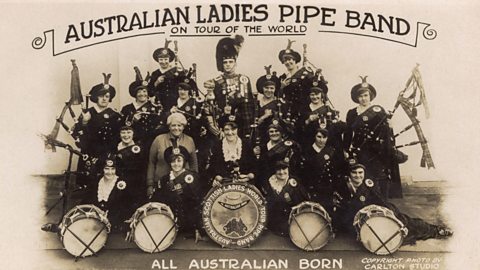
In some communities there was also a vibrant social life (there was even a Lithuanian orchestra). This culminated in the 1905 Lithuanian Festival in Glasgow's City Hall, which had displays of folk music, dance and traditional songs.
One way in which Lithuanians assimilated and contributed to Scottish society is through involvement in trade unions. In the coal and steels industries where they were predominantly employed, Lithuanian workers campaigned with Scots colleagues for better pay and improved working conditions.
Another way was through faith. Largely Catholic, Lithuanians took part in religious festivals and events such as the pilgrimages to the Catholic shrine at Carfin Grotto, Lanarkshire. It became such an important part of life in Scotland for Lithuanians that services in their native language were organised.
Image source, Daily Herald Archive / Getty ImagesThe impact of WW1 on Scotland's Lithuanians
 Image source, Classic Image/ALAMY
On the outbreak of WW1, Britain passed the 1914 Aliens Restrictions Act.
The act placed severe restrictions on immigrants in Britain and allowed the authorities to determine what immigrants could do, where they could live, and arrest them. The restrictions placed on immigrants under the act effectively ended immigration from Lithuania.
Under this act all immigrants were compelled to register as aliens. All Lithuanian migrants, even those who had been resident in Scotland for 30 years or more (perhaps even having sons serving in the British Army) had to register.
Worse followed with the 1917 Anglo-Russian Military Convention that allowed the deportation of "Russian Subjects" to ensure that they undertook military service in Russia. Lithuania, as a part of the Russian Empire, fell into this category.
1200 Lithuanian men of working age were sent away leaving over 200 dependent families in Bellshill alone. By the time many arrived in Russia the country was in the middle of the The Bolshevik Revolution was an event in 1917 in the wider Russian Revolution that saw the Russian royalty overthrown and replaced by a socialist government under the leadership of Vladimir Lenin.. Only around a third of these men returned to Scotland.
Image source, Classic Image/ALAMYDisappearance of Lithuanian communities
Unlike other immigrant groups such as Italians and Jewish migrants that still maintain a persistent influence in Scotland, over time the Lithuanian presence in Scotland virtually disappeared.
Lithuanian names were often the first casualty. On arrival in Scotland, Lithuanian names were often changed to Scottish variants by immigration officers, leading to a loss of identity.
Later, many Lithuanians voluntarily changed their names to conceal their ethnic identity to avoid prejudice and improve their job prospects.
Over time, dedicated Lithuanian communities disappeared. During the interwar years as the traditional mining communities began to break up, marriage outside the community became common, children attended local schools and learned English and the Lithuanian language became almost obsolete.
As the Lithuanian population share declined in size, it became harder to maintain communities. Church services in Lithuanian became harder to support and the Lithuanian culture and traditions withered with them.
Test what you have learned
Quiz
Recap what you have learned
- Lithuanians migrated to Scotland in the mid-1800s due to escape persecution and famine in their homeland in the Russian Empire
- Most Lithuanians planned on travelling to a new life in America, but around 6,000 settled in Scotland
- Significant Lithuanian communities formed in the coal fields of Lanarkshire as Lithuanian migrants found work in mines and factories
- Lithuanians faced hostility due to cultural differences, competition for jobs, and religious tensions
- Scots feared Lithuanians were being used by companies as 'strike-breakers'
- During WW1, the 1914 Aliens Restrictions Act and the 1917 Anglo-Russian Military Convention led to deportations and the eventual decline of distinct Lithuanian communities in Scotland
- Decline in heavy industry led to the break up of communities and Lithuanian’s largely disappeared as a distinct group
More on Migration and Empire
Find out more by working through a topic
- count8 of 13