Political factors affecting development in sub-Saharan Africa
Quick version
Good governance is when the government improves the lives of all citizens, This is important for long-term development but in many sub-Saharan African countries bad governance is common.
Widespread corruption and misuse of government money, has left many countries in debt, with cash shortages in public services and has hampered development.
One of the biggest factors limiting development in many countries is armed conflict or war.
Armed conflict has many devastating consequences including:
- people forced to leave their homes and flee their country
- farmland is neglected and crops fail leaving food shortages
- loss of life
Learn in more depth
Keep going to learn:
- How does bad governance affect development?
- Case study: Democratic Republic of Congo
- The impact and effects conflict has on sub-Saharan Africa's development
- Case study: Sudan
Then test how much you have learned.
How does bad governance affect development?
There are many political factors which limit development in African countries. These factors include bad governance and conflict.
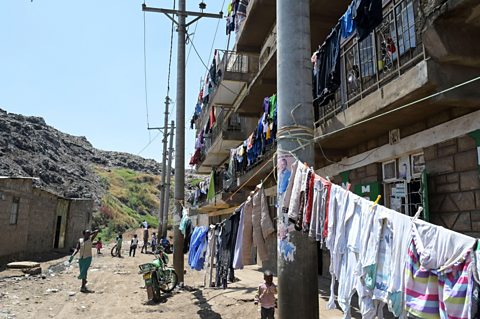 Image source, Joerg Boethling / Alamy
 Good governance or rule by government that improves the lives of all citizens is essential to bring about long-term development.
Bad governance does the opposite.
One problem which affects many countries in sub-Saharan Africa is their governments do not work on behalf of the people i.e. the government is undemocratic, does not respect human rights and is systematically corrupt.
The consequence of bad governance in many sub-Saharan Africa countries has severely limited progress. Widespread, systematic corruption and the misuse of government money, running into billions of pounds every year, has contributed to many countries being in debt. Public services such as education and healthcare are left lacking money to afford the resources they need.
Image source, Joerg Boethling / Alamy Case study: Democratic Republic of the Congo (DRC)
The Democratic Republic of Congo (DRC) is rich in natural resources but has suffered from political instability, a lack of infrastructure, centuries of both commercial and colonial exploitation, and little widespread development since gaining independence in 1960.
The country’s recent history has been one of civil war and corruption.
DRC Statistics
| Life expectancy | 65.4 years old (2024) |
| Infant mortality | 30.6 per 1000 live births (2024) |
| GDPR per capita | $714.76 (2024) |
When he was first elected in 2019, President Felix Tshisekedi had promised an end to widespread corruption. In the DRC’s most recent elections in December 2023, Tshisekedi was re-elected having secured 73% of the vote.
After the election, opposition parties to the government declared the result a “sham” and said there had been widespread vote rigging. Tshisekedi’s return to power, they argued, would mean another period of corruption and poor governance for the DRC.
According to Transparency International, an independent organisation which measures openness and honesty in national governments globally, the DRC is rated very poorly at 162/180 countries in the world for corrupt government. In one opinion poll taken in the DRC, most people (85%) thought corruption increased in the country in 2023.
One report in 2023 claimed that $400 million was embezzled or stolen by government officials every year. (Source: US Department of State)
In 2024, the country’s Inspectorate General of Finance revealed massive fraud in the public payroll department, where payments to non-existent employees cost the state nearly $800 million a year.
In May 2025, a former prime minister of the Democratic Republic of Congo, Augustin Matata Ponyo, was found guity of embezzling about $245m (£182m) of public funds alongside Deogratias Mutombo, former governor of the DR Congo's central bank.
The DRC is one of the poorest countries in Africa. As of 2023, an estimated 74.6% of Congolese people lived on less than $2.15 a day. The country cannot afford to see any of the country’s wealth disappear to corrupt officials if the lives of its people are to be improved.
The impact and effects of armed conflict
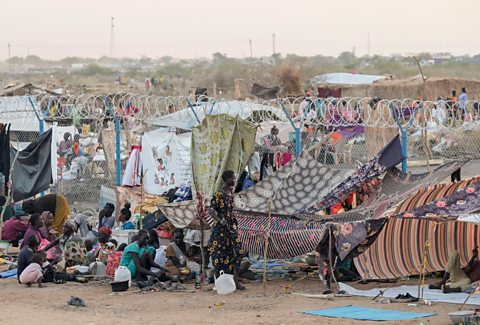 Image source, Joerg Boethling / Alamy
 One of the biggest factors limiting development in sub-Saharan Africa is armed conflict/war.
As of May 2024, there were 35 internal armed conflicts ongoing in sub-Saharan Africa, including the Central African Republic (CAR) Southern Sudan and the Democratic Republic of Congo (DRC). (Source: Geneva Academy)
In recent years, all these countries have each been badly affected by conflict and it is likely that the effects of these wars will be felt for years to come.
Image source, Joerg Boethling / Alamy Armed conflict has many devastating consequences including:
People are attacked and killed. Children lose parents, wives lose husbands, etc. The effects of war on families will be felt for years afterwards.
Facilities are destroyed or ransacked including homes, schools and hospitals.
People are forced to leave their homes and may also flee their country. Refugees spill over into other countries with nowhere to live and little on which to survive.
Farmland is neglected and crops fail. Problems of food shortage arise later.
Soldiers steal what they need including food supplies. Sometimes soldiers employ a ‘scorched earth’ policy which leaves whole communities without homes, farm animals, food and fresh water supplies, clinics, schools, etc.
Children are taken as child soldiers where they experience horrific abuse.
War costs money. Often poor countries borrow to fund wars leaving a legacy of debt.
Soldiers prevent aid agencies such from helping those in need. Emergency supplies for those in need are stolen for use by the army.
Case study: Conflict in Sudan
Sudan statistics
| Life expectancy at birth | 67.6 years |
| Infant mortalities | 50.1 per 1000 live births |
| GDP per capita | $989.3 |
(Sources: UNICEF, WHO, World Bank)
Sudan is one of the largest and least developed countries in the world. In most of its recent history Sudan has experienced devastating internal conflicts which have severely limited its progress. The most recent conflict started in 2023 when a power struggle broke out between different military leaders. On one side there is the Sudanese Armed Forces (SAF) led by Lieutenant-General Abdel Fattah al-Burhan and on the other, there is the Road Support Force (RSF) led by General Mohamed Hamdan “Hemedti” Dagalo.
The consequences of the current conflict have been catastrophic for Sudan’s development, coming after many previous devastating conflicts. A 2024 report by news agency Al Jazeera stated that this conflict had led to up to 7.2 million people being displaced from their homes on top of 2.8 million from earlier conflicts. 55% of these people are children. The report also estimated that as many as 150,000 people had been killed.
The UN estimates that 18 million people are acutely hungry, with 3.6 million children acutely malnourished. Both sides have been accused of war crimes including targeting civilian areas and deliberately blocking humanitarian aid.
In June 2024, the United Nations Security Council passed a resolution demanding the RSFs withdraw all its fighters from El Fasher in the Darfur region of north Sudan given the threat to civilians.
Quiz
Recap what you have learned
Many African countries face political development challenges due to:
- bad governance
- undemocratic rule
- not respecting human rights
- widespread corruption
- mismanagement of resources and funding
There is ongoing conflicts in sub-Saharan Africa, including those in the Central African Republic, Southern Sudan and the Democratic Republic of Congo.
War and conflicts can have devastating impacts such as:
- displacement of people
- loss of life
- food insecurity
- a legacy of debt
- communities destroyed due to soldiers employing a ‘scorched earth’ policy
All of these factors hinder long-term development and stability.
More on Development sub-Saharan Africa
Find out more by working through a topic
- count5 of 9