Social factors affecting development in sub-Saharan Africa
Quick version
Social factors that can lead to development challenges include a lack of educational opportunities and a lack of good healthcare systems.
A 2020 report into education in sub-Saharan Africa found that one-fifth of children between the ages of 6 and 11 years were not in school.
Only 42.56% of people in sub-Saharan Africa have access to essential healthcare services.
In 2022, the average life expectancy in sub-Saharan Africa was around 57.8 years for men and 61.6 years for women.
Learn in more depth
Keep going to learn more on:
- Education in sub-Saharan Africa
- Case study: Malawi
- Healthcare in sub-Saharan Africa
- Case study: Kenya
Then test how much you have learned.
Which social factors affect development in sub-Saharan Africa?
There are many social factors which limit development in sub-Saharan African countries. Two key social factors are:
- a lack of educational opportunities
- a lack of healthcare facilities
What level of education is there in sub-Saharan Africa?
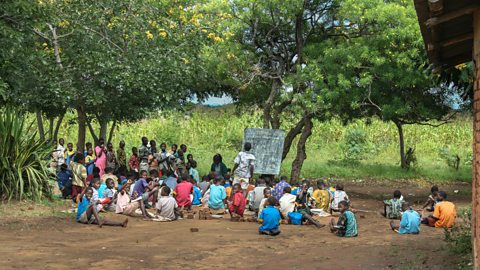 Image source, Julian Lott / Alamy
The United Nations Educational, Scientific and Cultural Organization is the United Nation’s specialised agency for education.
In 2020, UNESCO published a report into education in sub-Saharan Africa which found:
- one-fifth of children between the ages of 6 and 11 years were not in school
- of those aged 12 to 14 years, one third were not in school
- the number of children not in education was likely to increase
- many schools in Africa lacked basic amenities, such as access to electricity and potable (drinkable) water
- there is an estimated need for 15 million new teachers in sub-Saharan Africa by 2030
- the current teacher shortage means class sizes that are too large
- educational inequality where pupils of many ages and stages were being taught in the same room
Female education is a particular concern. UNESCO found:
- across sub-Saharan Africa, 9 million girls would never go to school, compared to 6 million boys
- 23% of primary school aged girls were not in primary school compared to 19% of boys
- 36% of secondary school aged girls were not in school compared to 32% of boys
Image source, Julian Lott / AlamyHow does education affect development?
There is a close link between a country’s educational success and its development.
A well-educated adult workforce is essential for development.
- High educational attainment within a country provides skilled workers for industry which may then see businesses relocate to employ the skilled workers.
- Skilled workers are more highly paid.
- More highly paid workers can pay higher taxes.
- More tax collected provides the government with greater income to invest in more educational opportunities for the next generation of people from that country.
This is a positive cycle of development.
However, the opposite is true when there are few educational opportunities.
Countries with very high levels of human development e.g. Switzerland Human Development Index - a composite measure of development within a country using GNI per capita, years of education and life expectancy rank 1 has a total of 13.9 years for mean years of schooling. However, Somalia HDI rank 193 (of 193 countries) has a total of 1.9 years for mean years of schooling.
UN Sustainable Development Goals
In 2015, the United Nations drew up 17 Sustainable Development Goals.
Goal 4 is Quality Education, which includes a global target to:
Ensure inclusive and equitable quality education and promote lifelong learning opportunities for all.

Case Study: Education in Malawi
Malawi is a country located in the south of the African continent. According to a report from UNESCO published in early 2024, Malawi is facing a “learning crisis”.
Statistics on education in Malawi
| Primary education completion rate | male = 76% | female = 85% |
| Secondary education completion rate | male = 24% | female = 22% |
| Higher education completion rate | male = 2% | female = 1% |
UK and Malawi comparison
| UNDI rank | Pupil/Teacher ratio | Adult (15+) literacy rate percentage (%) | |
|---|---|---|---|
| United Kingdom | 15 | Scotland = 13.2 to 1 | 99% |
| (2022-23 stats) | England = 18.0 to 1 | 99% | |
| Malawi | 172 | 59 to 1 | 68% (2022) |
UK (classed as very high human development)
Malawi (classed as low human development)
(Sources: UNESCO, govt.scot, gov.uk (2022-2023))
These statistics show that:
- Many children and young people in Malawi are not completing primary education.
- Most will not complete secondary education.
- Only a very small percentage will complete higher education.
(Source: UNESCO)
By comparison, in Scotland 41.4% of people have a university degree or professional qualification.
The statistics from Malawi (and many other African countries) suggest that although most children do complete primary education, 89% were not able to read as well as they could be expected to read by age 10 years. They had experienced “learning poverty” i.e. their level of education was below where they should have achieved.
A 2022 report from the World Bank, has estimated that with so many children experiencing learning poverty, these young people would be at risk of losing huge amounts of earnings later in life, as they did not have the educational qualifications required to secure better employment.
Malawi and other African countries would also not benefit as much from the work of an under-educated population, significantly reducing the economy and the country’s GDP.
An under-education population means reduced development.
What level of healthcare is there in sub-Saharan Africa?
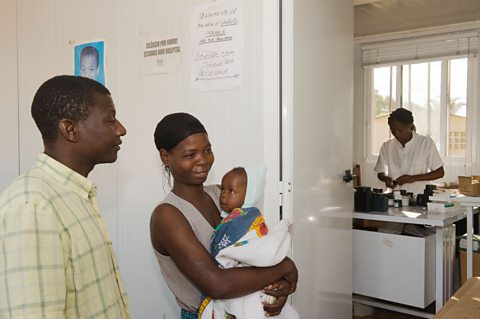 Image source, Ulrich Doering / Alamy
Although there has been significant progress in improving health outcomes and developing healthcare provision across Africa, substantial challenges remain.
There is a close link between a country’s healthcare provision and its development.
The United Nations 17 sustainable development goals also included a global target to:
Ensure healthy lives and promote well-being for all at all ages.
(UN Sustainable Development Target No. 3).
Image source, Ulrich Doering / AlamyHow does healthcare impact on development?
Quality healthcare is an important requirement to allow a country to develop:
When people’s health is properly provided for, they are in a better position to gain an education and then work.
With work, people can earn a higher income and thereafter pay more tax.
Healthier people are likely to remain in work for longer and can keep paying tax to the government.
Once more, for government, the greater the tax return, the greater the opportunity to invest further in health.
Again, a positive cycle of wealth-creation is created.
How does healthcare in sub-Saharan Africa compare to Europe?
Norway is a country with very high levels of human development. It has an HDI rank 2 and a high life expectancy (83.4 years at birth).
South Sudan has low levels of human development, an HDI rank of 192 (of 193 countries) and a low life expectancy (55.6 years at birth).
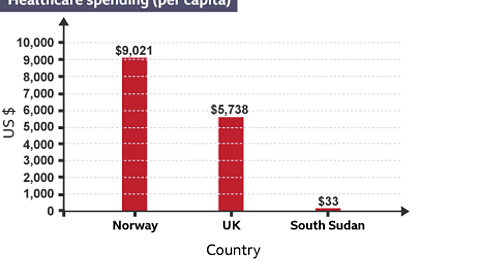
In terms of healthcare spending per capita, i.e. amount spent on healthcare spent in that area, divided by the number of people there, Norway spent $8,637 in 2022 compared to South Sudan at $49.41 in 2022.
Healthcare in sub-Saharan Africa, UK and Norway
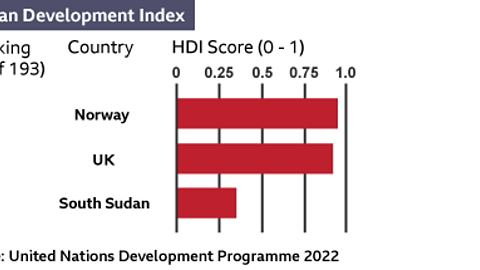
Image caption, Graph showing HDI scores for Norway, UK and South Sudan.
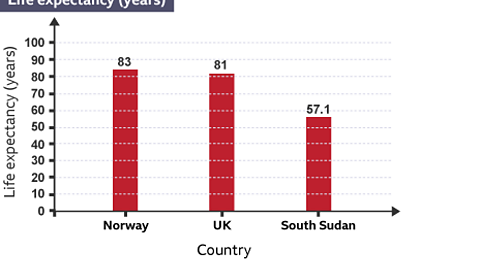
1 of 3
What are current health outcomes in sub-Saharan Africa?
Average life expectancy in sub-Saharan Africa is around 57.8 years for men and 61.6 years for women in 2022. (Source: United Nations 2022)
Two-thirds of people living with HIV/AIDS live in Africa. (Source: 2021 - National Library of Medicine 2023)
There were 228 million recorded cases of malaria in 2020 (95% of all malaria cases in the world with 602,000 malaria deaths (80% of these were children aged below 5 years). (Source: World Health Organisation 2022)
Of 1.9 million stillbirths globally, 47% in sub-Saharan Africa. (Source: United Nations Inter-agency Group for Child Mortality Estimation (UN IGME) 2023).
Nearly 1 in 10 children dies before their fifth birthday. (Source: World Health Organisation 2022)
What level of health provision is there in WHO Africa region?
Only 42.56% of people in sub-Saharan Africa have access to essential healthcare services. Source: The National Library of Medicine
Africa has an average of 1.55 health workers per 1000 population below the 4.45 health workers per 1000 population needed to deliver essential services. Source: British Medical Journal Global Health, 2022.
There will be a shortfall of 6.1 million health professionals across Africa by 2030. Source: World Health Organization 2022
Europe had 3.4 million medical doctors and 7.4 million nurses for 743 million people in 2022 compared to Africa with 300,000 doctors and 1.2 million nurses for 1.2 billion people. Source: World Health Organization 2022
UK and Mozambique comparison
| UNDI rank | Life expectancy years | Spending per capita | Healthcare spend % of GDP | |
|---|---|---|---|---|
| United Kingdom (2023) | 15 | 80.4 | $5493 | 11.3% |
| Mozambique (2021) | 83 | 60 | $45 | 9.05% |
UK (very high human development)
Mozambique (low human development)
(Sources: OECD, WHO, World Bank)
Case Study: Kenya
Kenya is a developing country in East Africa. It has a population of around 56 million (2024). Like most developing countries, it struggles to provide quality healthcare services to its people.
GDP per capita in Kenya in 2023 was $1,949 compared to the UK which was $48,866.
Kenya’s healthcare system faces many challenges in providing for the needs of the population. The country is desperately short of many types of healthcare services. Rural areas being particularly affected.
Across the country, Kenya’s doctor-to-patient ratio is 1 doctor to 5,725 patients, far above the United Nation’s target of 1: 1,000 UK approx. 1: 314).
There are also shortages of facilities, hospital beds, medical equipment and of nursing staff. There are shortages of oxygen sources and ambulances and a lack of facilities to train more people to deliver healthcare services.
Maternal mortality rate in Kenya
One consequence of a lack of healthcare facilities is in services for expectant mothers. In 2022, a report by the World Bank found that the maternal mortality ratio (MMR) in Kenya was one of the highest in the world. MMR measures the risk of maternal death associated with pregnancy and childbirth.
It recorded a death rate for women of 530 per 100,000 births, with the rate twice as high in rural areas compared to urban areas.
How does healthcare vary across Kenya?
There are more healthcare services in urban areas of Kenya than in rural areas.
The country has a small number of very wealthy people (the top 1% of Kenyans – 8,300 people - are thought to be wealthier than the bottom 99% - 44 million Kenyans) and there are health services available in the largest cities, such as the capital Nairobi. For the wealthiest Kenyans there is a range of healthcare provision which they can afford to access.
The World Economic Forum estimates that 72% of Kenya’s population lives in rural areas with limited access to healthcare services.
How are healthcare issues in Kenya being addressed?
In 2023, to tackle some of the problems in the Kenyan healthcare system, including shortages and access to services, parliament passed the Social Health Insurance Act.
This parliamentary act increased the amount of money people pay for their healthcare services (to 2.75% of their annual salary), as well as increasing the rate for the highest earners.
Investment in healthcare has increased at a local level. In 2021, nearly 80% of Kenya’s 48 counties allocated 30% or more of their budget to health - up from an average of 19% in 2015.
(Source: Royal Society for Public Health)
Quiz
Recap what you have learned
People having access to good education is vital for a country's development as high educational attainment within a country provides a skilled workforce.
Skilled workers also pay higher taxes which provide the government with greater income to invest in more educational opportunities for the next generation.
One-fifth of children aged 6-11 and one-third of those aged 12-14 are not in school in sub-Saharan Africa with many schools lacking basic amenities such as access to electricity and portable water.
A strong healthcare system is essential for a healthy workforce and economic growth within a country.
Many sub-Saharan Africa countries have poor healthcare, with 42.56% of people not having access to essential healthcare.
Africa has an average of 1.55 health workers per 1,000 population below the 4.45 health workers per 1,000 population needed to deliver essential services.
Of 1.9 million stillbirths globally, 47% occur in sub-Saharan Africa.
More on Development sub-Saharan Africa
Find out more by working through a topic
- count5 of 9