Attempts to resolve a lack of development in Sub-Saharan Africa
Quick version
Bilateral aid is aid is given directly from one country to another.
Multilateral aid is aid from international organisations such as the UN or World Bank. Multilateral aid allows collective efforts from multiple countries.
Non-Government Organisations (NGOs) or voluntary organisations such as Oxfam and Save the Children also provide aid funded by donations or through governmental and international support.
Military involvement has also been utilised for humanitarian efforts.
Critics of aid argue that it can promote dependency and corruption with aid being wasted on projects that do not help the poorest.
Learn in more depth
Keep going to learn more:
- What is bilateral aid?
- What is multilateral aid?
- How do voluntary organisations provide aid?
- Military intervention to support humanitarian efforts
- Why is international aid criticised?
Then test how much you have learned.
What is bilateral aid?
There are many non-military ways in which the development can be supported in Sub-Saharan Africa including bilateral aid.

Bilateral ODA (Official Development Assistance) is aid given directly by one country to another.
This type of aid is usually given from one government to another government, but some bilateral aid may be delivered through third party partners e.g. voluntary organisations.
The majority of UK aid is bilateral. In 2024, the UK provided £11,261 million in bilateral aid which was an increase of 13% (£1,257 million) from 2023.
In terms of where in the world UK bilateral ODA is spent, in 2024 Africa received the most aid (£1,479 million), followed by Asia (£1,040 million).
(Source: gov.uk)
Although UK bilateral aid is spent in a range of different projects, the UK government states the priorities for the aid budget are:
- reducing hunger
- reducing poverty
- tackling climate change.
For example, in 2023 over £100 million was to be spent on tackling food insecurity in countries such as Ethiopia, Sudan, South Sudan and Burkina Faso.
These priorities are in line with the United Nation’s Sustainable Development Goals (SDGs).
There has been continued ongoing controversy in respect of the UK government’s decision in 2020 to reduce the amount of money spent on overseas aid. Aid spending was reduced from the United Nation target of 0.7% of Gross National Income (GNI), first achieved by the UK in 2013, to 0.5% of GNI.
At the time, the Conservative government claimed the temporary cut in overseas aid was to offset additional UK government costs associated with the COVID pandemic. It aimed to reverse the cut some time after 2027/28.
The decision to cut UK aid has been widely criticised.
The House of Commons International Development Select Committee (IDC) stated in 2023 that the aid cut would have a “devastating” effect especially on women and girls with the cancellation of many sexual and reproductive health programmes.
It stated that in 2020 approximately 287,000 women died during pregnancy and childbirth in Sub-Saharan Africa and that cuts to UK aid levels would endanger many more women and children. The chair of the International Development Select Committee said,
A girl in South Sudan is more likely to die in childbirth than to finish secondary school
There are currently no signs of a return to the UK spending 0.7% of GNI on international aid despite calls from Non-Governmental Organisation (NGOs) such as Save the Children and Oxfam.
In February 2025, the Prime Minister, Keir Starmer, announced that the UK would increase defence spending by reducing aid spending from 0.5% of GNI to 0.3% in 2027.
The Labour government said they will return international aid spending to 0.7% of GNI when the country’s finances allow, but in the short-term, they aim to target UK aid better, where support has the potential to improve the lives of the poorest in the most-needy countries.
Why do governments give aid?
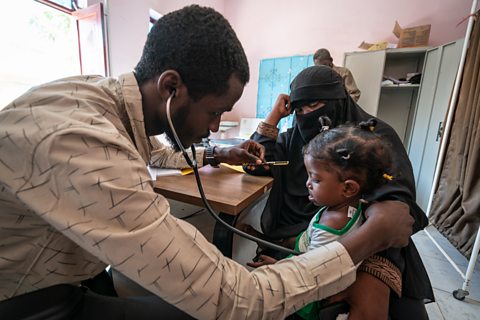 Image source, Giles Clarke / Getty Images
Individual governments, including the UK, provide aid for a number of different reasons:
To meet their international obligations. For example, the UN-recommended target for developed countries to provide at least 0.7% of Gross National Income (GNI) in international aid.
Humanitarian reasons. These include responding to emergencies such as drought or flooding, or to tackle disease such as HIV/AIDS or malaria or to reduce poverty
To help reduce the impact of climate change and support progress towards the United Nations’ Sustainable Development Goals (SDGs)
To help improve the international image of the country as well as promote trade and business links between the donor and receiving countries. Some commentators argue this also gives the donor country greater influence over the receiving countries.
Economic factors - Many African countries have large mineral and other resources. Providing aid and investment may be seen as a way for countries to access resources and boost their own economies. Countries with existing relationships with African nations may have easier access to new and growing markets for goods and services.
It is worth noting that a sizeable percentage of the money which is described as “international aid spending” is often spent in the donor country. For example, in 2023 £4.3 billion (27.9%) of the total UK overseas development budget was spent supporting refugees in the UK.
(Source: gov.uk)
Image source, Giles Clarke / Getty ImagesWhat is multilateral aid?
Multilateral aid is aid which is delivered by international organisations such as the United Nations (UN) or the World Bank.
For the United Nations, most multilateral aid funding comes for member country governments.
The amount paid by each United Nations member country depends on the size of the country’s economy. As the US and China have the world’s biggest economies, they paid the most to the United Nations. In 2022, the US gave the United Nations over $18 billion by way of financial contribution.
In 2023, the UK provided £5,517 million to multilateral organisations. This was 35.9% of total UK aid.
(Source: gov.uk)
How do voluntary organisations provide aid?
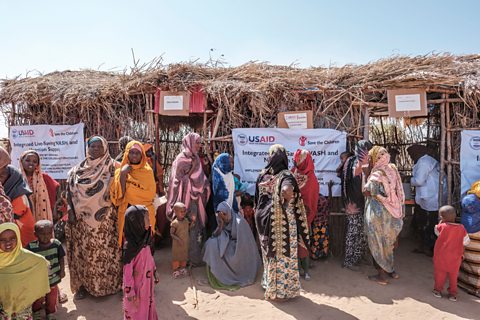 Image source, EDUARDO SOTERAS / Getty Images
Non-Governmental Organisations (NGOs) or voluntary organisations play an important role in trying to further development in sub-Saharan African countries.
There are many well-known NGOs which support a range of development projects in sub-Saharan Africa. For example, Oxfam, Save the Children, WaterAid and The British Red Cross, all provide development support and assistance.
Most of the income for NGOs comes from charitable donations but on some occasions, NGOs receive support from governments or international organisations such as the United Nations.
The amount of aid given by NGOs is far less than the amount of aid given by national governments.
For example, Save the Children is one of the world’s largest NGOs. It had a total income in 2024 of £309 million of which £215 million was spent on assistance programmes internationally and in the UK. This represents less than 3% of the UK's aid budget in 2024.
(Source: Save the Children, annual report 2024)
Nonetheless, NGOs undertake extremely important work which positively impacts on the lives of millions of people every year.
Unlike governments of individual countries, multilateral and voluntary organisations are principally motivated by humanitarian reasons when giving aid.
Image source, EDUARDO SOTERAS / Getty ImagesMilitary intervention
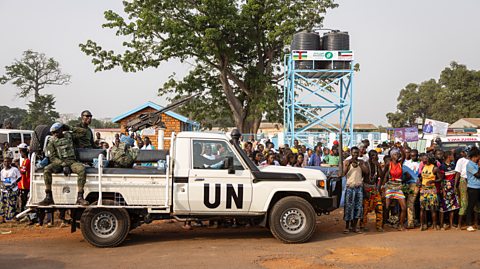 Image source, PATRICK MEINHARDT / Getty Images
Although military interventions in sub-Saharan Africa have largely been in response to trying to reduce ongoing conflict, there have been occasions where military personnel have been used to help support humanitarian efforts and provide development assistance:
Central African Republic
In 2024 there were 17,420 United Nations uniformed personnel employed in a variety of roles as part of the Multidimensional Integrated Stabilization Mission in the Central African Republic (MINUSCA) peacekeeping operation.
Where called upon, peacekeeping soldiers were involved in:
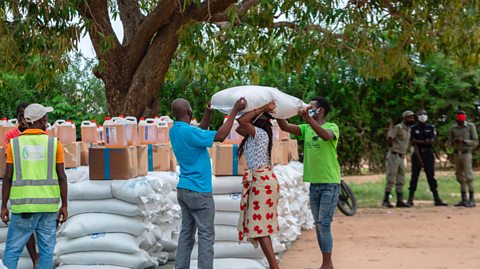
- distributing humanitarian assistance including emergency food and medical supplies
- protecting and assisting aid workers to ensure development projects could progress.
South Sudan
In South Sudan in 2024, over 19,000 international peacekeeping personnel were deployed as part of a United Nations Mission in South Sudan (UNMISS) operation.
As in the Central African Republic, military personnel have been delivering humanitarian assistance as well as assisting with projects to support development in education and healthcare.
Image source, PATRICK MEINHARDT / Getty ImagesThe aid debate
Although international development aid is important in helping to support people in humanitarian crises and promoting long-term development, the giving of international aid has been criticised by some economists.
Critics of international aid claim that a great deal of the aid is wasted on projects that do not help the poorest. They argue it facilitates greater corruption in developing country governments and aid encourages dependency where developing countries become tied to aid “hand-outs” as opposed to aid being used to provide a “hand-up” to develop themselves.
Those who support the giving of overseas aid, such as the United Nations and Non-Governmental Organisations (NGOs), would argue that without international aid more people would die or live in extreme poverty and economic development would be slower, widening the gap between the developed and the developing world.
Whatever overall view of international development aid, the reality is that this aid is not guaranteed, and many countries have significantly reduced their aid budget in recent years.
Quiz
Recap what you have learned
Governments and international organisations have taken numerous approaches to address underdevelopment in Sub-Saharan Africa, involving both military and non-military methods.
Non-military approaches include:
- Bilateral aid where countries provide direct assistance. The majority of all UK aid is bilateral and the UK spent £11,261 million in bilateral aid in 2024.
- Multilateral aid involves international bodies like the United Nations and the World Bank. In 2023, the UK provided £5,517 million to multilateral organisations.
- Voluntary organisations or Non-Governmental Organisations (NGOs) such as Oxfam and Save the Children play a key role, funded by donations or through governmental and international support.
Although military involvement is often tied to reducing conflict, it is also used for humanitarian efforts. In places like the Central African Republic and South Sudan, military personnel have been delivering humanitarian assistance and supporting development projects.
Some economists argue aid can promote dependency and corruption, while supporters believe it is essential for humanitarian relief and development.
More on Development sub-Saharan Africa
Find out more by working through a topic
- count9 of 9
- count1 of 9