Economic factors affecting development in sub-Saharan Africa
Quick version
Countries in sub-Saharan African often face unfair terms in global trade, receiving minimal benefits such as low payment levels for exports like cocoa and bananas.
African agricultural producers encounter tariffs and other trade barriers. It can be difficult to sell their goods competitively and reinvest in their own countries to improve themselves.
Although all countries take on loans to finance development projects, many African countries face unsustainable debt levels which hinder economic growth.
High debt forces countries to choose between repayments and providing public services to support their people.
Learn in more depth
Keep going to learn more about:
- trade
- international debt
Then test how much you have learned.
How do terms of trade affect development in Africa?
There are many economic factors which limit development in African countries. These factors include:
- terms of trade
- debt.
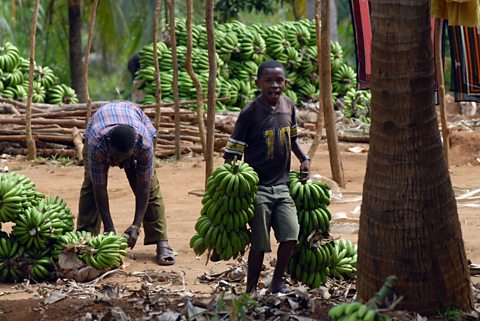 Image source, Kim Haughton / Alamy
 International trade can benefit all countries involved.
Trading goods as freely as possible can:
- create jobs
- deliver higher pay
- ultimately, lead to more wealth and a better standard of living for everyone.
For many Africa countries, global trade does not bring these benefit as fully as they should.
Many of Africa’s poorest people, such as farmers and agricultural labourers (who do most of the work when it comes to the producing commodities including cocoa and bananas), gain little benefit from the goods they sell to international buyers.
Often payment levels for goods are very low. According to the Fairtrade Foundation, on average cocoa famers earn just 6% of the final value of a chocolate bar. This is one reason around 429 million people in Africa were living in extreme poverty (income below US $2.15 per day) in 2024.
Agricultural producers in many African countries face trade barriers (or restrictions on how they can trade) with the likes of the European Union and therefore find it difficult to sell their goods at competitive rates.
As a result, African countries cannot secure enough income from the sale of their goods to reinvest in their own countries to improve themselves.
In a similar way, heavily subsidised EU or USA food product surpluses, such as milk powder and poultry, have often been said to have been “dumped” on African markets, undercutting local farmers and destroying local production.
Image source, Kim Haughton / Alamy Case study: Cocoa farming in West Africa
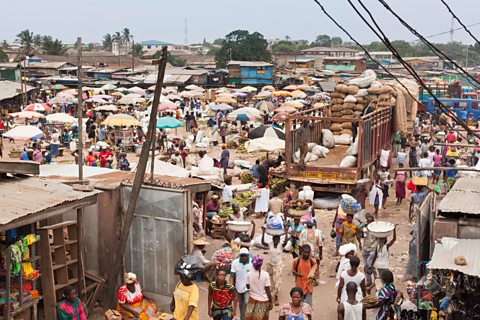 Image source, David Dorey / Alamy
 Cocoa is the main ingredients in chocolate.
West Africa grows around 70% of the world’s cocoa beans.
The value of the global chocolate industry runs into billions of pounds every year, however, many African farmers who grow the cocoa live in appalling poverty.
The wealth created from the trade in cocoa does not often find its way back to the ordinary West African farmers and their families.
Large multinational companies and traders determine low prices for cocoa beans, which leaves small business farmers unable to negotiate. Some farming families rely on child labour and as a result this next generation misses out on education.
A cocoa farmer’s livelihood is also dependent on land availability and weather conditions which can be affected by deforestation and climate change.
Image source, David Dorey / Alamy How does international debt affect development in Africa?
All countries take on loans to finance development projects, but too much debt and unsustainable levels of interest on debt repayments are a major cause of a lack of development in African countries.
According to World Bank Group, by the end of 2022, public debt in sub-Saharan Africa reached around $1.14 trillion.
In 2022, a UN report found that 24 African countries had a debt to GDP ratio over 60% the level seen as the threshold for sustainability.
The consequences of high debts and debt repayments for many African countries have been devastating. Countries must choose between paying debt or supporting their people:
- Between 2019 and 2021, 25 African countries spent more on interest payments than on health.
- Over the same period, seven African countries spent more on interest payments than on education.
(Source: UNCTAD, the United Nations Conference on Trade and Development)
Case study: Debt in Angola
Angola statistics
| Life expectancy (2024) | 62.5 years |
| Infant mortality rate (2024) | 38 deaths per 1,000 live births |
| Adult literacy rate (2022) | 72.4% |
Angola is situated in south west Africa. Is has a population of nearly 38 million people. Its capital city is Luanda where around 9.7 million people live.
Angola’s main export is oil, on which it depends heavily to make money. However, the fluctuating price of oil internationally leaves the country at risk of not being able to secure enough income from oil sales to pay its bills.
International debt is a major problem for Angola. It is one of the most indebted countries in Africa
– Angola’s government debt was 85.2% of the country's GDP in 2023.
- The country owes around $52 million.
This has a huge negative impact on the country’s ability to develop itself.
In 2022, Angola’s HDI was 0.59 placing the country in the medium human development category.
The impact of having to make international debt repayments before investing in education, healthcare and other developmental projects has been severe. A World Bank estimate for 2024 put the poverty rate (less than $2.15 per day) at 36.1% or 13.5 million people in the country.
Quiz
Recap what you have learned
429 million people in Africa live in extreme poverty (under $2.15 per day in 2024).
Often in sub-Saharan Africa, farmers and agricultural labourers do not get the benefits of global trade with those producing things like cocoa and bananas facing low payments from international buyers.
Cocoa famers on average earn just 6% of the final value of a chocolate bar.
Trade barriers can include things like tariffs from the European Union(EU), which can limit their competitiveness.
Heavily subsidised products from the EU and the USA, such as milk powder, are often dumped in African markets, undercutting local farmers.
African countries face high debt levels forcing many to choose between making debt repayments and providing public services like education, healthcare and other developmental projects.
In 2022, a UN report found that 24 African countries had a debt to GDP ratio over 60% the level seen as the threshold for sustainability.
More on Development sub-Saharan Africa
Find out more by working through a topic
- count5 of 9