Key points
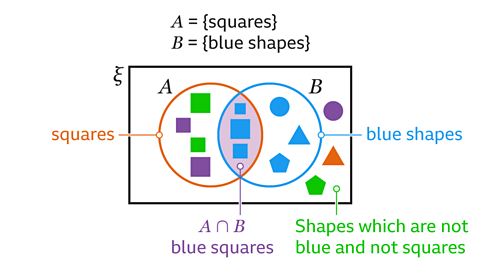
An A piece of information or a letter, or a number, in a set. Also described as a member of the set. of a A collection of information or letters or numbers. The members of the set can be listed inside curly brackets, { }. A set may be described in words inside curly brackets { }. On a Venn diagram a set is shown as a circle. is a member of that set.
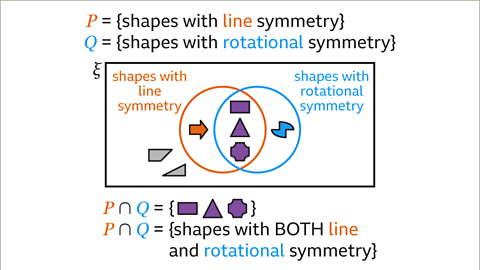
An element that is contained in two different sets is a member of both of those sets and is in the On a Venn diagram, the region where sets overlap. 𝑷∩𝑸 is the intersection of set 𝑷 and set 𝑸. 𝑷∩𝑸 = {elements in 𝑷 that are also in 𝑸}.
The intersection contains any elements that are common to all of the sets being considered.
The The largest factor that will divide into the selected numbers. Eg, 10 is the highest common factor of 30 and 20. Highest common factor is written as HCF. of two or more numbers can be found using the intersection of sets in a A diagram used to sort data..
Understanding and using the intersection of sets
The intersection of two or more sets is the overlap between the sets.
The symbol ∩ is used to show that sets Where lines cross or overlap..
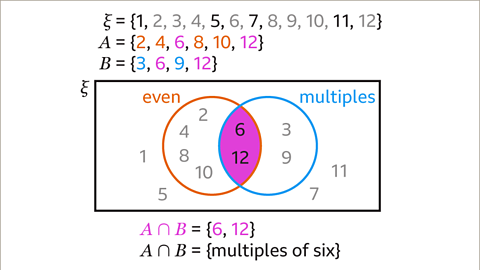
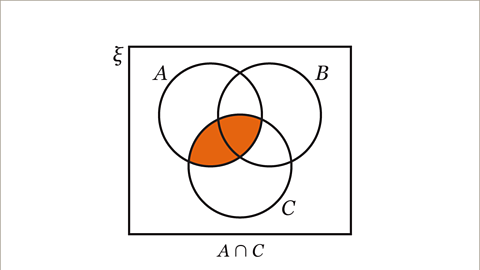
\(A\)∩\(B\) is the intersection of set \(A\) and set \(B\) and contains the set of elements which are in both set \(A\) and set \(B\).
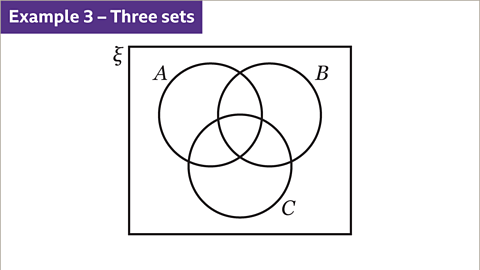
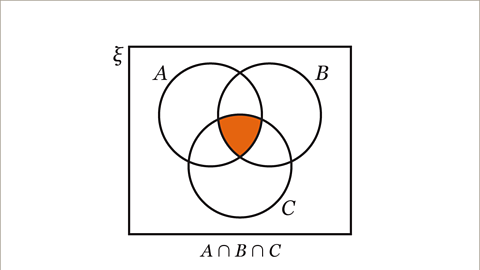
\(A\)∩\(B\)∩\(C\) is the intersection between set \(A\), set \(B\) and set \(C\) and contains the set of elements which are in set \(A\), set \(B\) and set \(C\).
The symbol \('\) is written after the lettered name of the set to give the complement of the set. \(Q'\) is the complement of set \(Q\).
Examples
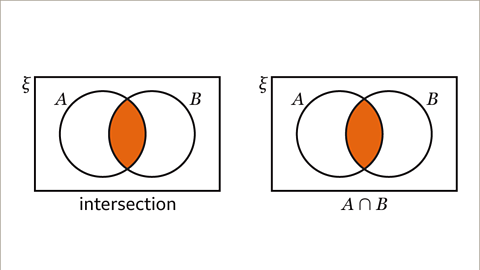
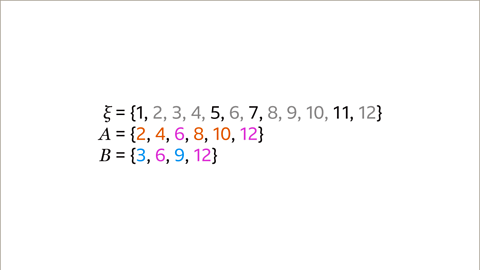
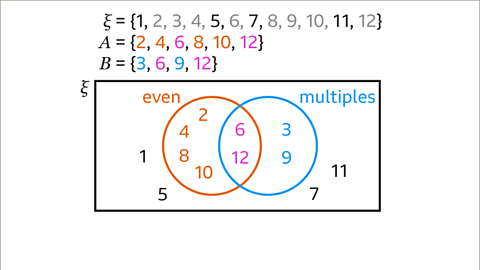
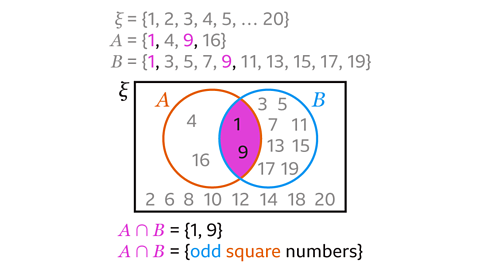
Image caption, The intersection of a set is the overlap between the sets. 𝑨∩𝑩 is the intersection of set 𝑨 and set 𝑩.
1 of 10
Question
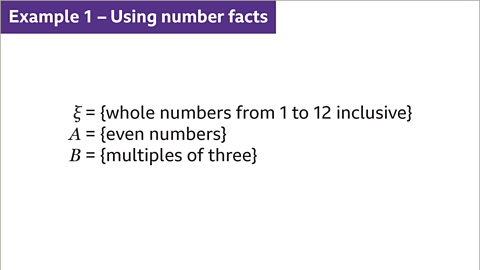
List the elements in 𝑨∩𝑩 and describe the intersection.
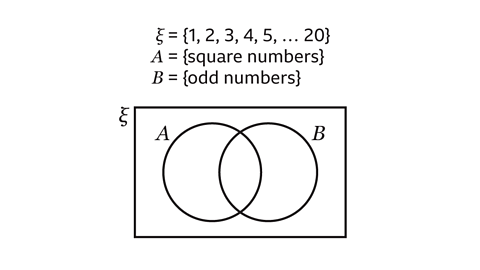
The elements in 𝑨∩𝑩 are numbers that are both odd and square.
These are the numbers 1 and 9
𝑨∩𝑩 = {1, 9}.
Use a Venn diagram to find the HCF of two or more numbers
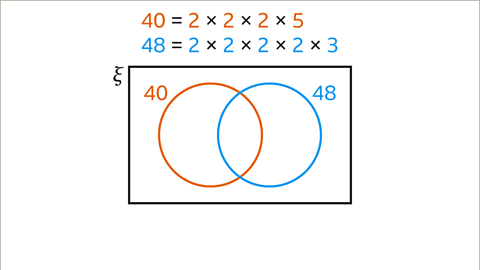
- To use a Venn diagram to find the HCF (highest common factor) of two or more numbers:
- Write each number as a The factors of 12 are 1, 2, 3, 4, 6 and 12. The prime factors of 12 are 2 and 3. 12 may be expressed as a product of its prime factors: 12 = 2 × 2 × 3 without using Indices are powers eg, 3 to the power of 2, written 3² .
- Draw a circle for each number. The circles will overlap.
- Place the factors that are common to both (or all) numbers in the On a Venn diagram, the region where sets overlap. 𝑷∩𝑸 is the intersection of set 𝑷 and set 𝑸. 𝑷∩𝑸 = {elements in 𝑷 that are also in 𝑸}. of the circles and place the remaining prime factors for each number in its own circle.
- Multiply the numbers in the intersection. The product of these numbers is the HCF.
Examples
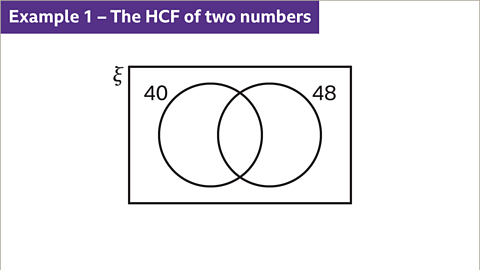
Image caption, Find the highest common factor (HCF) of 40 and 48
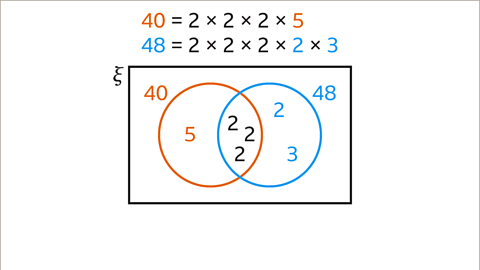
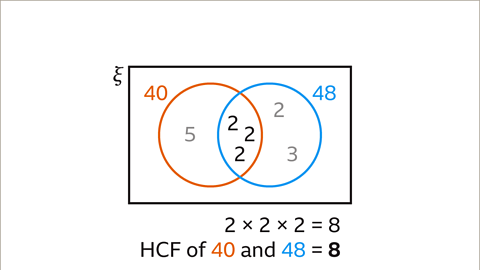
1 of 4
Question
Given the product of prime factors of 36 and 54, use the Venn diagram to work out the highest common factor of 36 and 54.
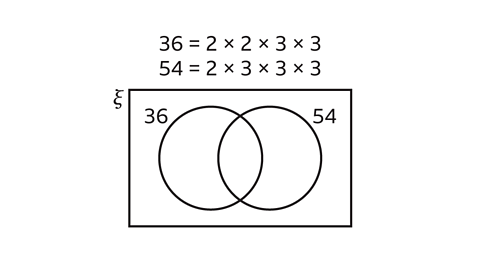
The circle for 36 contains the prime factors of 36. The circle for 54 contains the prime factors of 54
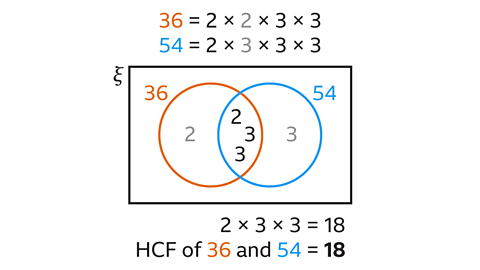
The intersection contains all the prime factors that are common to both 36 and 54
The HCF of 36 and 54 is the product of the common prime factors.
2 × 3 × 3 = 18
The HCF of 36 and 54 is 18
Practise understanding and using the intersection of two sets
Quiz
Play Sudoku with BBC Bitesize!
Every weekday we release brand new easy, medium and hard Sudoku puzzles. Perfect for testing your skill with numbers and logic.
More on Sets and Venn diagrams
Find out more by working through a topic
- count3 of 5
- count4 of 5
- count5 of 5
- count1 of 5