Hello, I’m Mrs Shaukat and today we will look at the skill of prediction.
When we are reading, we’re constantly thinking about what is happening.
I often ask myself questions when I’m reading like… What is happening? Why did he do that? Will that be important later in the plot? I wonder why that has happened now?
Good writers have this impact on us readers. Their writing ignites ideas in our minds and cause us to just speculate, “I wonder what might happen.”
Sometimes when we are reading we comment on characters or plot. For example… I didn’t expect her to do that! I feel betrayed by the writer, I trusted that character until now!
When we are reading we’re constantly predicting what might happen next.
It is very important to use what we have read to make our predictions.
Although it might be entertaining to predict out-of-the-box, the skill of prediction is actually quite hard.
Instead of predicting what we want to happen next, we need to predict what we think will happen next based on what has been stated out in plot.
Let’s try out our prediction skills now.
Two small children are in the forest looking for their dog.
Suddenly they hear a loud barking sound coming from behind the trees.
What happens next?
Pick the scenario you think is most likely.
One, the children are reunited with their dog.
Two, the children find their dog but he’s trapped in a cage.
Three, the children find their dog but he’s surrounded by aliens and mermaids.
Four, the children find their dog but he’s surrounded by aliens and mermaids who are in motorbikes and eating fish and chips.
Some of these predictions are based on what we have read. And some are really too far-fetched.
Which two are plausible?
Yes, the first two are believable as they are true to the setting.
We know that the children are in the forest looking for their dog.
They have heard him barking, so the chances are they have found him but may be in a cage.
However, the chances of aliens and mermaids on motorbikes, eating fish and chips in a forest, are slim.
And even though it might be the most exciting prediction, it is not true to the context.
When predicting, remember to identify characters, setting and plot.
Ask yourself who, where, what and why.
You could have some fun by thinking of a good prediction that is true to what we know, and a silly prediction that is not related to context.
Try at home with this one.
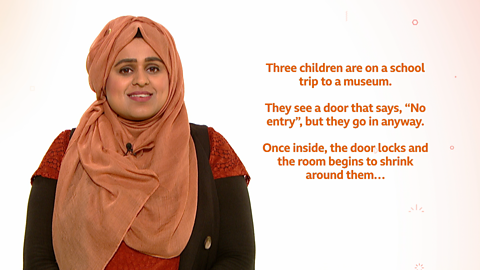
Three children are on a school trip to a museum.
They see a door that says, “No entry”. But they’re going in anyway.
Once inside, the door locks and the room begins to shrink around them.
Have fun predicting.
For more help, challenges and games on this subject visit bbc.co.uk/bitesize
Description
As we read, we naturally make predictions about things, like what is going to happen next or what does this word mean? We use clues in what we have already read to make these predictions. These clues are called context. You can learn more with this video.
Now playing video 8 of 10
- 4 of 10
- 6 of 10
- 7 of 10
- 10 of 10