Hello or…
A-up.
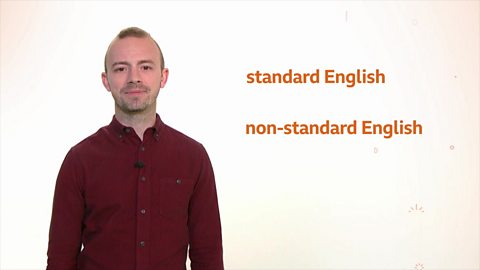
I’m Mr Smith and today we’re going to practise how to use standard and non-standard English.
Hyah.
Hey.
You good?
Good mornin’.
Mate.
Hello.
These greetings all convey a similar message: Hello.
However, some of these phrases include standard English and others non-standard English.
When we say standard English, we’re talking about the English uniformed language, which is taught around the world.
It follows the grammatical rules and the correct use of verb tenses or pronouns, and is used in formal settings such as writing a letter to the Queen or reporting the news.
Because it follows the core grammatical rules of English, it can be understood by a wide audience.
For example: “NASA scientists have discovered a new cluster of galaxies.”
On the other hand, we use non-standard English often in informal settings like with our friends or families.
Non-standard English generally follows most of the grammatical rules as standard English, but may also include slang and words particular to where we live.
For example: “We went NASA last year – them scientists are ace.”
So, when we speak or write, we need to consider our audience and identify if it’s a formal situation or an informal situation, and whether we should use standard or non-standard English.
Let’s take a closer look.
Coming up are a list of places and people you’re likely to talk or write to.
I’d like you to divide them up into formal and informal situations.
Ask yourself: do you know the person or are they in a position of authority?
Ready?
Excellent.
There’s actually only one example of an informal setting here – and that’s chatting with your friend about a film.
The other three examples are all formal situations, so would therefore require you to use standard English.
OK, next up – believe it or not – Barack Obama, former president of the United States of America, is coming to dinner.
The question is whether he’d like peas or beans with his meal.
Should we use standard English to ask him or non-standard English?
Is it a formal or informal situation?
And therefore, which sentence do you think is most appropriate?
That’s right.
We should use standard English and ask:
“Mr Obama, would you prefer peas or beans with your meat?”
The former president might be a familiar face to us and we may also be in our own home.
However, most of us don’t know him personally.
So, we should use formal language and standard English.
Next up, can you turn a sentence using non-standard English into a sentence using standard English?
Let’s do it.
“They was really noisy in the hall and the teacher weren’t happy.”
You may say this sentence to your friends.
But if you were to write this, it’s really important to write in standard English.
In order to transform this sentence into one using standard English, we need to swap out two words.
Which words are they?
That’s right – “was” and “weren’t”.
Which words should we use instead to transform this sentence from using non-standard English to standard English?
Let’s take a look now.
Using standard English the sentence will now read:
“They were really noisy in the hall and the teacher wasn’t happy.”
Did you suggest them too?
Awesome.
So, “well done” – standard English.
And “nice one, guys” – non-standard English.
You’re now an expert linguist.
Why not write a poem next?
One draft in standard English and the other in non-standard English.
For more help, challenges and games on this subject, visit bbc.co.uk/bitesize
Description
Standard English is used in formal settings, such as when we talk or write to people we don’t know well, such as doctors or head teachers. We use non-standard English in informal settings, such as when we are more relaxed and with people we know well. Mr Smith explains more in this video.
Now playing video 9 of 10
- 4 of 10
- 6 of 10

- 7 of 10