MR MCPARTLIN: Hello, I’m Mr McPartlin, and today we’re checking out the similarities and differences between biographies and autobiographies.
Biography and autobiography. These words might look and sound pretty similar. But they don’t mean the same thing.
First, let’s start with the similarities. Biographies and autobiographies tell the story of someone’s life. They’re both written in the past tense and recount events in chronological order—that’s the order in which things happened.
While it may be fun to add in outrageous tales or a moment of great valour that didn’t actually happen, biographies and autobiographies are non-fiction works. They tell the lives of people as accurately as possible.
Now we’ve covered the key similarities. So, what’s the main difference between the two?
An autobiography is written by a person about their own life. This means it will be in the first person, using words such as “I”, “my” and “me”.
Whereas a biography is written about another person’s life. So it’ll often name the individual it’s writing about and refer to them in the third person, with words such as “she”, “they” and “her”.
Let’s put our knowledge into practice. Coming up are two sentences. I’d like you to work out whether each belongs in the autobiography or the biography.
“Her determination and strength shone as she led the national rugby team to victory.” Where does this sentence belong? That’s right—by using the pronouns “she” and “her”, this sentence belongs to the biography.
How about this sentence?
“I was six when I first picked up an electric guitar. Guitar in hand, I could see my name in lights.” Ready?
Well done!
Yes, this is from an autobiography. The three "I"s and “my” were big hints here.
Ready to make a start on your own autobiography?
Brilliant!
Whether you are writing an autobiography of your life or the biography of someone you admire, these handy tips will have you sorted for both.
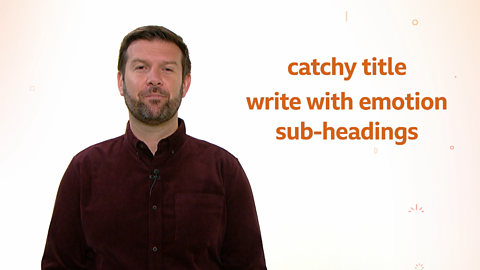
First up, you need a catchy title. “Astronauts, Asteroids And My Love Of Aliens” is so much more interesting than just “My Life.”
Next up is writing with emotion. Once you’ve established the facts, add in the feeling. This will help to make your reader feel like they were there.
For instance:
“My nerves boiled within me as the rocket burst into action. It was equally thrilling and terrifying.”
Finally, there’s so much to say in an autobiography and biography that sub-headings can really help the reader to navigate the way through.
For example: Astronauts, School, Life in Space, and Touchdown would be super sub-headings for this astronaut autobiography.
Why don’t you try writing your own autobiography? You’ll also need:
A super catchy title.
Lots of descriptive, emotive moments.
A few subheadings to guide your reader through.
Some autobiographies are even turned into films.
I wonder which actor or actress would play you in your best-selling autobiography?
For more help, challenges and games on this subject, visit bbc.co.uk/bitesize.
Description
Biographies and autobiographies both tell the story of somebody’s life, but they are different. An autobiography is written by a person about their own life, whereas a biography is written by a person about somebody else’s life. Mr McPartlin explains more in this video.
Now playing video 1 of 10
- 4 of 10
- 6 of 10
- 7 of 10
- 10 of 10