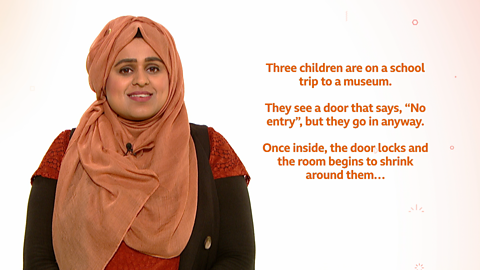
Hello. I’m Mrs Shaukat and we’re going to find out about subject-verb agreement.
I don’t always agree with my friends, but that’s okay.
However, the subject of a sentence and its verb must agree.
What do I mean by that? Let’s take a look.
The verb is the word in the sentence that shows action - words like “kick”, “jump”, “laugh” - or being, like “am”, “is”, or “are”.
The subject of a sentence is the person or thing that’s doing the action or being something.
So, in this sentence,“Lucy kicks the ball”, the subject is “Lucy” and she’s doing the kicking.
You have to match the verb to whoever or whatever is doing or being something in the sentence.
You wouldn’t say, “I is here” or “I are here”.
But you would say, “I am here”.
And you wouldn’t say, “He kick the ball”.
But you would say, “He kicks the ball”.
You pick the right verb to go with the subject of the sentence. They fit, they suit each other, they go together, they agree.
Spot the subject in this sentence and say A or B when you think you know the answer.
The donkey is in the field.
Is the subject A, donkey,
or B, field?
If you said A, donkey, you were right. The donkey is doing the being. So the sentence’s subject is “donkey”.
Next sentence.
At the bus stop, Anwar sings loudly.
Is the subject A, bus stop,
B, Anwar,
C, loudly?
The subject of the sentence is B. Anwar, the person doing the singing.
Some sentenceshave more than one subject, but each subject must still agree with its verb.
Here comes a sentence with two subjects. The bus and the children.
And it has two verbs, one for each subject.
A, the bus stop and the children gets on.
And B, the bus stopsand the children get on.
Which version of this sentence is right? A or B?
The answer is B: The bus stops and the children get on.
Phew! The subjects and their verbs agree.
Now you practise spotting the subject of a sentence.
Now it’s time to choose the right verb to fit that subject. Which verb should fill the gap here?
Is it A, “eat”,
or B, “eats”?
The answer is B: Jenni eats an apple.
Next, what about this one?
Is it A, “are”,
B, “is”,
C, “am”?
The answer is B, “Anwar is asleep”.
Now you’re getting the idea.
If the subject is singular - there’s just one person or thing - its verb shows that too.
And if the subject is plural - there’s more than one person or thing - its verb will show that too.
It’s the same with “was” and “were”.
Try this last sentence.
Should it be A, “The two donkeys was happy and Jenni were happy too”?
Or is the correct sentence B, “The two donkeys were happy and Jenni was happy too”?
Yes, it should be sentence B.
The two donkeys were happy and Jenni was happy too.
Two subjects and two verbs that agree with them.
So, remember…
The subject of a sentence and its verb must agree.
Spot the subject. See if it is singular or plural. Then check the verb fits and the subject and verb suit each other.
Check they agree.
Agreed?
Agreed.
For more help, challenges and games on this subject, visit bbc.co.uk/bitesize
Description
The verb in a sentence is the word that shows action or being. The subject of a sentence is the person or thing that’s doing the action, or being something. Join Mrs Shaukat in this video to learn more.
Now playing video 2 of 10
- 4 of 10

- 6 of 10

- 7 of 10

- 10 of 10