Worship at home
In Judaism the home is often regarded as the most important place of worship and includes prayers, observing The seventh day of the week; a day of spiritual renewal and rest commencing at sunset on Friday and terminating at nightfall on Saturday., celebrating festivals and studying the scriptures. Many Jews believe that praying regularly at home helps to build their relationship with God.
Praying at home
The Jewish prayer book, the The literal meaning is order, ie the order of the synagogue service. The term is used for the daily prayer book used by Jews., includes special services which can be followed at home as well as in the Building for Jewish public prayer, study and assembly..
As part of daily prayers at home, many Jews aim to recite the Major Jewish prayer affirming belief in one God. The Shema is found in Exodus 20:2-14, Deuteronomy and Numbers. at least twice a day to declare their belief in only one God.
Modeh Ani
Upon waking, the first thing that many Jews try to do is to say a morning prayer called the A daily prayer said by Jews upon waking, thanking God for returning their soul to their body after sleep. . Many Jews believe that sleep is almost like death because the soul goes to God, who chooses whether or not to return it to the body. Waking in the morning means that God has chosen to return the soul to the body; the Modeh Ani thanks God for the gift of another day.
The actual words said may vary, but a version might be: I am thankful before you, living and enduring King, for you have mercifully returned my soul within me. Great is your faithfulness.
The prayer does not mention God by name - many Jews believe that it is disrespectful to use God’s name before they have washed their hands and body.
Mezuzah
Jewish homes often have a A small capsule containing a scroll with quotes from the Torah, attached to the doorposts of Jewish homes. fixed to doorposts in their homes. A mezuzah is small parchment scroll, with the The ancient language of the Jewish people. The language of the Torah, the Temple and the modern state of Israel. words of the Shema handwritten on it, rolled up and placed inside a decorative case. For Jews, a mezuzah reminds everyone of the family’s connection to God and their Jewish faith. Many Jews touch the mezuzah on leaving and entering the home as a physical reminder of their covenant with God.
Shabbat
The fourth of the The list of rules, revealed by God to Moses, found in the Old Testament books of Exodus and Deuteronomy. Also known as the Decalogue. tells Jews that they must keep the Sabbath day holy (Exodus 20:8-10). To fulfil this commandment, every Friday evening from sunset until sunset on Saturday evening is a weekly day of rest for Jewish people. This is called Shabbat. If scripture is interpreted strictly, no work, including tasks such as cooking and driving, is to be done because the day commemorates God resting on the seventh day after he made the world.
Shabbat at home
In many Jewish homes, a number of preparations are made before Shabbat. The house is tidied, and food is prepared, and two candles are placed on the dining table. These represent the two commandments received by Moses on Mount Sinai related to Shabbat, which were to “remember” and “observe” the The seventh day of the week and a day of rest for Jews (Shabbat is Friday sunset to Saturday sunset). Sunday is the day of rest for Christians..
Also on the table will be two loaves of A special braided bread eaten on Shabbat. to represent the food God provided for the Jews when they were walking through the desert as they escaped from Egypt.
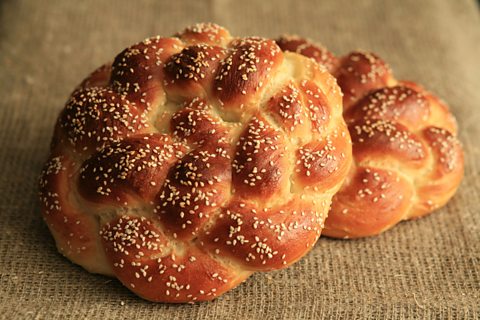
On Friday evening, the focus of Shabbat is a meal that brings the family together. The day of rest is welcomed with the lighting of the two candles. Traditionally, the mother of the family places her hands over her eyes and recites a blessing. Before any food is eaten, more blessings are said for the children, and A prayer sanctifying the Sabbath and festival days, usually recited over wine. is said over the wine to make the evening holy. Drinking wine shows that it is a joyful, celebratory time. The challah is blessed and everyone takes a piece. Typically, the meal lasts for a few hours with everyone enjoying family time, often singing songs and telling religious stories.
On Saturday, after visiting the synagogue, the family shares another meal. The afternoon is spent studying the Law; teaching. The word Torah can be used in a narrow sense to mean the first five books of the Hebrew Bible (The Five Books of Moses) and also in a wider sense to include the whole of the Hebrew Bible and the Talmud., relaxing and playing games as a family.
Question
Why do Jews not mention God by name when saying Modeh Ani?
They will not mention God’s name without being in a state of cleanliness. The Modeh Ani is said straight after waking and before washing, so mentioning God’s name would be disrespectful.
