Ecological and social footprint
A great number of trees have to be cut down in order to manufacture ‘Virgin’ paper does not contain recycled material.. Paper and board can only be recycled seven times before it has to be mixed with new fibres. It is important to To break down and process so a new material is produced - one of the 6 Rs. paper and boards as this will have less impact on the environment through factors such as deforestation, which can then lead to soil erosion. The cutting down of trees and forests to allow a different land use. has a huge effect on the ecosystem and the people and specific breeds of animals that rely on them.
Many companies now replant trees to replace the ones they have removed, although it will take many years for them to grow back. It is important this is managed well, as there has been poor management of this in the past. The biggest problem is the use of Hardwood trees grow slowly and are deciduous - they drop their leaves., which take many years to mature. Hardwood trees take a long time to grow, around 60 years (sometimes up to 100). In comparison, softwood trees like pine take just 25 years.
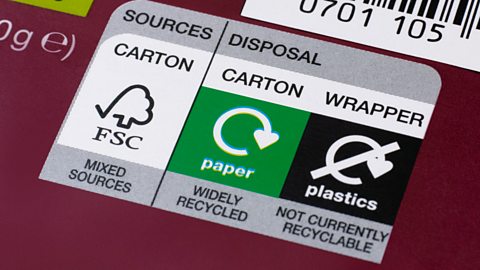
The Forest Stewardship Council (FSC) is an international, non-governmental organisation dedicated to promoting responsible management of the world’s forests. It provides certification for companies so that In business, a consumer is a person who uses a product and may also buy it. know that there has been some responsible management of the forests. Their logo appears on many packaged products.
Whenever environmental impact is to be reduced, ‘the 6 Rs’ can be addressed to ensure an in-depth analysis has been done. The 6 Rs can be considered by the designer, the A person or company that makes something from raw materials or from an assembly of component parts. and the In business, a consumer is a person who uses a product and may also buy it. to reduce that negative impact on the environment.
Considering the 6 Rs when designing food packaging
The 6 Rs
The term ‘the 6 Rs’ can be applied to the design of new products or when a product is finished with, used up or no longer wanted. Here are some questions to prompt 6 Rs thinking:
- To make decisions that decrease the amount of waste produced - one of the 6 Rs. - Think of a package that was bought recently. Could any part of the packaging be reduced?
- To use a product again rather than replacing with a new one - one of the 6 Rs. - Rather than disposing of a package once you have opened it, could it not be reused?
- Recycle - Many papers and boards are made from material that is fully or partly recyclable. Can the paper or board be disposed of correctly so that it can be recycled?
- To change the design of a product to be more environmentally friendly - one of the 6 Rs. - Rethink how actions contribute to damaging the environment. Rather than buying a coffee that is served in a disposable, laminated card cup, why not buy a cup that can be refilled?
- To avoid using a product to save on waste - one of the 6 Rs. - Consumers have a huge amount of power when it comes to the choices they make when buying, including refusing to buy a product if they believe it is bad for the environment. Could a material that is sustainable be used instead?
- To fix a broken product - one of the 6 Rs. - Many products are designed to be No longer used or needed. after a given period. When a product is broken, can it be repaired rather than discarded? If a repair can be carried out on the product, it could remain out of a landfill site for much longer.
