Accuracy and quality control
Consistency and quality are very important to a A person or company that makes something from raw materials or from an assembly of component parts. who wants to offer the customer the best product. No product is made exactly the same, but an acceptable The amount by which a measurement can vary without affecting the ability of the product to be manufactured accurately., or range of difference, can be controlled when a product is being manufactured.
If a photo frame has to be made to hold an A4 certificate, the frame must allow for the A4 paper to fit neatly inside. A4 paper is 297 × 210 mm. In this example, if the frame is inaccurate by +/- 1 mm, then this could still be acceptable. This range of measurement is called the tolerance - in this example the tolerance would be shown as 297 × 210 +/- 1mm.
Some products need to be more accurate than others. A complex pop-up card might be made to a tolerance of +/- 0.1 mm, whereas a simple pop-up card could be made with a tolerance of +/- 1 mm. It is important for designers to know the tolerance so that they can calculate the upper and lower limits.
Example
A A set of checks intended to ensure that a product will meet the specified customer requirements once it has been manufactured. These procedures are followed before work is complete, as opposed to afterwards. check is carried out on a random sample of greetings cards - each should be made with a tolerance of +/- 1 mm.
The length of the card is meant to be 195 mm and the first greeting card measured is 197 mm in length. This is 2 mm too long and so is outside the 1 mm tolerance.
Question
A quality control check is made on a random sample of leaflets. Each leaflet should be 155 mm in length +/- 1mm.
Below shows a table of the lengths recorded of a sample of ten leaflets:
| Leaflets | Length measured |
| Leaflet 1 | 155 mm |
| Leaflet 2 | 153 mm |
| Leaflet 3 | 155 mm |
| Leaflet 4 | 154 mm |
| Leaflet 5 | 156 mm |
| Leaflet 6 | 154 mm |
| Leaflet 7 | 157 mm |
| Leaflet 8 | 155 mm |
| Leaflet 9 | 155 mm |
| Leaflet 10 | 154 mm |
| Leaflets | Leaflet 1 |
|---|---|
| Length measured | 155 mm |
| Leaflets | Leaflet 2 |
|---|---|
| Length measured | 153 mm |
| Leaflets | Leaflet 3 |
|---|---|
| Length measured | 155 mm |
| Leaflets | Leaflet 4 |
|---|---|
| Length measured | 154 mm |
| Leaflets | Leaflet 5 |
|---|---|
| Length measured | 156 mm |
| Leaflets | Leaflet 6 |
|---|---|
| Length measured | 154 mm |
| Leaflets | Leaflet 7 |
|---|---|
| Length measured | 157 mm |
| Leaflets | Leaflet 8 |
|---|---|
| Length measured | 155 mm |
| Leaflets | Leaflet 9 |
|---|---|
| Length measured | 155 mm |
| Leaflets | Leaflet 10 |
|---|---|
| Length measured | 154 mm |
How many leaflets were out of tolerance and should not be used, and which leaflets are they?
Two leaflets were produced out of tolerance. These were leaflet 2 and leaflet 7.
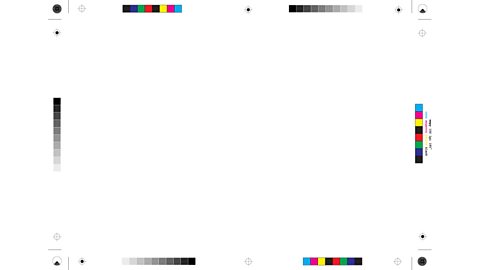
Companies will put quality control procedures in place to ensure the products are produced to a high standard and no errors occur. In printing, a A registration mark is a circular pattern that is printed using all four colours. When all four colours overlap they produce a black circle. If the alignment of a colour is out, the colour will show. is used, which can be looked at to ensure the printing lines up with the paper - this prevents the person from having to look at the whole product to check for errors.
Small lines in each corner of paper or board to indicate where it should be cut after printing. are used to show where to cut on a sheet of paper, and A reference chart on a sheet of paper to check whether the colour is printed to the correct intensity. are used to check that the colours are being printed to the correct consistency and intensity.