Deforming and reforming
Folding
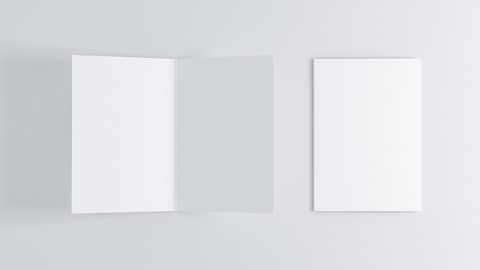
When paper or card is folded, the forces are applied at an angle. If the card is An indented scratch to allow paper or card to fold with ease. before bending, the damage to the paper or card can be minimised. This scored piece of paper or card is now more flexible.
| Advantages of folding | Disadvantages of folding |
| Adds interest to packaging | Extra process costs more |
| Folds can create movement | Ink must be dry before folding |
| Simple process | Weakens card along the score |
| Advantages of folding | Adds interest to packaging |
|---|---|
| Disadvantages of folding | Extra process costs more |
| Advantages of folding | Folds can create movement |
|---|---|
| Disadvantages of folding | Ink must be dry before folding |
| Advantages of folding | Simple process |
|---|---|
| Disadvantages of folding | Weakens card along the score |
Die cutting
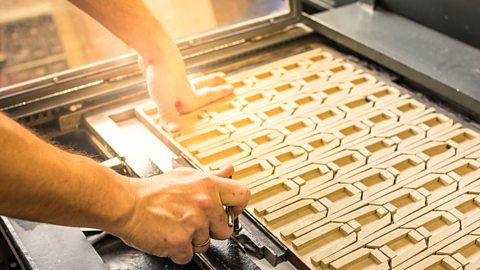
Die cutting uses a wooden block with mounted steel knives. The die is pressed against the card and the steel cuts into the card. Sharp blades will cut through the paper/card whereas rounded blunt blades will crease the paper/card for folding. This process is used for making card A net of a solid shape is a flat shape which can be cut out and folded to make the solid shape..
| Advantages of die cutting | Disadvantages of die cutting |
| Accurate | Expensive to make the die cutter |
| Able to cut and fold paper and card | |
| Suitable for high volume | |
| Fast process once set up |
| Advantages of die cutting | Accurate |
|---|---|
| Disadvantages of die cutting | Expensive to make the die cutter |
| Advantages of die cutting | Able to cut and fold paper and card |
|---|---|
| Disadvantages of die cutting |
| Advantages of die cutting | Suitable for high volume |
|---|---|
| Disadvantages of die cutting |
| Advantages of die cutting | Fast process once set up |
|---|---|
| Disadvantages of die cutting |
Cropping
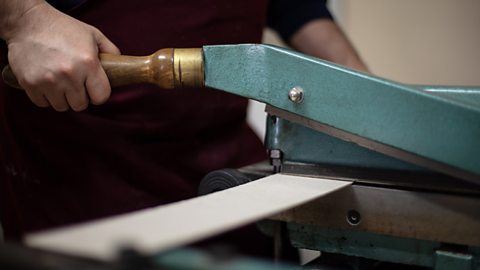
An industrial guillotine is used to crop paper or card using the printed Small lines in each corner of paper or board to indicate where it should be cut after printing. that are placed around the packaging design as a guide. This ensures the correct size is achieved.
Joining methods
There are many ways to join card and paper together:
| Adhesive product | Description | Uses |
| Polyvinyl acetate (PVA) | A general-purpose glue | Wood, paper, card, foam board and foam blocks |
| Spray adhesives | Adhesive in an aerosol can | Large areas of paper and card |
| Hot-melt glues | Adhesive sticks or pellets for use in a glue gun | Joining different materials |
| Glue sticks | Solid stick of PVA-based adhesive in a tube | General purpose |
| Adhesive tape (clear) | Single or double-sided tape on a roll | Paper, card, lightweight materials |
| Masking tape | Paper-based low-tack tape on a roll | Temporary fixing |
| Adhesive product | Polyvinyl acetate (PVA) |
|---|---|
| Description | A general-purpose glue |
| Uses | Wood, paper, card, foam board and foam blocks |
| Adhesive product | Spray adhesives |
|---|---|
| Description | Adhesive in an aerosol can |
| Uses | Large areas of paper and card |
| Adhesive product | Hot-melt glues |
|---|---|
| Description | Adhesive sticks or pellets for use in a glue gun |
| Uses | Joining different materials |
| Adhesive product | Glue sticks |
|---|---|
| Description | Solid stick of PVA-based adhesive in a tube |
| Uses | General purpose |
| Adhesive product | Adhesive tape (clear) |
|---|---|
| Description | Single or double-sided tape on a roll |
| Uses | Paper, card, lightweight materials |
| Adhesive product | Masking tape |
|---|---|
| Description | Paper-based low-tack tape on a roll |
| Uses | Temporary fixing |
Binding methods
A finishing process to join pages together to form a book. is the process where printed material is put together into a book so that the pages are in the correct order and fixed with a front and back cover.
| Binding method | Description | Use |
| Wire stitching | Also called stapling, a fast method of using a metal wire (staples) to punch through the material to hold it in place, the staple is then folded by the stapler | Booklets, brochures, magazines |
| Perfect binding | The gutter fold (margin around the print) is cut off and pages and cover are glued together | Paperbacks |
| Slot binding | Like perfect binding but glue is forced into slots in the gutter fold | Paperback |
| Sewn binding | Pages are gathered and sewn together and the cover is glued on | Good quality paperbacks |
| Spiral binding | Pages are punched with holes and a wire spiral inserted | Reports, manuals, planners |
| Binding method | Wire stitching |
|---|---|
| Description | Also called stapling, a fast method of using a metal wire (staples) to punch through the material to hold it in place, the staple is then folded by the stapler |
| Use | Booklets, brochures, magazines |
| Binding method | Perfect binding |
|---|---|
| Description | The gutter fold (margin around the print) is cut off and pages and cover are glued together |
| Use | Paperbacks |
| Binding method | Slot binding |
|---|---|
| Description | Like perfect binding but glue is forced into slots in the gutter fold |
| Use | Paperback |
| Binding method | Sewn binding |
|---|---|
| Description | Pages are gathered and sewn together and the cover is glued on |
| Use | Good quality paperbacks |
| Binding method | Spiral binding |
|---|---|
| Description | Pages are punched with holes and a wire spiral inserted |
| Use | Reports, manuals, planners |
