Punishments - transportation
Transportation was a frequent form of punishment until 1868. It was viewed as a suitable alternative to hanging. From 1787 onwards, convicts were sent to Australia, where they faced many years of hard labour.
Reasons for transportation
Transportation had been used since the 1660s and was the most common form of punishment given to murderers who did not receive the death penalty. At first, criminals were sent to the British colonies in America or to the Caribbean islands, where they were forced to work on plantations - growing and harvesting crops. From 1787, criminals were sent to Australia. Transportation was increasingly used as a punishment from this time. This was for several reasons:
- For a while, A disused warship that was used as a temporary prison. were used. These were old warships on the River Thames. However, they were becoming very overcrowded and conditions were terrible. Prisoners suffered from dysentery and typhus.
- Hanging was widely becoming viewed as too extreme. Transportation was seen as a good alternative, particularly as courts were more prepared to use it. Prisons in Britain were still viewed as too expensive.
- People who have concern for, and help to improve the happiness and welfare of others. thought that it was a good opportunity to reform criminals. They would be forced to work hard but would also learn new skills, which would help them once they were freed.
The choice of Australia
South-east Australia was chosen as a A settlement used to isolate prisoners by sending them to a remote location, often an island or distant colonial territory. because:
- America had become independent from Britain in 1776, which meant convicts could no longer be sent to America.
- Captain James Cook first sighted parts of Australia in 1770. The British would later claim the area as a colony - enforcing control over the people who already lived there. British prisoners were used as forced labour to help build this new colony.
- To the British, Australia was an unknown area on the other side of the globe. People believed that the idea of being sent to Australia might deter criminals from committing crime.
The convicts
Between 1787 and 1868, around 160,000 convicts were transported to Australia. A variety of people were transported:
- There were more male than female convicts - only about 25,000 women were transported.
- The average age of a convict was 26, although children as young as 11 were transported.
- Over 80 per cent of the prisoners had been convicted of theft, usually of small items. There are records of people being convicted for stealing things like cucumbers and ducks. Most were repeat offenders.
- Only around 3 per cent had been convicted of a violent crime.
- Political prisoners, rebels and protesters were often transported too.
Transportation reached its height during the 1830s. On average, 5,000 people were transported each year during this decade.
The voyage
- The journey of the transported convicts on the first ships in 1787 took eight months, and around 6 per cent of the prisoners died.
- By the 1830s, the journey time had been halved and roughly 1 per cent died on the way.
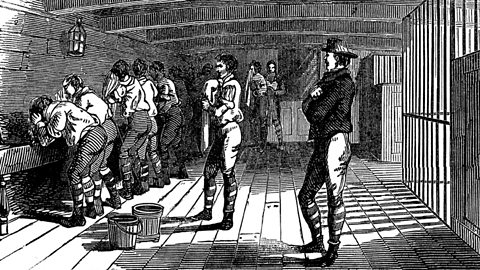
- Convict ships were cramped, wet and dark.
- Heavy irons were fastened to the convicts’ ankles.
The sentence
Labour
Convicts were usually sentenced to 7 years, 14 years or a lifetime of hard labour. When they arrived, some convicts were assigned to Someone who moved of their own free will to start a new life in places such as Australia or the United States. and had to work for them. Others worked for the authorities, helping to build the new colony. Work included:
- digging ditches
- felling trees
- farming
- constructing buildings and roads
Punishments
Harsh punishments were used to ensure convicts in the colony followed the rules. Those who broke rules would be flogged with 25, 50 or even 100 lashes. In Port Arthur, Tasmania, convicts were subject to the silent system. This was a form of psychological punishment - convicts were hooded and placed alone in a tiny room for days on end.
After the sentence
When a convict’s sentence had been served, they usually worked for one of the free settlers. Very few returned to Britain, because they couldn’t afford it.
Good behaviour was rewarded by early release, which provided a motivation for many convicts. In some ways, transportation was seen as a good opportunity for a new start for many criminals. They were much less likely to reoffend than prisoners back in Britain.
The end of transportation
By the 1830s, transportation as a punishment was coming under criticism from several directions:
- People argued that conditions on the ships and in the colonies were inhumane.
- British Someone who pays taxes. disliked the fact that they had to support the families of the convicts who were left behind.
- Some people viewed transportation as too soft a punishment. They saw it as an opportunity for a criminal to have a new and better life after their sentence was complete.
- The Australian authorities objected to the amount and frequency of criminals entering the country.
Fewer people were transported from the 1840s onwards. Transportation was no longer used as a form of punishment after 1868.
