Tundra ecosystem
Description
Tundra environments are known as 'the land without trees'. The very cold and dry The usual type of weather that occurs in an area. mean that these areas contain only a small variety of plants and animals, in comparison to the A natural region located between the Tropics..
The soil is permanently frozen for much of the year and is known as Permanently frozen soil.. Even at the peak of summer, the soil underneath the surface remains frozen. As a result, plants that require deep root systems cannot survive - vegetation is low and fast growing.
The The length of time it takes for plants to fully mature. is only about 50 to 60 days long and the thin soils are relatively When there are no longer any nutrients in the soil.. The bare, rocky ground can only support low growing plants like Small bush-like plants., Small plants that grow in damp or shaded places., heaths, and A type of fungus that grows on rock.. The combination of permafrost, short summers and seasonal Water that submerges land and makes it marshy., accounts for the fact that trees cannot grow in the tundra.
In winter, the tundra is covered in snow and ice and the soil is permanently frozen. Chilling winds compound the cold and little precipitation means that vegetation cannot survive. Animals like the polar bear, Arctic fox and snowshoe hare turn white to An ability to blend in with a background. themselves so they can hunt for food.
In the summer, when the snow and the top layer of permafrost melt, the landscape is covered with An area of land submerged in water., A pool of water on the surface of the landscape., A muddy area of land. and streams. The tundra appears like a wet and soggy place in summer because the precipitation that falls evaporates slowly and the permafrost prevents drainage.
During the summer months, when there are more food sources, the tundra is home to a variety of mammals, such as An animal native to the Tundra (also called a reindeer). (reindeer), birds - (eg A type of bird that migrates into the Tundra during summer months.) and insects - (eg black flies).
Vegetation adaptation
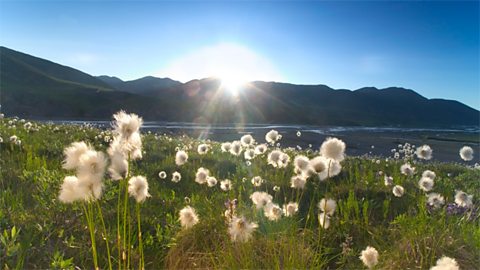
Vegetation needs to be able to tolerate cold and dry conditions. A type of vegetation found in the Tundra. is a plant able to survive the harsh conditions in the tundra. The features which enable it to survive are:
- It is short, which protects it from the wind, and snow cover in winter shields it from the extreme cold.
- It scatters seeds in the wind.
- Its narrow leaves help to reduce moisture loss.
- It has a short growing season.
- Its compact flower heads reduce heat loss.
- Its darker leaves help to absorb energy from Sun.
