Use of the equatorial landscape
Shifting cultivation
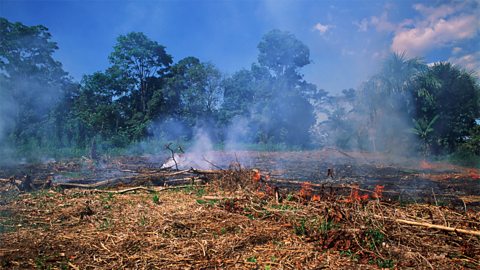
A burning section of the Amazon in Para State, Brazil
Indigenous people have lived in the world’s rainforests for thousands of years without irreparably damaging it. They practise a primitive form of agriculture called 'A type of farming that involves moving every 2-3 years.'.
It is a traditional and sustainable method of farming which involves producing just enough food for survival. Along with other features of their culture and traditional way of life, shifting cultivation is under threat from When many trees are removed from an area. of the rainforests.
- 'An agricultural process where plants are chopped down and then burnt.' agriculture is a subsistence farming system practised by the Kayapo Amerindians in the Amazon rainforest in Brazil.
- A small area of land (approx. 1 hectare) is cleared using stone axes and A long knife.. These clearings are called chagras.
- Larger trees and those which bear fruit are left to aid Re-growth of vegetation after it has been removed by shifting cultivators.
- The vegetation is burned, providing ash which is used as a natural A nutrient added to the soil to increase the soil fertility..
- Crops such as A crop grown in the rainforest to provide carbohydrates to the diet. and yams are planted using a long pointed digging stick.
- The diet is supplemented by hunting, fishing and gathering fruit.
- For a few years the soil remains fertile for the people to grow crops.
- After 2-3 years when the soil's fertility is exhausted, crops no longer grow well. The soil has been leached - nutrients have been washed out of the top soil. Soil has also been eroded and washed into rivers.
- The people have to move on and clear another small area of forest to begin the whole process again.
- The original area is regenerated over a period of 30 - 60 years, as it takes nutrients and seeds from surrounding vegetation.
- Although it destroys some rainforest land, it is An activity which does not consume or destroy resources or the environment. as it is small-scale and vegetation grows back in time.
Misuse of the equatorial landscape
People destroy equatorial rainforests for a number of reasons:
- Land is cleared for farming, housing and roads, eg the Trans-Amazonian Highway in the Amazon rainforest in Brazil.
- Resources are exploited to reduce developing countries’ Money that is owed to someone else. - large The amount of money made after all expenses have been paid. can be made from mining A rock containing the metal iron., A type of metal used in industry., gold, silver and diamonds.
- Employment - jobs are created for local workers in The removal of trees for timber., When herds of cattle are farmed on a large area of land., Rows and rows of shrubs that bare coffee beans., mining and the construction of hydro-electric power schemes.
- Income is generated when timber, minerals, and other resources are sold on the Countries across the globe that are able to buy resources..
- Plants are removed for scientific and The on-going investigations into cures for incurable diseases. which may provide new food sources and An example of a commercial use of plants eg penicillin, aspirin and morphine. for life-threatening diseases.
- To improve The basic structures needed for an area to function, for example roads and communications. , eg profits from selling rainforest resources can be used to build schools and hospitals.
