CAM and lasers
Specialist equipment is sometimes needed in production.
The importance of CAM in modern high-volume production
In modern production, designers and A person or company that makes something from raw materials or from an assembly of component parts. use specialist equipment, known as The manufacture of a part or product from a computer aided design (CAD) using computer-controlled machinery, such as a 3D printer. machines. These machines are controlled through a computer, and are used in modern high-volume production.
Two examples of CAM machines used in the production of polymers are:
- A machine that uses a laser beam to vaporise material and cut out shapes very accurately. - A laser is directed from a precise length on to a material to either cut or etch. The laser is controlled from a computer using a The process of creating a 2D or 3D design using computer software. drawing. Manufacturing can be restricted because of material choice and thickness.
- Computer numerical controlled (CNC) miller - Similar to a pillar drill, a milling machine uses a rotating cutting tool. This tool is able to move along multiple axes to create a range of shapes and designs. This movement is controlled through a computer using a CAD drawing.
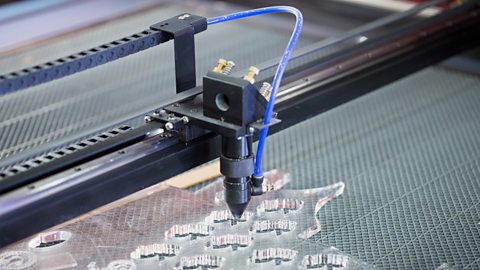
Image caption, Laser cutter
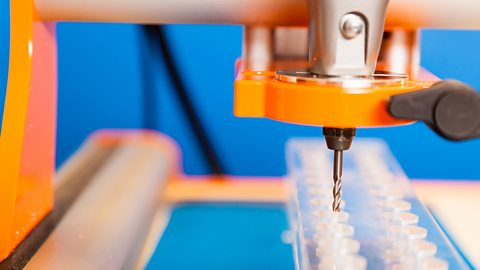
1 of 2
End of image gallery
| Advantages of CAM | Disadvantages of CAM |
| Creates products that are identical to each other | The software itself is expensive so initial costs are high |
| Drawings can easily be repeated for new batches | Machinery can be expensive and time consuming to repair |
| Enables very high accuracy levels in large-scale production | Users need to be trained how to use the software and machinery, which adds to costs |
| Usually speeds up production of low-volume products |
| Advantages of CAM | Creates products that are identical to each other |
|---|---|
| Disadvantages of CAM | The software itself is expensive so initial costs are high |
| Advantages of CAM | Drawings can easily be repeated for new batches |
|---|---|
| Disadvantages of CAM | Machinery can be expensive and time consuming to repair |
| Advantages of CAM | Enables very high accuracy levels in large-scale production |
|---|---|
| Disadvantages of CAM | Users need to be trained how to use the software and machinery, which adds to costs |
| Advantages of CAM | Usually speeds up production of low-volume products |
|---|---|
| Disadvantages of CAM |
