Changes in cinema and television
Cinema
- Cinema had been a popular form of entertainment in America before World War Two.
- Cinema audiences had been in decline as television became more popular after the war.
- Changes in how people could watch film led to an increase in the popularity of cinema later in the 20th century.
Drive-ins
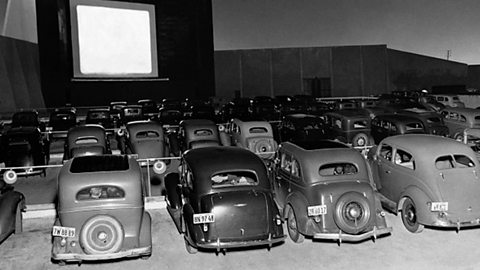
A cinema where people sit in their own vehicles to watch a film. became very popular in the 1950s, especially in more remote communities where travelling to a traditional cinema, in towns and cities, was more difficult. There were almost 4,000 drive-in cinemas by the early 1960s.
Drive-ins became popular with teenagers as they were ideal for dating.
Multiplexes
The revival of cinema was helped by the development of the A cinema complex where different films are shown on different screens. the first of which was opened by Stanley Durwood in Kansas City in 1963. This was a cinema complex that showed different films on different screens. Multiplexes greatly increased the choice of films that people could see, rather than all having to go and see the same film. By the end of the century, multiplexes had helped to revive cinema attendance.
Blockbusters
By the 1970s, film companies had started to release big-budget A film that was expected to make a lot of money by appealing to a large number of people. films. The aim was to draw audiences back into cinemas to experience things they wouldn’t be able to get from watching films at home. These often relied on increasingly sophisticated special effects. The blockbuster trend of films began with Jaws in 1975 and Star Wars in 1977.
A series of films featuring the same characters, sometimes continuing a storyline. also became popular, where multiple sequels became a way of getting audiences to come back to cinemas year after year. Examples include Indiana Jones and Terminator film series.
Movie stars
Many people visited movie theatres to see particular actors on screen. In the 1950s, actors such as James Dean and Marlon Brando became associated with teenage rebel characters. Later, audiences became more interested in the complex adult characters played by actors such as Robert de Niro and Al Pacino. The 1950s also saw the rise of female actors such as Marilyn Monroe and Kim Novak. By the 1980s and 1990s, cinema was dominated by films that featured highly paid A centre in California for film creation and production. stars such as Tom Cruise, Demi Moore, Julia Roberts, Arnold Schwarzenegger, Will Smith and Meryl Streep.
Television
Television was still a relatively new form of entertainment at the end of the 1940s. However, by 2000, it had become the dominant form of entertainment in America.
Growing TV ownership
There were around 7,000 television sets in America in 1946, but by 1960 this had increased to 50 million. By the end of the 1950s, the average American family was watching six hours of television a day. Between 1960 and 1970, the number of houses that had at least one television set grew from 88 per cent to 96 per cent.
There was already a wide variety of channels available to watch. However, the number increased even further in the 1980s with the introduction of Regular payments to access a service. television on satellite and cable networks.
Variety of programmes
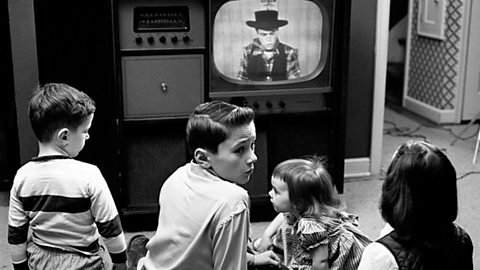
There was a wide range of programmes available to watch on American television from the 1950s to 2000:
- A comedy series set around a particular situation, such as a family home or a school classroom. Also known as a sit-com. (also known as ‘sit-coms’), often built around a particular star, such as Lucille Ball or Phil Silvers
- western dramas set in the Wild West, such as The Lone Ranger, Gunsmoke and Bonanza
- serial dramas known as A drama series with ongoing storylines. Originally, these were often sponsored by companies selling washing products, which gave them the name ‘soap opera’. such as Dallas and Beverly Hills, 90210
- entertainment shows that showcased a wide variety of talent, such as The Ed Sullivan Show
- daytime chat shows such as The Phil Donahue Show, The Oprah Winfrey Show and The Jerry Springer Show
- informative A factual programme. programmes such as You Are There and news programmes fronted by journalists such as Walter Cronkite
- children’s programmes such as Sesame Street and cartoons including Scooby-Doo, Where Are You!
Early American television focused almost exclusively on the lives of white middle-class Americans. This reinforced traditional American values that were associated with suburban family life. This would later change, with sit-coms such as The Fresh Prince of Bel-Air and chat shows such as The Oprah Winfrey Show - both fronted by black stars - gaining huge audiences. However, the diversity of people on screen was still limited.
VHS and DVD
It also became possible in the early 1980s to record programmes on video home system (VHS) tapes to watch at a more convenient time or to rewatch whenever you wanted. VHS tapes were played using a video cassette recorder (VCR). This also allowed people to buy or rent pre-recorded films or TV series to watch at home. By 1997, better-quality recording became possible with the invention of digital video discs (DVDs) and DVD players to play them on.
