A trip to Germany
A journey through Germany – eine Reise durch Deutschland – is sure to be a fun and interesting trip, as the country is so diverse with lots to see. But how many tourist attractions do you know in Germany?
Hilfsvokabeln– Helpful vocabulary
- im Norden – in the north
- im Osten – in the east
- im Süden – in the south
- im Westen – in the west
- der Badeort (m) – seaside resort
- die Heimat (f) – homeland, birthplace
- an der Küste – on the coast
- liegen (v) – to lie, to be situated
- in der Mitte – in the centre
- die Ostsee (f) – the Baltic Sea
- der Weinberg (m) – vineyard
Question
Match up these German and English phrases which describe German tourist attractions.
| German | English |
| 1. Der höchste Berg in Deutschland liegt in Bayern in Süddeutschland. | A. There are lots of vineyards on the (rivers) Rhine and Mosel. |
| 2. Die schöne Insel Sylt liegt an der Ostsee im Norden. | B. In the south lies Bavaria with its many beautiful mountains where you can walk or ski. |
| 3. Berlin hat viele interessante Gebäude, besonders das Checkpoint Charlie Museum. | C. In the east are the famous cities Dresden and Leipzig. |
| 4. Im Süden liegt Bayern mit vielen schönen Bergen, wo man wandern oder Ski fahren kann. | D. All of the seaside resorts are in the north. |
| 5. In der Mitte von Deutschland liegt Kassel, Heimat der Gebrüder Grimm. | E. Neuschwanstein is a very famous German castle and is situated in the south. |
| 6. Im Osten liegen die berühmten Städte Dresden und Leipzig. | F. In the middle of Germany lies Kassel, birthplace of the Brothers Grimm. |
| 7. Am Rhein und an der Mosel gibt es viele Weinberge. | G. Berlin has lots of interesting buildings, especially the Checkpoint Charlie Museum. |
| 8. Alle Badeorte sind im Norden. | H. The beautiful island of Sylt lies on the coast of the Baltic Sea is in the north. |
| 9. Neuschwanstein ist ein sehr berühmtes deutsches Schloss und liegt im Süden. | I. The highest mountain in Germany is in Bavaria in the south of Germany. |
| German | 1. Der höchste Berg in Deutschland liegt in Bayern in Süddeutschland. |
|---|---|
| English | A. There are lots of vineyards on the (rivers) Rhine and Mosel. |
| German | 2. Die schöne Insel Sylt liegt an der Ostsee im Norden. |
|---|---|
| English | B. In the south lies Bavaria with its many beautiful mountains where you can walk or ski. |
| German | 3. Berlin hat viele interessante Gebäude, besonders das Checkpoint Charlie Museum. |
|---|---|
| English | C. In the east are the famous cities Dresden and Leipzig. |
| German | 4. Im Süden liegt Bayern mit vielen schönen Bergen, wo man wandern oder Ski fahren kann. |
|---|---|
| English | D. All of the seaside resorts are in the north. |
| German | 5. In der Mitte von Deutschland liegt Kassel, Heimat der Gebrüder Grimm. |
|---|---|
| English | E. Neuschwanstein is a very famous German castle and is situated in the south. |
| German | 6. Im Osten liegen die berühmten Städte Dresden und Leipzig. |
|---|---|
| English | F. In the middle of Germany lies Kassel, birthplace of the Brothers Grimm. |
| German | 7. Am Rhein und an der Mosel gibt es viele Weinberge. |
|---|---|
| English | G. Berlin has lots of interesting buildings, especially the Checkpoint Charlie Museum. |
| German | 8. Alle Badeorte sind im Norden. |
|---|---|
| English | H. The beautiful island of Sylt lies on the coast of the Baltic Sea is in the north. |
| German | 9. Neuschwanstein ist ein sehr berühmtes deutsches Schloss und liegt im Süden. |
|---|---|
| English | I. The highest mountain in Germany is in Bavaria in the south of Germany. |
- Der höchste Berg in Deutschland liegt in Bayern in Süddeutschland. – I. The highest mountain in Germany is in Bavaria in the south of Germany.
- Die schöne Insel Sylt liegt an der Ostsee im Norden. – H. The beautiful island of Sylt lies on the coast of the Baltic Sea is in the north.
- Berlin hat viele interessante Gebäude, besonders das Checkpoint Charlie Museum. – G. Berlin has lots of interesting buildings, especially the Checkpoint Charlie Museum.
- Im Süden liegt Bayern mit vielen schönen Bergen, wo man wandern oder Ski fahren kann. – B. In the south lies Bavaria with its many beautiful mountains where you can walk or ski.
- In der Mitte von Deutschland liegt Kassel, Heimat der Gebrüder Grimm. – F. In the middle of Germany lies Kassel, birthplace of the Brothers Grimm.
- Im Osten liegen die berühmten Städte Dresden und Leipzig. – C. In the east are the famous cities Dresden and Leipzig.
- Am Rhein und an der Mosel gibt es viele Weinberge. – A. There are lots of vineyards on the (rivers) Rhine and Mosel.
- Alle Badeorte sind im Norden. – D. All of the seaside resorts are in the north.
- Neuschwanstein ist ein sehr berühmtes deutsches Schloss und liegt im Süden. – E. Neuschwanstein is a very famous German castle and is situated in the south.
Did you know?
The island of Sylt is Germany's fourth largest island. It lies 9-16 km off the coast of northern Germany and is connected to the mainland by a causeway known as the Hindenburgdamm.
As a result of its exposed position, the island is regularly battered by severe storms in winter. This means that its distinctive long and narrow shape is constantly changing as the shoreline is eroded by the storm tides.
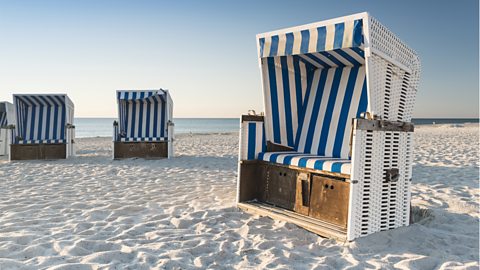
This fact does not deter tourists, however. Sylt boasts a 40 km long sandy beach, which is popular with German holidaymakers. During the summer, people will rent a Strandkorb – a two-seater, reclining wicker chair topped off with a small roof to protect against both the sun and the wind.