Holiday activities
Was kann man hier tun? – What can you do here?
The phrase man kann comes from the verb können and means 'you can'. You have to use a form of können with an The part of the verb found in the dictionary. It is the basic form of a verb without a subject, and the equivalent of English 'to...' verbs, and usually ends in -en, -n, -ern, -eln in German, eg spielen - to play. to say what you can do.
Question
Read these sentences and work out what activities you can do on holiday.
- Man kann das Schloss besuchen.
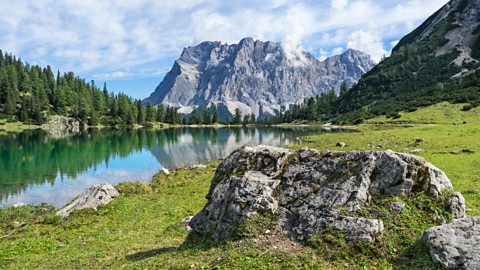
- In den Bergen kann man gut wandern.
- Im Winter kann man Ski fahren.
- Man kann ins Konzert gehen.
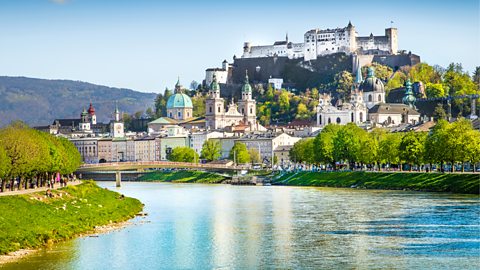
- Man kann die historische Altstadt besuchen.
- Man kann gut Rad fahren.
- An der Küste kann man segeln.
- Man kann die Denkmäle besuchen.
- Man kann ans Fest teilnehemen.
- Im Sommer kann man im See schwimmen.
- You can visit the castle.
- In the mountains you can go for a good walk/hike.
- In winter you can go skiing.
- You can go to a concert.
- You can visit the historic old part of town.
- You can go for a good bike ride.
- On the coast you can go sailing.
- You can visit the monuments.
- You can take part in the festival.
- In summer you can swim in the lake.
Travelling in Austria
Was kann man in Österreich tun? – What can you do in Austria?
Hilfsvokabeln– Helpful vocabulary
- der Bodensee – Lake Constance
- die Salzburger Festspiele – The Salzburg Festival (music, theatre)
- der Stephansdom – St Stephen's Cathedral, Vienna
- die Spanische Hofreitschule – The Spanish Riding School, Vienna
- der Tirol – the Tirol (sometimes spelt Tyrol), an important alpine area of Austria
- Wien – Vienna, capital city of Austria
Question
Read this text and then decide whether the statements are true or false - richtig oder falsch.
Österreich bietet den Touristen viel an. Für die Kulturfans gibt es viele Möglichkeiten, besonders in den Großstädten Wien und Salzburg. Jedes Jahr im August finden die berühmten Salzburger Festspiele statt und in Wien kann man den Stephansdom und die anderen historischen Häuser besichtigen. Die Spanische Hofreitschule ist immer beliebt. Es gibt auch viele Sportmöglichkeiten. Am Bodensee kann man segeln oder baden und im Tirol kann man wandern oder im Winter Ski fahren.
- Es gibt in Österreich viel für Touristen.
- Es gibt nicht so viel für Menschen, die Kultur mögen.
- Die Salzburger Festspiele finden nur im August statt.
- Der Stephansdom ist das einzige historische Gebäude in Wien.
- Die Spanische Hofreitschule ist nicht sehr populär.
- Es ist möglich am Bodensee zu segeln.
- Im Tirol gibt es viele schöne Wanderungen.
- Richtig: Österreich bietet den Touristen viel an. - Austria has a lot to offer to tourists.
- Falsch: Für die Kulturfans gibt es viele Möglichkeiten. - There are a lot of opportunities for culture lovers.
- Richtig: Die berühmten Salzburger Festspiele finden jedes Jahr im August statt. - The Salzburg Festival takes place in August every year.
- Falsch: Man kann den Stephansdom und die anderen historischen Häuser besichtigen. - You can visit St Stephen's Cathedral and other historic buildings in Vienna.
- Falsch: Die Spanishe Hofreitschule ist immer beliebt. - The Spanish Riding School is always very popular.
- Richtig: Am Bodensee kann man segeln. - You can sail on Lake Constance.
- Richtig: Im Tirol kann man wandern. - You can go walking in the Tirol.
Did you know?
The highest mountain in Germany is called the Zugspitze.
It lies on the border between Austria and Germany, so depending on which country you are in when you start to ascend it, you will travel on the Bayerische Zugspitzbahn (Bavarian Zugspitze Railway) or the Tiroler Zugspitzbahn (Tirolean Zugspitze Railway).
It is 2,962 metres above sea level. The highest mountain in Austria is the Großglockner.