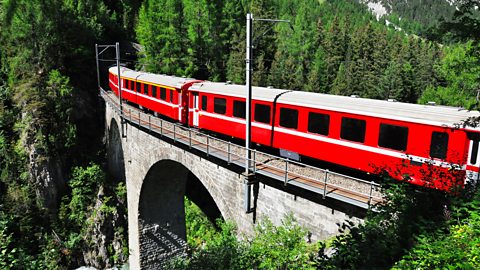
Getting around
Wie fährst du in den Urlaub? – How do you travel on holiday?
In German the usual way of saying that you travel 'by' a means of transport, is to use mit (with), followed by the dative case.
The Denotes the indirect object of a sentence (eg the girl gave a present TO THE man). The dative case is also used after the following prepositions: aus, außer, bei, gegenüber, mit, nach, seit, von, zu. definite article for masculine and neuter singular nouns is dem, but for feminine nouns it is der.
So you would say mit dem Bus (m) – by bus, or mit dem Flugzeug (nt) – by plane, but you must say mit der Bahn because die Bahn is feminine.
Question
Read the sentences below and match them with the pictures.
- Ich fahre mit dem Rad.
- Ich fahre mit dem Motorrad.
- Ich fahre mit dem Wohnmobil.
- Ich fahre mit dem Auto.
- Ich fahre mit der Bahn.
- Ich fahre mit dem Fluzeug.
- Ich fahre mit dem Reisebus.
- Ich fahre mit dem Boot.
- Ich fahre mit dem Rad. – G. I travel by bike
- Ich fahre mit dem Motorrad. – E. I travel by motor bike
- Ich fahre mit dem Wohnmobil. – H. I travel by camper van
- Ich fahre mit dem Auto. – B. I travel by car
- Ich fahre mit der Bahn. – A. I travel by train
- Ich fahre mit dem Fluzeug. – C. I travel by plane
- Ich fahre mit dem Reisebus. – D. I travel by coach
- Ich fahre mit dem Boot. – F. I travel by boat
Did you know?
The German word for 'railway' is die Bahn.
German Railways are known as Deutsche Bahn and abbreviated to DB.
Austrian Federal Railways are the Österreichische Bundesbahnen or ÖBB for short.
Swiss Federal Railways are called Schweizerische Bundesbahnen and referred to as SBB in German. The full and official abbreviation uses initials from German, French and Italian – SBB CFF FFS. CFF stands for the French Chemins de fer fédéraux suisses and FFS stands for the Italian Ferrovie federali svizzere.
German speakers also use the phrase mit dem Zug to say that they travel 'by train'. So you may hear both mit der Bahn and mit dem Zug when people refer to travelling 'by train'.
Ich verstehe nur Bahnhof – literally this means 'I only understand railway station', which does not make sense in English. It actually has nothing to do with travel, trains or railway stations. It means, 'I don't understand any of it'. In English we would say, 'It's all Greek to me'.