Britain since c.1900 - reasons for change
Since 1900, Britain has undergone major technological, social and political changes. This has led to an emergence of new crimes and new types of law enforcement. This case study summarises the main changes that took place in this period and examines the reasons for them.
Changes in crime
Crime rates 1900-1955
- Crime increased during the economic depression of the late 1920s and 1930s, when unemployment was high. There were also lots of A situation when workers refuse to work - as an act of protest - often because of disagreements about pay or working conditions. and protests.
- There was an increase in crime during World War Two. Criminals took advantage of the air raids during the A period when London was repeatedly bombed at night time during World War Two by Nazi Germany, from September 1940 to May 1941. to steal from people’s homes and shops. There was also illegal trade on the Illegal trading in goods.
- After 1955, crime increased significantly, at a much faster rate than the increase in the population.
- However, there are problems with comparing statistics across time, changes to the law, changes to data gathering and people reporting certain crimes more can all lead to difficulties when analysing and interpreting crime statistics.
Car crime
- Car ownership increased and laws to restrict speeding and drinking under the influence of alcohol were introduced. As a result, crime related to cars has become one of the biggest categories of crime.
- Types of car crime include drink driving, not wearing a seat belt, breaking the speed limit, joy-riding and car theft.
Hate crimes
- After the passing of the 1948 Nationality Act, many people from places such as the Caribbean, India, Kenya and Pakistan moved to Britain. This wave of immigration led to a great deal of social tension. New arrivals often faced discrimination in finding housing and jobs, as well as physical violence.
- From the 1960s onwards, British governments passed legislation in the form of Race Relations Acts, which explicitly outlawed racial discrimination. In 1998 and 2003, a new category of offence called A crime motivated by hatred for the victim based on their race, religion, sexual orientation, disability or transgender identity. was introduced.
- The overall percentage of criminal offences that are recorded as hate crimes is small but government statistics show that the figure has been rising.
Cybercrime
- Crime has risen since widespread access to the internet increased in the 1990s, leading to a new type of crime called cybercrime.
- Types of cybercrime include illegally downloading films and music, sending An attempt to gain personal information about someone by way of deception, eg sending an email pretending to be from their bank asking them for their bank details. emails, the use of computer viruses to detect people’s passwords, and hacking into the systems of government departments or big businesses.
Question
Why has there been an increase in crime since 1900?
- War - Crime increased during the night-time air raids of World War Two, when thieves took advantage of air raids to steal from homes and shops.
- Social tension and changes in society - Immigration to Britain from Commonwealth countries increased after World War Two. This led to a rise in race-related crimes and often racially motivated physical violence.
- Government action and new laws - During the 1960s, governments passed laws to make it a crime to discriminate against people in jobs, accommodation or other places because of their race. This means that discrimination of this kind is now a crime as well.
- Technology and wealth - New crimes emerged as technology changed and ordinary people gained more access to it. For example, the emergence of the internet in the 1990s led to the downloading of films and music from illegal websites, as well as criminals sending phishing emails to trick people into sharing their credit or debit card details. Car crime has also increased as more people can afford to have cars.
Changes in law enforcement
- The work of the police has increased and become very specialised. There are now special police squads for areas such as A false representation of facts made for personal gain. riots, preventing The use of violence and threats to intimidate or coerce, especially for political purposes. and The use of scientific knowledge in solving crimes.
- More police officers patrol the streets in cars today as opposed to on foot, as they have bigger areas to cover. Some people argue that this is more effective and efficient, but some people miss the reassurance and visibility of the local ‘bobby’.
- In the present day, the police service is now more diverse, starting salaries for new recruits have increased and candidates need to have a good standard of education. Recruits now receive more guidance and typically undertake around 18–22 weeks of classroom-based training as well as other additional training before serving as officers.
- Since the early 1900s, the police have been able to use fingerprints and blood groups to assist them in eliminating suspects and identifying criminals. Since 1984, A method used to identify an individual from their unique sequence of DNA base pairs has been used as well.
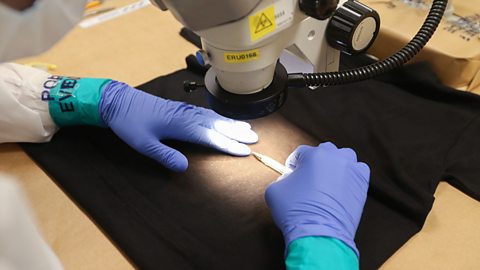
Advances in police forensic technology have enabled Metropolitan police examiners to spot blood almost immediately, 2022
- Police telephone boxes (since 1929), patrol car radios (since the 1960s) and portable radios (since 1969) have all allowed improvements in police communication.
- The police now have national databases of fingerprints, missing persons and criminal records. These can be accessed by all local forces. Information can be shared and obtained quickly and easily.
- The police regularly use Closed-circuit television (CCTV) is the use of cameras to observe different locations, usually for security reasons. to track the movement of suspects on the road and in public places. Some officers also wear small cameras on their uniforms to record incidents that happen while they are on duty. The police can make requests to monitor the emails, text messages and internet use of their suspects.
Question
Why have there been changes to the police force since 1900?
- Population growth and urbanisation - The police have patrolled more in vehicles than on foot since the growth of towns and cities means they have much larger areas to cover.
- Technology - New technology means that the police now use different methods of crime detection and suspect elimination, such as radios, forensic science, DNA fingerprinting, CCTV and email surveillance.
- Change to crime - Changes in types of crime mean that there are now whole sections of the police dedicated to particular crimes, such as terrorism and fraud.
