Enforcing law and order
This case study compares how people in Britain attempted to enforce law and order during the early modern and industrial periods.
Early modern Britain
The hue and cry
Citizens were expected to respond to the A method of raising the alarm to the rest of the village after a crime had been committed, usually by shouting loudly. if a crime was committed, to try to catch the culprit. The hue and cry was led by the constable and the local A group of men aged 15 or over who were called up to chase a criminal. could be called upon to help in the search.
Constables
There were usually two constables for each town or village. They were normally wealthier and well-respected men. They served for a year at a time. Their duties included dealing with small crimes, such as begging, and inflicting some punishments, such as whipping Homeless, unemployed person who wandered the streets. also known as vagabonds.
Justices of the Peace
Someone responsible for maintaining law and order in a county. Often abbreviated to JP. ran the Courts held every three months when a group of JPs would hear serious cases. They were also responsible for things like granting licences for alehouses and regulating sports.
Watchmen
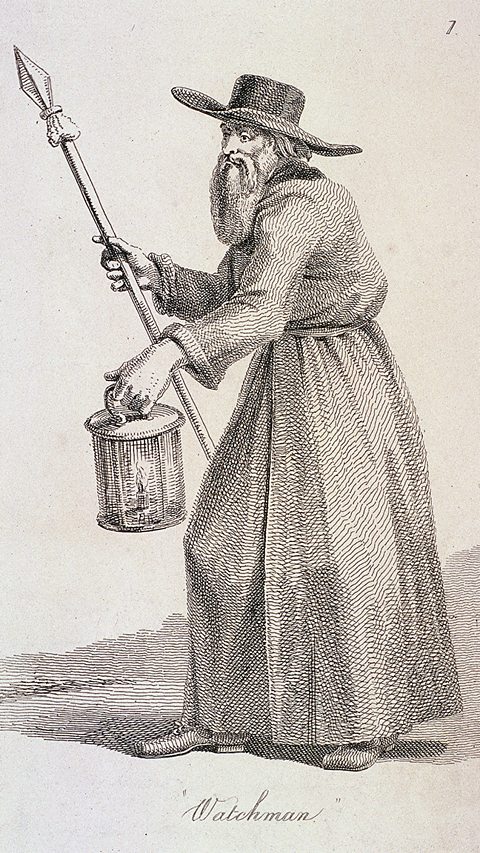
Larger towns employed watchmen to patrol the streets at night and during the day. Their job was to arrest drunkards, vagrants and other criminals. They weren’t very effective as they were poorly paid, often elderly and generally not very committed.
Thief-takers
Thief-takers were private individuals who made a living from tracking down wanted criminals in order to collect the reward on offer. However, they were often quite corrupt, extorting money from the criminals they were supposed to catch. They were even known to set up innocent people by luring them into crime purely to collect the reward later on.
The courts
There were several types of court at this time:
- Royal judges ran assize courts in each town twice a year to deal with serious crime.
- JPs ran quarter sessions and, in the 17th century, petty sessions. They tried less serious crimes.
- Church courts tried to maintain high standards of Christian behaviour.
Industrial Britain
The Bow Street Runners
In the 1750s a group of part-time constables patrolled the streets of London each evening until midnight. They were organised by John and Henry Fielding, brothers and magistrates at Bow Street Court. They were paid using magistrates’ funds and became known as the Bow Street Runners. By 1800 there were 68 of them.
The Metropolitan Police Force
In 1822, Sir Robert Peel became the A government minister responsible for law enforcement and national security. He helped soften Translated as ‘leave well alone’ or ‘let the people choose’. A government policy of interfering as little as possible in social and economic policy. attitudes towards government involvement in crime prevention, and set up the Metropolitan Police Force in 1829. Initially, there were 3,200 men operating in a seven-mile radius in central London. They were paid for by government taxation. They wore top hats and blue uniforms to distinguish them from the army’s red coats. They were unarmed apart from a A short, thick stick carried by a police officer.
After 1829, the government introduced a series of laws to try to encourage the establishment of local police forces across the country.
The police force contributed to the steady fall in crime after 1850. The police arrested petty thieves, sorted out traffic problems and removed drunkards from the streets. The Metropolitan Police Force set up a detective branch in 1842 and set up the Criminal Investigation Department (CID) in 1878. By 1900, the CID was using technologies such as photography and fingerprinting.
The courts
There were several types of court at this time:
- The system of holding local assizes in the main towns of each county remained the same. Assize court judges continued to deal with serious offenders, such as murderers, burglars and highwaymen. Verdicts were returned by locally picked A group of people (usually 12 in number) who listen to the facts of a case in a court and give their verdict. consisting of 12 people.
- JPs continued to hold quarter sessions four times a year and petty sessions more regularly. They were still unpaid, local representatives. They became known as magistrates.
- A medieval manor was the land owned by a local lord and Church courts were no longer used.
Summary of changes and continuities
Question
How far do you agree that methods of law enforcement were the same in the early modern and industrial periods?
Look at the 12 statements listed below.
- Place statements that apply only to the early modern period in the left circle.
- Place statements that apply only to the industrial period in the right circle.
- Place statements that could apply to either period in the middle.
| 1. There were unpaid law enforcers | 2. Ordinary citizens were expected to respond to the hue and cry | 3. There was a national police force paid for by government taxation |
| 4. Assize courts heard the most serious crimes | 5. The Bow Street Runners were part-time, private constables | 6. There was a Criminal Investigation Department (CID) |
| 7. Justices of the Peace held quarter and petty sessions | 8. Manorial courts were in operation | 9. Private individuals made a living from tracking down criminals as thief takers or part-time constables |
| 10. Law enforcement was effective and contributed to a fall in crime | 11. Constables were all unpaid and inflicted punishments such as whipping vagrants | 12. Church courts tried to maintain high standards of Christian behaviour |
| 1. There were unpaid law enforcers |
| 2. Ordinary citizens were expected to respond to the hue and cry |
| 3. There was a national police force paid for by government taxation |
| 4. Assize courts heard the most serious crimes |
| 5. The Bow Street Runners were part-time, private constables |
| 6. There was a Criminal Investigation Department (CID) |
| 7. Justices of the Peace held quarter and petty sessions |
| 8. Manorial courts were in operation |
| 9. Private individuals made a living from tracking down criminals as thief takers or part-time constables |
| 10. Law enforcement was effective and contributed to a fall in crime |
| 11. Constables were all unpaid and inflicted punishments such as whipping vagrants |
| 12. Church courts tried to maintain high standards of Christian behaviour |
Extent of continuity
On the whole, there was more change because the introduction of a national police force paid for by taxation was revolutionary. However, this change did not take place until the 1850s. Additionally, in relation to the court system, there was a huge amount of continuity with the assizes, and Justices of the Peace operated much as they had done in the early modern period.
