Punishments
This case study compares punishments and attitudes towards punishment during the industrial period and in Britain since c.1900.
Industrial Britain
Capital punishment
The number of executions dropped and more humane forms of hanging were developed. This was because of concerns about public behaviour at executions, courts being unwilling to use the death penalty and the spread of People who have concern for, and help to improve the happiness and welfare of others. ideas.
However, people were still hanged for certain crimes, mainly murder. There were still 297 executions between 1830 and 1835.
The new drop was used after 1783 and the long drop after 1874. Both methods led to a quicker and less painful death.
Transportation
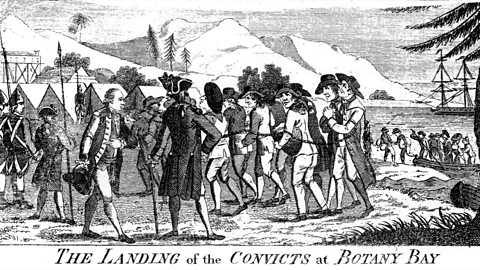
To send a convicted criminal to a prison camp overseas, such as in America or Australia. initially to America and then to Australia, was the main alternative to hanging until 1868. Some people thought that transportation would reduce crime because it completely got rid of criminals from Britain. Humanitarians thought that it was a good opportunity to reform criminals. Between 1787 and 1868, around 160,000 convicts were transported to Australia.
Convicts were usually sentenced to 7 years, 14 years or a lifetime of hard labour. When they arrived in Australia, convicts were made to work for the Someone who moved of their own free will to start a new life in places such as Australia or the United States. or for the authorities, to help build the new colony. Work included digging ditches and felling trees.
The colony was based on harsh punishment. Convicts who broke rules would be flogged with 25, 50 or even 100 lashes. However, good behaviour was rewarded by early release, which provided good motivation for many convicts.
Prisons
In 1750, prisons were run by gaolers as a business. Prisoners had to pay for everything themselves, including their bedding, food and fuel. Prisoners did no real useful work and conditions were cramped and unsanitary. Some gaolers used brutal punishments, such as whipping.
Prison reformers such as John Howard and Elizabeth Fry worked to improve conditions. In 1823, the Gaol Act introduced changes, such as:
- The system of paying fees to gaolers ended.
- Someone responsible for maintaining law and order in a county. Often abbreviated to JP. had to visit gaols and write reports on conditions.
- Women had to be supervised only by female wardens.
- Prisoners should sleep in their own cell with their own bed or hammock.
From the 1850s onwards, some prisons used the silent system. Prisoners were allowed to work together but in silence. Also, it was generally accepted that serious criminals serving over four years in prison would have their sentence reduced after a four-year period of good behaviour.
However, by the 1860s, governments encouraged the use of pointless tasks, such as turning the crank or walking the treadmill, for prisoners. This was because they thought that if criminals hated the work, they would be less likely to reoffend.
Furthermore, the moral panic following the A series of muggings where victims were choked on the streets of London in the 1860s. of the 1860s led to politicians bringing in new legislation on prison conditions. Conditions were made substantially harsher:
- Flogging (abolished in 1861) was brought back in 1863.
- The 1865 Prisons Act increased hard, pointless labour.
- The act also introduced punishments such as a diet of bread and water and more solitary confinement.
Britain since c.1900
Capital and corporal punishment
In 1900, A punishment involving physical harm, such as flogging. such as beating and Striking a person with a birch rod (a bundle of twigs bound together). were still used. However, physical punishments were abolished for all offenders in 1948. After 1962, corporal punishments were no longer used against prisoners either.
Public opinion on the death penalty was divided:
- Those in favour argued that the death penalty was a strong deterrent that would prevent people from committing murder, and that prisons were too comfortable for people who had committed horrendous crimes.
- Those against the death penalty made the case that it was not an effective deterrent as most murders are carried out spontaneously. They also said that it was irrational to punish murder with murder - even if it was approved by the state.
Prisons
More people argued that people turned to crime as a result of their circumstances, such as poverty or being born into a criminal family. This led to changes to make prisons places of reform and The process of educating and restoring an offender back towards being a non-offending member of society. rather than just harsh punishment:
- The use of the treadmill and the crank in prisons ended in 1902.
- Prisoners were allowed to mix and talk to each other.
- Teachers were employed in prisons to increase education.
- Work was made more meaningful and prisoners were paid for their work.
- Diet, heating and conditions in cells were improved.
Young offenders
From c.1900 onwards, psychologists and prison reformers argued that the best way to improve society was to treat its youngest members well.
In 1902, detention centres - known as Borstals - specifically for young people were introduced. The emphasis was on support, education and training young offenders so they would have the skills needed for employment once they were released.
However, between 1979 and 1990, under Prime Minister Margaret Thatcher, the ‘short, sharp shock’ regime was used in detention centres. This involved using a deliberately tough approach, including military-style drills and marching, for a few weeks or months.
Alternatives to prison
There have been many problems with prisons, such as rising costs and overcrowding. A number of alternatives have been used alongside the prison system:
- In 1907, the Probation Service was introduced. In some cases, instead of offenders being sent to prison, some trustworthy people were made responsible for supervising and advising them. These people became known as probation officers. At first, they had no formal training. However, now probation officers are full-time professionals trained in the job. They supervise minor offenders within the community.
- Since 1967, some prisoners have been released on The release of a prisoner before their sentence has been fully served, on the promise of good behaviour.
- Since 1972, community service orders have been used to sentence offenders to activities such as unpaid work.
- Since the 1990s, electronic tags have been used to monitor the locations of some offenders.
Comparing punishments in c.1750-c.1900 and since c.1900
Question
How far do you agree that methods of punishment were the same in industrial Britain and Britain since c.1900?
- Identify two continuities in punishment, meaning two punishments that were the same or similar, in both periods.
- Identify two changes in punishment. These could be new punishments that only emerged after 1900 or punishments that only ended after 1900.
Two examples of continuity are:
- Harsh punishment - In the industrial period, some punishments were deliberately brutal to act as a deterrent. For example, the system of transporting convicts was based on harsh punishment. Convicts who broke rules would be flogged with 25, 50 or even 100 lashes. Harsh punishment can also be found in aspects of punishment since c.1900. For example, Prime Minister Margaret Thatcher introduced the ‘short, sharp shock’ regime in youth detention centres. This involved using a deliberately tough approach, including military-style drills and marching.
- Prison reform - Prison reform began in the industrial period. For example, women had to be supervised only by female wardens and criminals serving over four years could have their sentences reduced for good behaviour. This transformation of prisons into places of reform continued after c.1900. For example, the use of the treadmill and the crank ended and teachers were employed in prisons to increase education.
Two examples of change are:
- The death penalty - Although the use of the death penalty decreased after 1830, people were still hanged for murder. There were still 297 executions between 1830 and 1835. However, since c.1900, more people have supported the idea that execution is not an effective deterrent and it is not rational to punish murder with murder. The death penalty was abolished for all murders in 1969.
- Alternatives to prison - Since 1900, a variety of alternatives to prison have been developed that did not exist in the industrial period. For example, since 1972, community service orders have been used to sentence offenders to activities such as unpaid work. In the 1990s, electronic tags were introduced to monitor the locations of some offenders.
Question
Why have there been changes to punishment since c.1900?
- Beliefs, values and attitudes - Attitudes about the purpose of punishment have become more liberal since 1900. Most people have argued that prisons should focus on reform and rehabilitation rather than harsh punishment. This has led to the end of corporal and capital punishment. There is also now more education and training in prisons, and different institutions for young offenders have been set up. The focus on reform has also led to the development of alternative punishments, such as community service.
- Technology - Alternatives to prison such as tagging (introduced in the 1990s) have been made possible through the development of new technology.
- Individuals - The work of Alexander Paterson led to the relaxation of harsh prison regimes in the 20th century.
- Prison overcrowding and cost - The increasing cost of prisons, added to the rising prison population, has meant that alternatives to prison have been used. Examples include parole, probation and community service.
Extent of continuity
On the whole, there has been more change than continuity. Although there was some prison reform in the industrial period, this was undermined by the later reintroduction of harsh regimes and flogging. Additionally, although the ‘short, sharp shock’ approach of the 1980s was considered harsh for the time, it is not really comparable to the physical and psychological punishment of transportation. It was also out of step with the more general turn towards rehabilitation instead of punishment since 1900.
